Thursday, March 12, 2015

Earth Day Essay Contest

What better way to usher in springtime than with an Earth Day essay contest? That’s exactly what we’re doing here at Cascadia. If you’re in grades 6-8 within Chelan or Douglas County, we think you should tell us about being a young environmental steward.

Sadly, we haven’t been able to put on the Earth Day essay contest since 2012. But this year we have sweet prizes from generous local businesses, an early spring for inspiration and a thought provoking prompt: How can a middle school student be an effective steward of the environment?

For added inspiration, here’s the winning essay from 2012. It was written by 7th grader Mariela Morales from Orchard Middle School. She was answering the question “What have you learned from Nature and why is what you've learned important?”

What’s damaging nature? Humans. If we say Earth is our mother, then nature is our sister. Nature teaches us how to survive in her. And we dig holes and drill out stuff from her insides, then burn them causing poisons to fill the atmosphere. That pollutes the air preventing the sun from shining on the fields properly. In nature I learned that you can be free whenever you like. But more importantly I have learned that our lifestyle causes a lot of damage.

We have killed off vast amounts of Earth’s ecology, turning what used to be delicate ecosystems into deserts. So, a question we all should be asking is: how can we help? Walk or bike instead of driving a car- a good walk is a conversation between the walker and the environment. A simple walk through nature can provide hope and inspiration. Plant trees- they absorb carbon dioxide. It sounds cliché but we must act now before it’s too late.
Nature is not only enchanting but healing too. Her pleasures may be plain, but are kindly and she’s native to us. She’s our friend and will provide. Nature is consistent, she’ll grow even when cut. Those who’ve harmed nature have had their day with her beauty; now let our children have theirs with her beauty that remains. If we consider how much we really belong to nature, we shouldn’t care so much for building cities. Nature helps us when we are sick and instead, we are making nature sick. Knowing that nature is part of our only home means knowing we have to take care of her.
Inspired? Often insight is gained through our more simple and innocent citizens- our children. In that vein, American Rivers created a most apt video illustrating a child’s love of rivers.
Entry Form

If you or someone you know would like to submit an essay, here are the particulars:
• The essays should be 500 words or less, size 12 Times New Roman font, and double-spaced.
• Typed essays are preferred, but hand written essays will be accepted provided they are legible.
• Word count should be included in the bottom, right corner of the essay.
• Essays must be turned in with completed entry form (pictured to the right)
• Sorry, electronic submissions will not be accepted.          
• Essays are due Monday April 13, 2015. Essays postmarked April 14th or later will be disqualified.
• Winners will be announced on our website on April 22.
• Send or deliver essays to 14 N Mission St., Wenatchee, WA 98801

If you or someone you know still lacks the inspiration to put ink to paper and drop some stewardship knowledge, consider our awards for the top three entries: A day rafting the Wenatchee River with Orion River Expeditions and a hand painted field journal created by local artist Heather A. Wallis.


Today’s snowpack as a percent of average is a derisory 53% (USDA/NRCS National Water and Climate Center, http://www.wcc.nrcs.usda.gov).

Monday, February 23, 2015

What Cascadia Does, Part II

Two weeks ago we took a look at how Cascadia Conservation District is an asset to the community through its Landowner Owner Assistance Program. Continuing with that theme, we’re going to take a quick look at the Family Forest Fish Passage Program, which is run by the Washington State Department of Natural Resources- one of Cascadia’s partnering organizations. Cascadia’s roll in this program is to help Chelan County landowners determine eligibility, file the application and finally oversee implementation once funding is made available by the DNR.
Culverts like these block fish passage,
especially for juvenile fish.

A good portion of Washington’s forested land, 3.2 million acres (http://www.dnr.wa.gov), is privately owned by small forest landowners. These 3.2 million acres are an important habitat component in a state with federally protected anadromous fish populations. This is where the Family Forest Fish Passage Program comes in.

Working with qualified landowners, the purpose of the Family Forest Fish Passage Program is to replace culverts and other barriers with new structures that allow fish easy passage and reduce habitat degradation while improving access for land owners. Common culprits, culverts can degrade and dissect fish habitat in several ways. A culvert can deter fish passage if there is a drop, similar to a water fall, from the output of the culvert. Similarly, a culvert can become a barrier if it is undersized, creating high water velocity and pressure so great it prevents fish, especially juveniles, from advancing upstream.

Unlike our Landowner Assistance Program, there are several conditions for eligibility. You must be a private small forest landowner and harvest less than 2 million board feet of timber annually from your property. The barrier must be associated with a road and on forested land capable of supporting a merchantable stand of timber. Finally, the barrier must be in a fish-bearing stream, typically wider than 2 feet with a gradient less than 20%.

If you’d like to learn more about this program, visit the Washington State Department of Natural Resources website, call our office at (509) 436-1601 or come to our office at 15 N Mission St. Wenatchee, WA.

Today’s snowpack in North Central Washington is down to 55% of the 34 year average (http://www.wcc.nrcs.usda.gov).


Thursday, February 12, 2015

What Cascadia Does

“Oh yeah, the conservation district… That must be, uh, some interesting work?” Verbatim, my loquacious uncle’s reply when I told him what I’ve been up to and where I’m working. Like most, my uncle had no idea what a conservation district is. Surprisingly, I’ve had a hard time getting people to understand just what a conservation district does. There is no easy elevator speech for conservation districts. So I’d like to use the next few blog posts to highlight some of our programs.

 Officially, from the National Association of Conservation Districts’ website,"Conservation districts are local units of government established under state law to carry out natural resource management programs at the local level. Districts work with millions of cooperating landowners and operators to help them manage and protect land and water resources on all private lands and many public lands in the United States" (http://www.nacdnet.org/). In short, it is an organization that seeks to help people take care of the land and environment around us. Cascadia’s landowner assistance program is one of several ways we do this.

A hedgerow, planted to attract pollinators and other beneficial insects.
 The landowner assistance program is for landowners in Chelan County, excluding those within Wenatchee and Chelan city limits, who are looking for technical and/or financial assistance in installing best management practices (land use practices which mitigate environmental degradation). This could mean replacing outdated irrigation, restoring buffers or riparian zones or even soil testing. Because of this area’s predominant agriculture industry, its proximity to anadromous fish habitat and its proclivity for wildfires, much of our landowner assistance is for landowners with streamside, farmland, orchard or forested property. That said, if your land does not fall in one of these categories, it does not disqualify you for such assistance.

An excellent example of landowners who not only took advantage of our landowner assistance program, but also became role models for environmental stewardship, was highlighted in a blogpost of ours from November 21, 2011.

If you’d like more information on landowner assistance you can call us at (509) 436-1601, email us at www.cascadiacd.org or just come by our office at 14 N Mission St. Landowner assistance is only a fraction of what we do here at Cascadia, so please come back next week for a look at the Family Forest Fish Passage Program.


With all of the warm weather and rain we’ve had in the last week, today’s snow pack in our area is a measly 63% of the 34 year average.  

Thursday, February 5, 2015

Wild and Scrumptious

Continuing with our native plant theme, and considering several of our native plants for sale are edible, it seems appropriate to devote a blog to edible native plants. Before delving into this topic, I’d like to be clear that eating plants found in the wild holds some risk and should not be done in a casual manner. If you’re a novice identifying plants or are unsure, it’s best to get a second or third opinion from someone in the know before munching down.

There are many benefits to eating wild plants. First of all it’s free, and as someone on a tight AmeriCorps budget, I’m all for free. Also, generally speaking, plants lose nutritional value the longer they sit after being harvested. So you get more bang for your buck when you eat freshly harvested plants. Depending on values and disposition, it’s also common that people gain a deeper appreciation for the things they eat when they’re able to see their food in its natural environment and gather it themselves.

Being a novice in the subject myself, it seems the best place to start is with plants that are relatively easy to identify and have no poisonous lookalikes. It’s also recommended that one learn the few poisonous plants around in order to better avoid them. The following are just a few examples of the many tasty edible plants you can find in our area:

-Evergreen Huckleberry produces edible berries, which are commonly used to make delicious jelly and jam.
Evergreen Huckleberry (Vaccinium ovatum)
-Hooker’s, or tapertip onion has edible flowers and bulbs and can be consumed raw or cooked. While raw this onion is said to be overpowering, it’s purportedly sweet and delectable when cooked.

Hooker's Onion (Allium acuminatum)
-Camas also has edible bulbs which can be eaten raw or cooked. When cooked, they’re known to be sweeter than a sweet potato. The bulbs can also be ground into flour. It should be noted that Camas has a deadly lookalike aptly named "death camas". To avoid any fatal mix-ups, double, triple or even quadruple check to be sure you've got the right camas. It's easiest to distinguish one from the other while they're flowering.


Camas (Camassia)
-Wild licorice was commonly used by Native Americans. They have sweet, fleshy roots which get sweeter when cooked.
Wild Locrice (Glycyrrhiza lepidota)
If you’re like me, your mouth is watering just thinking about those scrumptious local flora and you can’t wait to get out and try your hand at finding, preparing and devouring such delicacies. And, if you’re a novice like me, you probably need to pump your breaks, hard. Not only is it the wrong time of year to be gathering many of these edible plants, but there are also some guidelines everyone should abide by when harvesting wild plants. This list of dos and don’ts is from the Washington State University Snohomish County Extension website (http://ext100.wsu.edu/snohomish/wp-content/uploads/sites/11/73aEdibleWildPlants.pdf):

  • Know what you are picking
  • Collect only what you can positively identify as edible
  • Harvest only plants that look healthy in uncontaminated areas
  • Clean and prepare wild foods like you do cultivated crops
  • Eat only small quantities when first trying an edible plant
  • Get property owners' permission before gathering wild foods
  • Never over-harvest. Take only what you can use and use what you take.

If this blog has convinced you to take up gathering wild edible plants, there are plenty of resources online to help you get started. There are also some great field guides worth their weight in edible flora such as A Field Guide to Edible Fruits and Berries of the Pacific Northwest by Richard J. Hebda and Edible and Medicinal Plants of the West by Gregory L. Tilford.

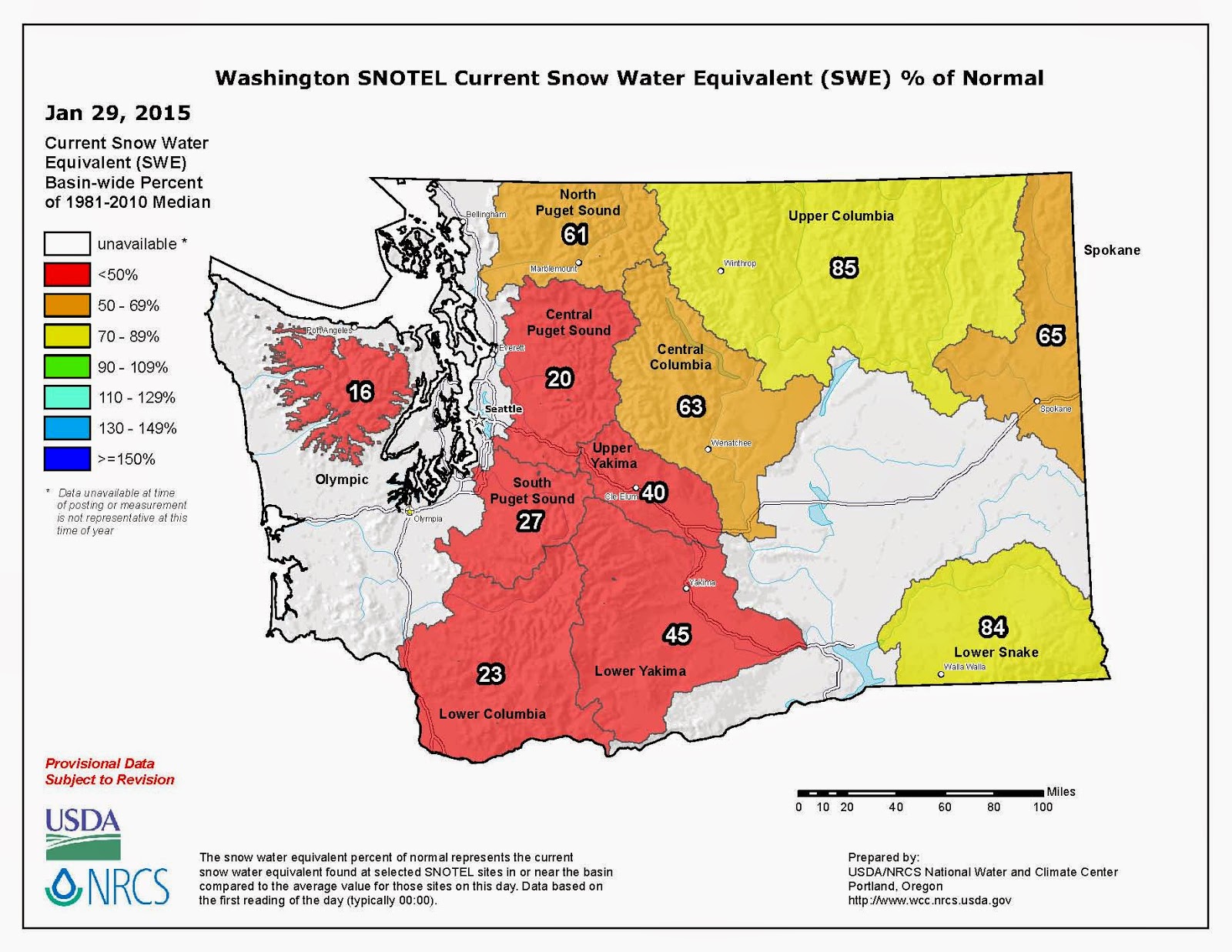
While it’s been raining down here in Wenatchee, the higher elevations have been getting snow which has increased our snowpack in this area to 64% of the 34 year average (ftp://ftp.wcc.nrcs.usda.gov/data/water/wcs/gis/maps/wa_swepctnormal_update.pdf).


Thursday, January 29, 2015

Icons of North Central Washington


With this post we’ll conclude our look at the native plants offered by the Cascadia Conservation District. If you’d like to see the full plant list, make an order or get more information please visit our website.

These final two plants are symbols of our region. The grand ponderosa pine (Pinus ponderosa) and the vine maple often come to mind when thinking of healthy ecosystems in our area.

My favorite tree of all time, icon of the west and reigning top seller in our plant sale is the ponderosa pine tree. Ponderosa pine, colloquially ‘pondo’, is characterized by its orange, scaly, plate-like bark and long green needles which are typically borne in bundles of three. Growing to around 100 feet in mostly open stands, ponderosas often have the appearance of dominating their surroundings. They are also known for smelling like vanilla.

Very well adapted for our climate east of the Cascades, ponderosa pine isn’t just fire tolerant, it depends on fire. With its thick bark a large ponderosa can handle the low intensity fires that were ubiquitous to this area prior to modern forest management. These fires eliminated the pondo’s resource competitors, allowing it proper exposure and sufficient resources. Since management plans have included enthusiastic fire suppression, shade tolerant trees and shrubs have moved into ponderosa stands throughout the west, lending such stands the characteristics necessary for the increasingly large scale fires we’ve been seeing as of late.

As for conservation uses, ponderosa is commonly used in shelterbelts, living snow fences and in riparian restoration. Ponderosa stands make great habitat for squirrels, birds and bats and provide shelter for big game. Because ponderosa needs exposure, it is a seral species which, when mature, can provide the necessary shade for shade tolerant species to return after a significant disturbance. This makes it an excellent native plant choice for post fire restoration.

Vine maple (Acer circinatum) is another iconic native plant in our region. It is a deciduous tree with red and white flowers in the spring, and brilliant red to subdued yellow broadleaves in the fall. Typically vine maple will grow between 10 and 30 feet tall, with shaded specimens reaching the upper end of that range readily and exposed specimens on the shorter side.

Vine maple grows best along streams and moist sites. It prefers shady sites, but can tolerate some exposure.  In more exposed sites it often takes a single-stemmed tree form, while in shade it usually grows as a shrub in clumps and thickets.

With its white and red flowers in the spring and showy colors in the fall, vine maple is a common choice for those looking to use native species to beautify their landscaping. It is also used as a streamside stabilizer, as a pioneering species at disturbed sites and is an important food source for birds and large and small mammals alike.

Again, if you’re interested in ordering any of our plants, need more information or would like to sign up for our native planting workshop, please see our website.

Today’s Central Columbia River area snowpack is currently at 63% of its 29 year average (USDA/NRCS National Water and Climate Center, http://www.wcc.nrcs.usda.gov).

Thursday, January 22, 2015

Broadleaf Bonanza

For this week’s blog we’ll examine three broadleaf shrubs: the Oregon state flower, a red-barked soil retainer and stinky white flowers. Remember, these are but three of Cascadia’s 14 native plants for sale. To make an order, see a complete plant sale list or sign up for our free native planting workshop, please see our website.

Oregon Grape
Oregon Grape
Oregon grape (Mahonia aquifolium), Oregon’s state flower, is my favorite shrub in this year’s sale. With a waxy texture and sharp leaflets, its evergreen leaves strongly resemble those of ivy. Oregon grape produces dense clusters of small yellow flowers followed by tart, dark blue berries. It typically grows three to six feet tall and five feet wide.

Oregon grape will grow in a variety of settings, from the coastal range to the eastern slopes of the Cascades. It can grow in soils from moist to dry and at exposed to shady sites, but is especially well adapted for drier, exposed sites which makes it a great restoration species. It propagates via suckers and has an extensive root system, making it an excellent soil stabilizer. Birds and rodents are attracted to the berries and the new growth and leaves can be a food source for elk and deer.

Red osier dogwood (Cornus sericea) can grow to about 20 feet tall and 20 feet wide. It has thin, waxy, red bark with green deciduous leaves that turn red in the fall. In the spring it grows the beautiful white clusters of flowers characteristic of dogwood.

Red Osier Dogwood
Red osier dogwood often grows in dense thickets along riverbanks and is found much more sparsely at higher elevations and drier sites. While it prefers plenty of exposure, it will tolerate shade. It’s proclivity for moist soils and open sites and its extensive root system make it a great streamside restoration plant. It can stabilize soil as well as provide shade and habitat for fish. Its foliage is also an attractive food source for elk and deer.

Blue Elderberry
Blue elderberry (Sambucus nigra ssp. cerulea) is one of the largest shrubs we offer growing up to about 30 feet tall and 20 feet wide. It dawns white flowers in the spring which are aesthetically pleasing but emit a slightly rancid smell. These smelly flowers give way to purple or black, waxy berries. It has long, narrow green leaflets up to six inches long. 


While it can grow in a variety of habitats, blue elderberry does best on exposed sites. It’s an early seral species, but can persist beyond initial succession. In conservation, blue elderberry has a number of uses including riparian restoration, erosion control and habitat improvement.


Thanks to a brief, though much needed storm last weekend, the Central Columbia River area snowpack is currently at 71% of the 29 year average.  More specifically, as of January 1, the Wenatchee River drainage was at 68% of its 29 year median.  (USDA/NRCS National Water and Climate Center, http://www.wcc.nrcs.usda.gov). 

Tuesday, January 13, 2015

Three More Native Beauties...

I’d like to use this post to continue the tour of native plants offered by the Cascadia Conservation District. If you’d like to place an order, get more information or register for our native planting workshop, please see our website. Two of these next three native plants, woods’ rose and golden currant, are old plant sale standbys, while evergreen huckleberry is back for the first time since 2012.

Woods' Rose
Woods' rose (Rosa Woodsii), or Interior rose, grows in a variety of soils and climates, even in places with very little topsoil and at high elevations. It does well in varying degrees of sun exposure. It should also be mentioned that wild roses are far less susceptible to disease and recover much quicker than domesticated roses.

The woods’ rose is an excellent choice for someone looking to beautify their property in a harsh climate. As well as being a hardy survivor, it also dawns magnificent pink flowers and bright red hips. Because of its ability to grow with little soil on steep slopes and in generally tough conditions, the woods’ rose is a top choice for restoration.

Evergreen Huckleberry
Evergreen huckleberry (Vaccinium ovatum) is another hardy plant we offer. Though it is commonly found in coniferous forests and prefers shade, it can grow in full sunlight and sandy soil and it is drought tolerant.

In the spring the evergreen huckleberry, in ideal conditions, will grow light pink, urn-shaped flowers which will transform into delicious red, then purple berries. Its leaves are egg shaped, dark green and have a reddish hue when immature. The evergreen huckleberry grows up to 13 feet tall.

Golden Currant
Golden currant (Ribes aureum) is a deciduous shrub that grows up to 6 feet tall and 6 feet in diameter. Its waxy green leaves turn a showy yellow in the fall and the shrub produces yellow flowers which morph into berries of various colors.


Golden currant can grow in a variety of sites, from moist bottomlands to exposed hillsides making it a good soil stabilizer for nearly any location. Also, while its berries may taste tart to us, but they’re a favorite for birds and small mammals.


Today’s snowpack as a percent of average is 64% (USDA/NRCS National Water and Climate Center, http://www.wcc.nrcs.usda.gov).
 
USDA/NRCS National Water and Climate Center

Monday, January 5, 2015

Native Plant Sale

With this post I’d like to highlight several of my favorite plants available in our annual native plant sale here at the Cascadia Conservation District. Quaking aspen (Populus tremuloides), mock orange (Philadelphus lewisii) and serviceberry (Amelanchier alnifolia) are but three of our 14 plants for sale this year. For a complete list, to make an order or to get more information please visit our website.

Quaking aspen is a deciduous tree characterized by its trembling, nearly heart shaped leaves. The effects of the slightest breeze on an Aspen grove in the fall is spectacular. Quaking aspen have smooth white bark, grow up to 80 feet and have green, chartreuse or yellow leaves depending on the time of year.  

Quaking aspen are unique in that an entire colony shares a single root structure, and each tree is genetically identical to the next within the colony. Quaking aspen can grow in most soil types, but does best in soil that is moist most of the year. It’s useful along rivers and streams as a bank stabilizer, provides nesting places for many local bird species and its foliage is browsed upon by mammals.


 Mock Orange
Mock orange is a lovely little shrub in the late spring when it dawns fragrant, showy white flowers. It grows 6 to 12 feet tall, but typically doesn’t exceed 6 feet east of the Cascades. It grows in abundance in a variety of habitats including riparian zones along gullies and streams, forested bottomlands as well as upland sites. Mock orange acts as soil stabilizer and food for many insects like moths and butterflies.

Serviceberry
If you’re looking for a shrub with attractive fall foliage, look no further than serviceberry. Serviceberry is ubiquitous throughout the western United States and Canada. It even has a town in Saskatchewan named after it (Saskatoon). Like mock orange, it dawns showy white flowers in the spring. It grows in a variety of climates and habitats either as a small deciduous tree or upright shrub. Spreading via underground runners, serviceberry often grows in large thickets. It can grow in full sun or shade and on steep or level terrain. In terms of conservation, serviceberry is used for soil stabilization and enhancing wildlife habitat (food for birds, rodents and bears).

Today’s snowpack as a percent of average is 73%.  


Tuesday, December 23, 2014

Warm Winter Blues

Speaking with friends and fellow AmeriCorps members, many people seem to enjoy the mild, rainy weather we’ve been having in Wenatchee. It also seems that many of my friends and co-workers are out-of-towners, flatlanders who are new to an area that relies so heavily on a healthy dose of snow in the winter. Frosty car windows, poor driving conditions, freezing pipes, tailbone-bruising slips and falls and fender benders are all valid reasons to dislike typical winter weather. However, for me the benefits of a cold, snowy winter are worth any number of those pirouetting, painful falls on the buttocks. As unpleasant as it may be at times, cold weather and snow play an important role in many of the things we enjoy and may even take for granted.

Winter sports obviously require a certain amount of snow and cold. If you’re into snowshoeing, skiing, snowboarding or any other winter sports you know how difficult winters like this can be. With only one trail available at Mission Ridge and 8 of 49 trials open at Steven’s Pass, who had a “soft opening” on Dec. 20, I’m surely not the only skier/snowboarder jonesing for a big dump (of snow).  Worse yet, if you’re a professional in such an industry you’re probably thinking of ways to mitigate the loss of revenues associated with a lack of snow. How many lessons are ski instructors giving with such warm, rainy weather and only one trail to attract skiers to Mission Ridge? How many tickets do you think Mission Ridge must sell to pay for diesel for groomers and electricity for chairlifts for a day? How many skis, poles, boots, bindings, jackets, helmets, snowboards, goggles, gloves, wax and other merchandise do local sporting goods stores sell during warm, drizzly winters? Hotels around Wenatchee and Leavenworth also take a hit when ski resorts fail to attract out-of-town skiers and boarders. Winter sports may not be for everyone, but when it comes to the local economy around here, no one can deny their value.

For those of you who hate winter weather and are less prone to winter recreation, there are other reasons to appreciate a snowy winter. After a warm winter without much snow, we are left with a measly snowpack. A poor snowpack means poor spring and summer runoff, the consequences of which include but are not limited to increased wildfire risk and severity, spending on firefighting and poor air quality. As of December 22, this year’s snowpack is 69% of average for this time of year in our area (ftp://ftp.wcc.nrcs.usda.gov/data/water/wcs/gis/maps/wa_swepctnormal_update.pdf). That means we only have 69% of what the average snowpack has been on December 22 for the last 33 years. 69% of the average snowpack does not bode well for us in 2015, especially for those still reeling from the historic fire season we saw this year.


If you’re more into summer recreation, don’t be fooled. Warm winters effect summer recreation too.
Whitewater aficionados are surely watching the snowpack hoping winter brings enough snow to ensure water levels in their favorite rivers and streams are adequate through the summer season. Likewise, fisherman know that steady snow melt through the spring and summer is vital to small stream fisheries. The effects of a warm winter on our local economy are apparent in summer as well as winter. If the Wenatchee River is only runnable from April to July, local rafting outfitters lose out on an entire month of business. For businesses that are seasonal, or get an inordinate amount of business during a certain season, the snowpack can make or break an entire year.

If this post has you convinced that winter weather really isn’t so bad, do us all a favor and do a little snow dance at this very instant. Shake your rump and hope for a dump (of snow)! With this blog, for the remainder of winter, I’ll report on the current snowpack and we’ll know the collective effect of our snow dances. If you were reading in hopes of more information on Cascadia Conservation District’s native plant sale, don’t worry, next week we’ll look at quaking aspen, mock orange and serviceberry. If you can’t wait until next week, check out our website.


Friday, December 5, 2014

2015 Native Plant Sale

The Cascadia Conservation District’s 2015 native plant sale is underway! Using native plants when landscaping can be quite aesthetically pleasing, attract wildlife and is low maintenance. Because the plants we sell have evolved in this area, our climate suites them well and the local fauna depends on them. We have 14 species for sale this year and I’d like to use this post to highlight a few. If you’d like to browse our entire selection, make an order or find more information please visit our website.

Western White Pine (Pinus monticola)
This is the first time we've offered the western white pine (Pinus monticola). It is a conifer that is characterized by its open, narrow crown with up-raised, or vertical, branches near the top and horizontal branches lower down. The lower half of the bole is free of limbs. Western white pines do well in a wide range of soils and elevations. It is categorized as moderate in shade tolerance and can be an early seral species after fire or logging.    
The western white pine has an interesting history. Historically it was a prevalent species in Montana, Idaho, Washington and Oregon and was important in the timber industry. In Idaho today, a combination of factors have reduced it to about 7 percent of its historical norm. The most damaging of those factors is blister rust, which is a disease that can kill swathes of trees at a time. Over time, some western white pines showed more resistance to the disease than others and were selected as breeding stock. All western white pines sold in our plant sale are grown from blister rust resistant seed.

Red stem ceanothus (Populous sanguineus)
Red stem ceanothus (Populous sanguineus) is another plant we didn't offer last year. This shrub grows 3-6 feet tall and about 6 feet wide. The new growth has attractive red bark and produces masses of sweetly scented white flowers. Red stem ceanothus is well suited for our area as it does well with abundant sun exposure and dry, open sites.  If you’re looking to increase winter food sources for animals, the red stem ceanothus is worth considering. Its seeds, which persist through winter, provide an excellent food source for over-wintering birds and deer like the leaves and stems.      
      
Kinnikinnick (Arctostaphylos uva-ursi) is a groundcover native to both coasts of North America. It is an evergreen with white to pinkish, urn shaped flowers and leaves that turn reddish purple in the winter. Its bright red berries persist through fall and winter and will attract birds. Kinnikinnick does quite well in our region, and is often found growing in dense clusters. It will grow just about anywhere, but is especially well suited to dry areas with plenty of sun exposure. Low maintenance, attractive to birds and drought tolerant, this is sure to be one of this year’s most popular species.
Kinnikinnick (Arctostaphylos uva-ursi)
Our complete list of available plants can be found on our website. Stay tuned- next time we'll take a look at quaking aspen, mock orange and serviceberry.