Showing posts with label Winter. Show all posts

Thursday, November 30, 2017

Are LEDs a Bright Idea?


As we settle into winter, the temperatures begin to drop, the sun starts setting earlier and our days get shorter and shorter. With the decrease in sunlight, we begin to rely more and more on our lightbulbs to make up for the shortened days and lack of natural light. LED bulbs are a great way to keep energy costs down and increase the efficiency of your home or business, making it more environmentally friendly. The Dept. of Energy (DOE) has conducted research into solid state lighting or SSL, which includes Light Emitting Diodes (LEDs) and Organic Light Emitting Diodes or (OLEDs). According to the research done by the Dept. of Energy, “switching to SSL could reduce national lighting energy by 75% in 2035”.

LEDs or Light Emitting Diodes are the most efficient light bulb available on the market today. Using a semiconductor to convert electricity into light, they are able to use 95% of the energy they use to create light, wasting only 5%. This process decreases energy draw by around 80% when compared to incandescent light bulbs. Very little heat is lost from LEDs in comparison to incandescent bulbs, which can lose 90% of their energy as heat. The LED bulbs can actually benefit from cooler temperatures as well; the DOE found that they were 5% more efficient at -5 degrees Celsius than 25 degrees Celsius.  Not only are LEDs better in terms of efficiency, but they last much longer than other light bulbs.Depending on the LED bulb, a good quality one will last 25,000 hours or more.

If you have concerns regarding the variety, size, color or light quality, not to worry!! LEDs are one of the most compact lighting options available on the market, they are extremely durable, come in a number of colors and are very adaptable lighting options. The market is expanding as more and more people are making the switch to LEDs.

Another benefit of these beautiful bulbs is that, unlike compact florescent lights, LEDs do not contain any   mercury and do not need to be disposed of as hazardous waste. Though florescent lights are more efficient than the standard incandescent bulbs, they contain small amounts of mercury, less than 5 milligrams generally. However, even this tiny amount of mercury can poison thousands of gallons of water or pose a threat to people that come into contact with it. Despite the energy savings that the   florescent bulbs presented, their disposal and the mercury they contained created another issue. The bulbs must be recycled at a facility that is qualified to handle florescent bulbs, which are limited. These bulbs should not be thrown out in the trash due to the mercury they contain. Mercury does not decompose or dissipate, it remains in the environment.

Generally, the upfront cost of LED bulbs is a little higher the florescent or incandescent; however, you will be saving money as they last far longer and are much more energy efficient. Consider LED bulbs a good investment for the winter, and one that will continue to benefit you for years to come. 


-Justine

Works Cited


Wednesday, December 23, 2015

Let it snow!

Continuing in the tradition of the last few years of AmeriCorps blogs- I’m here to talk about snow! While the aforementioned element of fire has strongly affected my life, of equal importance is the element of water, specifically in the form of snow. As long as I can remember I’ve always had a deep connection to snow. Winters growing up in the Entiat Valley were always full of sledding, snowshoeing, and cross country skiing. After my family’s home burnt down in 1994, we lived in a yurt while re-building on our property. That was the winter of 1996-97, I was three years old and it snowed upwards of 5 feet. We couldn’t be happier as our yurt turned into an igloo and the landscape found relief in the added moisture. When I was six years old, my mom woke me up to show me that it had snowed overnight and I began to cry because I found it so beautiful. And at 14, I fell in love with the sport of alpine skiing at Mission Ridge and have been incredibly hooked on the sport since. I can’t quite put my finger on it; what snow brings that is so magical. Perhaps it is the peacefulness- the muffling of loud sounds, the necessity of moving slower through our day’s errands. Perhaps it is the nostalgia of feeling like a child again- the ageless feeling we get when playing in the snow. For me it is the coldness of the air that brings a sense of clarity and the endorphins I get from skiing, hiking, and playing in the snow. And obviously, it is the holidays that bring us all together- the break from work and school, the importance of reflection and gratitude we feel during this time of year.

The percentage of area in drought status is still higher right
now that it was one year ago.
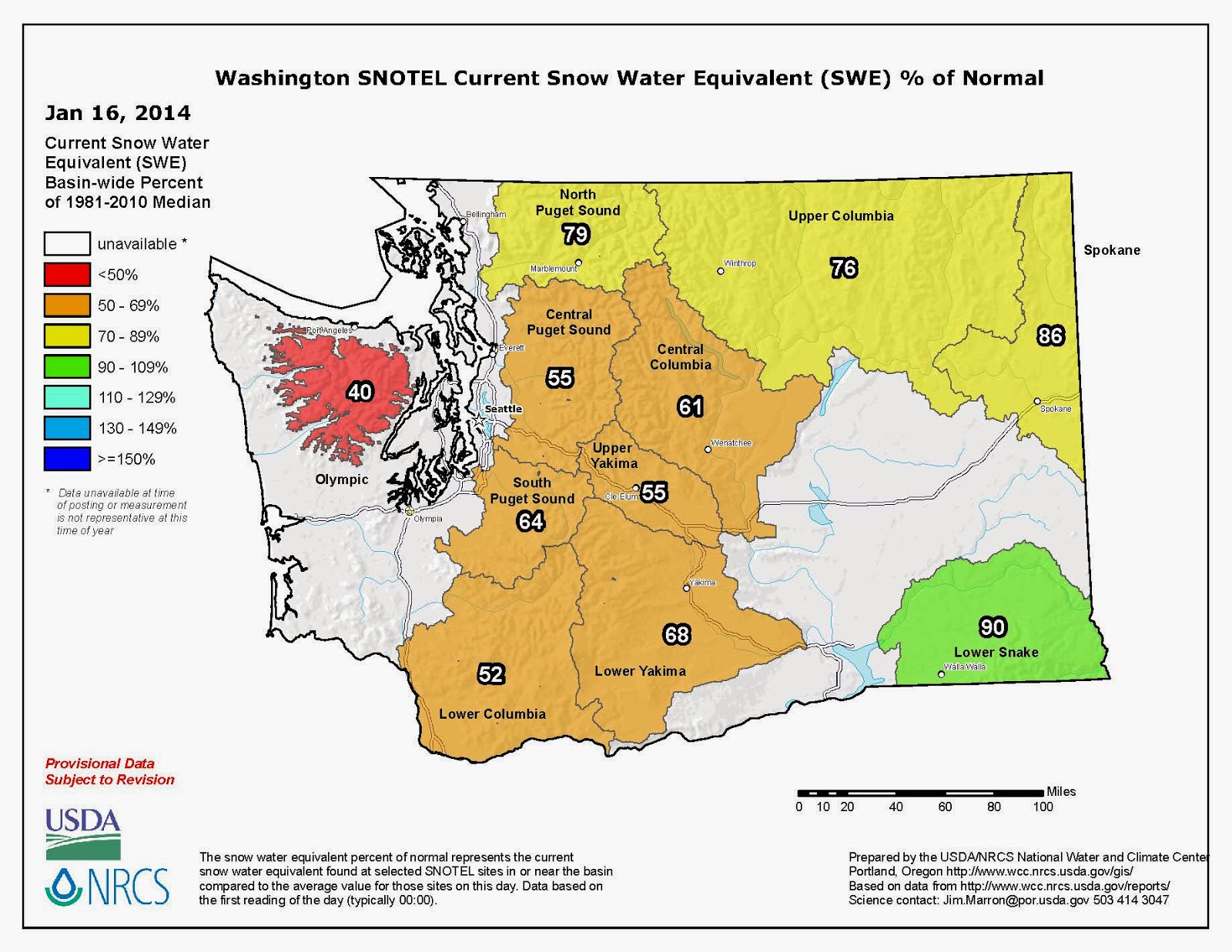
Besides the joyous wonders of a white holiday season- the effects of a snowy (or dry) winter last long into the summer. Last winter we saw an incredible lack of snow and the ecological and economic effects of that hit hard over the summer. The effects of the biggest wildfire ever in our state’s history led to lack of tourism and loss of important infrastructure. The lack of water led to a weakness in our defense against those fires, it was hard hitting on orchardists and farmers, habitat for important species suffered, the list goes on and on.  Although we are still currently in a drought- the Department of Ecology recently stated that the Drought Emergency Declaration will be ending at the end of the year due to snow levels being at or above 100% of normal for this time of year. For the emergency declaration to be made water supply levels must be below 75%. The month of December has been so good to our area with snow falling up high and a mixture of rain and snow falling down low. I am eager to see where this El Nino season takes us and am hoping that the trend of snow continues. And if it does, I am eager to see the effects of that come summertime.  
Our region is currently at 126% of normal
snow water equivalent.

As a person whose happiness strongly depends on the ability to ski in the winter months I will say that I’ve learned to do it while you can. Mission Ridge is at ~70 inches of snowfall for the month, close to their ~100 inch December snowfall record. Who knows what the rest of the season will bring us- hopefully more of the same, but possibly not. Until it changes, that’s where you’ll find me (and a few others from the Cascadia office)!

As always thanks for stopping by, on behalf of the Cascadia staff, we wish you a very joyous holiday season! Let me know in the comments what your favorite part of a snowy holiday season is!


-McKenzie

Sources:
ftp://ftp.wcc.nrcs.usda.gov/data/water/wcs/gis/maps/wa_swepctnormal_update.pdf
http://www.ecy.wa.gov/drought/index.html
http://droughtmonitor.unl.edu/Home/StateDroughtMonitor.aspx?WA


Wednesday, February 5, 2014

Early February Observations

This week and, really, the whole month, bring busy times here at Cascadia. Many of us in the office are busy sorting and packing in anticipation of moving from our current location in the lower level of the Okanogan-Wenatchee National Forest Headquarters and into new office space in downtown Wenatchee. Thankfully, I don’t have much to do with that until it comes time to load up boxes and equipment and then unload it again in our new location. (Americorps members get all the good jobs.) However, the Native Planting 101 workshop is also coming up this Saturday, February 8, and I’m rushing a little to finish up all the final touches for the workshop. With limited time something has to give, and so the blog this week is going to be a little shorter and less in-depth than normal. There won’t be much of a theme. Probably just some pretty pictures and a few observations.
How about that snow? I realize it’s not a lot, but it sure helps brighten up the landscape, bathing the hills in bright white with splotches of gray, brown, and green poking through. Every little bit of moisture helps. Hopefully it keeps up and we can avoid a dry spring, summer, and fall. Besides, winter is far too dreary without snow on the ground. It keeps everything looking clean and covers up the dirt and grime that coats much of the land during the winter and early spring months.
Hopefully this cold isn’t upsetting too many people. I was little surprised when it came on. That’s my own fault though because I don’t often look at the forecast. My theory being that the weather is going to show up regardless if I know about it or not. It’s amazing how much going from a high of 35 degrees down to a high of 18 degrees changes how it feels to be outside. Anything above 30 and I can usually leave my hands out walking outside. Now it’s almost too cold for them buried deep in my pockets. Any exposed skin can quickly go numb and ache with the cold. These cold days make me happy that I decided to grow a beard for the winter, and at times I wish it went further and covered the tops of my checks and nose. For those of you without a beard, I recommend a scarf if the cold bothers you.
So that’s all I’ve got for this week, time to go back to preparations for Saturday’s workshop. Make sure to sign up for the workshop if you live in or around Wenatchee and Chelan County and have an interest in native plants. It’ll run from 12-4:30 PM at the Chelan County PUD Auditorium. Topics covered will include restoration, pollinators, yardscaping, and noxious weeds. It promises to provide lots of useful and interesting information.


Friday, January 17, 2014

Beware a Mild Winter

I grab my jacket and slide it on as I step outside. I walk a few paces and realize I’m already too warm. It’s halfway through January and the temperatures outside are hovering around 50o. It’s only snowed in town a couple times all winter. The sun is shining, and it seems like spring is just around the corner. Too bad it’s not. Winter will be back. However, it’s still nice for a break, right? It may feel nice, but this weather is not without consequences. What might those consequences be? Well, let’s take a look.

First, the lack of snow is a big problem. Yes, I love having clear roads as much as anyone else. The headache of waking up with six inches of new snow and realizing I’m going to spend an hour or two of my day shoveling/plowing just to clear my driveway and paths is not pleasant. Neither is dealing with slick roads and all the other people out on the slick roads. (Funny how everyone always thinks it’s the other person that’s the bad driver.) I love being able to travel the mountain passes with peace of mind.
So why is the lack of snow such a problem? We receive very little precipitation throughout the year. What precipitation we do receive mainly comes as snow in the winter months. That buildup of snow in the mountains provides a water source for the rest of the year. When spring arrives and the temperatures begin to rise in the mountains the snowpack starts to melt. This melt feeds creeks, rivers, and lakes throughout the spring and summer, and starts to taper off in the fall. Without winter snow the snowpack won’t build up. Without a proper snowpack water flows will be hampered.
What happens when there’s less water? Well, that’s what we call a drought. Water suddenly becomes a hot commodity. Let me list a few things that rely on water flowing from the snowpack: dams, crops, orchards, lawns, drinking water, animals, fish, forests, and water recreation. I could keep going. The point is when there’s not enough water available everything loses. First go the unnecessary items. You’ll be asked to conserve water by watering your lawns and gardens less (or stopping all together if it’s severe enough), showering more efficiently, etc. Next, farmers with newer water rights may have to water their fields and orchards less. Of course someone could keep pulling out water and further lower the water levels, but that starts to affect the fish. Less water means streams, rivers, and lakes have less area to swim in. Less water means that the water will warm up quicker and get hotter than normal. Fish like cool water. An almost afterthought to most of us is the forests. Our forests do most of their growing in the spring from the influx of water from the snowpack. The less there is and the sooner it melts off leads to dry forests earlier in the year, increasing the chance of and severity of forest fires. Less water in the rivers lowers the amount of power that dams can generate.
Starting to get the picture? Snow is necessary. We must embrace the winter in order to enjoy the spring, summer, and fall. Without the winter snow, the rest of the year may be miserable.

My second point revolves around this warm weather we’re experiencing at the moment. A warm, sunny day seems nice, and one or two might not be that harmful, but extended warmth can lead to problems. Why?
Most plants go into dormancy for the winter. That means they shut down most of their natural processes. They flood their cells with chemicals that protect themselves from the winter cold, and wait it out. Generally, they wait until early spring to start the growth process. But what triggers their growth? We label March 20 as the first day of spring because it’s the spring equinox. (Our seasons change on the equinoxes and solstices.) However, a plant can’t read a calendar and decide when to break dormancy by a calendar date. A plant breaks dormancy on external cues. Mainly cues involving temperature.
See where I’m going with this? If the weather stays warm for too long in the middle of winter the plants might be tricked into thinking it’s time to break dormancy. They start their new growth leading to tender new shoots and flowers. The weather then crashes back down to normal winter temperatures. The new plant tissue can’t handle freezing temperatures and therefore dies.
Field crops might not be affected by this at all. A farmer realizes that these warm temperatures aren’t sustainable, and therefore doesn’t plant anything until spring. But trees aren’t this smart. They start to grow and head towards blooming. When the temperature crashes the new buds are killed off. No blossoms that year, and thus no fruit.


A mild winter like this seems nice, one with a warm, sunny week in the middle of January, and only a day or two of snowfall in town. You may be reveling in the decent driving conditions and your snow shovel gathering dust in the garage. But you shouldn’t be. This lack of snow and warm temperatures are only going to cause much bigger headaches later in the year than a normal winter causes on its own. I’m hoping that the temperatures drop to normal and we get massive snow falls the rest of January, February, and into March. Otherwise it’s going to be a dry rest of the year. 
The numbers are starting to look up from previous measurements, but are still far below where they should be.

Tuesday, November 19, 2013

Christmas Trees

If you take children along to cut a tree you can get them 
to carry it, and use that moment to take a cute photo.
So you want to cut your own Christmas tree? There are two reasons that come to mind when people choose to get their own tree. Either you hate paying $40 or $50 for a tree (don’t blame you), or you enjoy going out with your family and friends to pick out a perfect tree together. Personally, I combine both reasons. I like that it’s cheaper, and I enjoy spending the day driving through the forest looking for a tree. But you can’t just go anywhere you want and cut whatever tree you want. There are rules that need to be followed. For a complete listing of the rules visit the forest service website that outlines everything for you.


However, I’m still going to give you the basics of the rules. A quick and dirty version if you will:

1)      You will need a tree permit
a.       A mere $5 at a forest service office
2)      Trees must be less than 15 feet tall.
3)      Leave at most a 6 inch stump.
4)      Try not to cut the only tree in an area.
5)      Only cut trees within national forest lands.
6)      Do not cut any tree within 150 feet of any water, flowing or still.
7)      Do not cut trees out of campgrounds or other related sites

And now for a quick rundown of tree care:

1)      Be gentle with your tree as you transport it to prevent needle and limb loss.
2)      If tying your tree to the top of a car you may wish to wrap it to prevent wind damage.
3)      Once to your home make a fresh cut on the tree base and place directly in water.
4)      Keep tree in a cool, wind free place until you take it into the house.
5)      Do not put the tree next to any sources of ignition.
6)      Properly dispose of your tree.

That should cover the basics of cutting your own tree. On top of that remember to stay safe while you’re out there. Only take vehicles that you know can handle the rapidly changing conditions of winter forest service roads. A snow storm can start and dump inches of snow in the time it takes you to track down a Christmas tree.

The beginnings of Christmas trees. 
Talking about cutting your own Christmas tree kind of ignores the first decision that must be made when choosing a tree: real or fake? There are people that argue both sides for a variety of reasons. Let’s take a look.
The first reason is almost always aesthetical. It’s either you can’t tell the difference between them (those in favor of fake trees), or you’ll never beat the natural look (those in favor of a real tree). From there the argument usually dives into how you can’t beat the natural pine smell, and the other side arguing that’s a good thing. And then it turns into an argument of needles. The fake tree people say that it’s much easier to clean up, and the other side returns that it’s not so bad. Just make sure to get the right tree and they’ll hardly lose any needles. And finally you get to the cost argument. Well if you go cut your own tree it’s only $5! Yeah, well that $200 fake tree will be usable for years to come. It’ll add up. So this goes on and on for a while and neither side really bends. So who’s right? It’s really based on your own preferences.
Let’s start with the visual arguments. I personally think that a fake tree looks fake, which defeats the purpose of getting a tree in the first place. But, to be honest, it doesn’t look that bad. (Assuming of course it’s a fake green tree, and not one of the bright neon trees.)
The pine smell. This is at least half the reason I like real Christmas trees. It’s as if you get to bring the forest into your home for a month and enjoy it without having to go outdoors. I do realize that some people don’t care about the smell, or they find it offensive, and for them a fake tree may be more appropriate.
A few years old. Trees can take anywhere from 6 to 10
years to be ready for harvest.
The needles can be a pain, I agree. And there have been years that I had to vacuum almost every day just to keep my living room looking clean. But on the other hand my tree last year had next to no needle loss, and it continued to hold its needles well after I had taken it down and thrown it outside. (I should have made a note what type of tree it was, but of course I forgot.) The takeaway is that needle loss can be fairly well avoided with proper watering and tree selection.
The cost argument is usually what gets me. I hate spending $40 on a live tree. Let alone $200 or more on a fake tree. I do realize that if you do normally buy live trees for $40 or more that it quickly adds up from year to year. In that case buying an artificial tree might be cost effective. But remember when considering the cost effectiveness of buying a fake tree that you may not get all the years out of it you think you will. You may think that the tree will last you 10 or 15 years, when in reality it may only last you 5 before it gets too beat up to use anymore. And if you cut your own tree for only $5 it’s hard to argue the cost effectiveness of buying an artificial tree. (Even with factoring in $10 or $15 each year for the gas cost of getting your tree.)

Now let’s explore some environmental factors that might influence your decision. Mainly, which is more environmentally friendly? From the few studies that I could find that explored this issue neither one is that bad for the environment. Especially when compared to things such as driving to work every day. If you travel only a few miles to get a real tree than it can often be less environmentally damaging when compared to a fake tree. But that was based on a 6 year lifespan of an artificial tree. Increasing that lifespan or increasing the distance to get a real tree could flip the results around. However, it should be noted that parking your car for a week or two could offset the environmental cost of either option for any given year.


In conclusion the choice is yours. Depending on what you’re looking for you could choose a real or an artificial tree. Neither one has a huge advantage over the other. If you want to go with a live tree and want to cut it yourself remember to follow the rules and stay safe.

Make sure to tune in next week for another article.

Josh