Showing posts with label education. Show all posts

Monday, February 27, 2017

Earth Day Essay Contest

Cascadia Conservation District is pleased to announce our 6th annual Earth Day Essay Contest! 

The essay contest is open to students who live or attend school in Chelan or Douglas counties and who are in grades 6th-8th.

This year, the essay question is: 

Describe an experience you have had in nature, and how you connected with that experience personally. How does that make you want to be more environmentally responsible?

As students begin to think about this question, please encourage them to consider their connection to nature and their local environment. This activity is meant to encourage stewardship and integrate creative thought and writing with science.

The top three essays will get hand painted field journals created by local artist Heather A. Wallis Murphy and a student membership to the Wenatchee Valley Museum and Cultural Center!

Here are the particulars:

•The essays should be 500 words or less, size 12 Times New Roman font, and double-spaced.

• Typed essays are preferred, but hand written essays will be accepted provided they are legible.

• Word count should be included in the bottom, right corner of the essay.

• Essays must be turned in with completed entry form that can be found here.

• Essays are due Friday April 7th, 2017. Essays postmarked April 8th or later will be disqualified.

• Winners will be announced on our website and notified by Saturday, April 22nd.

Submissions should be mailed or turned in to:
Cascadia Conservation District
14 N Mission St.
Wenatchee, WA 98801


~ Ava

Tuesday, February 14, 2017

Native Planting 101 Recap


Last Saturday, February 11th, Cascadia Conservation District, with the help of AmeriCorps member Ava, hosted a Native Planting 101 workshop. 

AmeriCorps member Ava introducing speakers.


Connie Mehmel's Presentation 
It was a 4 ½ hour workshop with four presentations covering pollinator gardening, yardscaping, restoration, and weed management.


We had 46 adults attend, in addition to two volunteers and four speakers. 


Our 2017 Native Plant Sale is still accepting orders through March 1st!

All 11 species are still available. 

Download an order form HERE!

You can access some of the information presented on our website at http://cascadiacd.org/native-planting-101-workshop_335.html

If you missed this year’s workshop, look for next year’s workshop info in Cascadia’s winter newsletter.


Ted Alway's Presentation 


Listed below are some wonderful resources to get you started on planning your natural yardscape:


Native Plants

  • Washington Native Plant Society www.wnps.org
  • WTU Herbarium Image Collection: Plants and Lichens of Washington         www.biology.burke.washington.edu/herbarium/imagecollection.php
  • USDA-NRCS Plants Database  www.plants.usda.gov/java
  • Chalker-Scott, Linda. Sustainable Landscapes and Gardens: Good Science- Practical Application. GFG Publishing, 2009.
  • Fitzgerald, Tonie, Eve Carroll and Michael Terrell. Landscaping with Native Plants in the Inland Northwest. Publication MISC 0267.  WSU        Cooperative Extension, and US. Dept. of Agriculture, 2000.
  • Kruckeberg, Arthur R. Gardening With Native Plants of the Pacific Northwest. University of Washington Press, 1996.
  • Link, Russell. Landscaping for Wildlife in the Pacific Northwest. University of Washington Press, 1999.
  • Tallamy, Douglas W.  Bringing Nature Home: How You Can Sustain Wildlife with Native Plants. Timber Press, 2007.
  • Taylor, Ronald J. Sagebrush Country: A Wildflower Sanctuary. Mountain Press Publishing Company, 1992.

Weeds

  • Washington State Noxious Weed Control Board     www.nwcb.wa.gov
  • Chelan County Noxious Weed Control Board   www.co.chelan.wa.us/noxious-weed
  • Washington Invasive Species Council                                                                                          www.invasivespecies.wa.gov 
  • Burrill, Larry C., Steven A. Dewey, David W. Cudney, and B. E. Nelson. Weeds of the West. Western Society of Weed Science, 1999.

Yardscaping


Pollinator Gardening


~ Ava

Monday, September 26, 2016

Cascadia's New AmeriCorps Member


Hello!

My name is Ava Izdepski, and I am the new AmeriCorps member serving at Cascadia Conservation District.

I am originally from Edmonds. I went to college at the University of San Diego, where I was an Environmental Studies major. During my time in San Diego, I was a volunteer with the Ocean Discovery Institute. While volunteering, I was given the chance to help teach environmental education lessons to students in elementary schools. I recently moved back to Washington to be closer to family.  I am looking forward to continuing to teach environmental education with Cascadia, as well as participate in and bring value to the other programs the district implements.

Since starting my term of service, I have had the opportunity to demonstrate our Enviroscape model at the Chelan County Fair, work at the Rolling Rivers display during Salmon Festival in Leavenworth, and complete Wheat Week training in Quincy. I am very excited to continue to learn and grow throughout this year of service. I look forward to taking advantage of all the opportunities this area has to offer!

Thank you for viewing the blog and be sure to stay in touch with questions and/or comments throughout the year. I am looking forward to using the blog to encourage conversation about a variety of topics.

Our Picture Chelan County Photo Contest is still in full swing and accepting submissions until this Saturday, October 1st. You can submit photos of Chelan County for six categories including plants, wildlife, agriculture, recreation, landscapes, and water. You can upload your photos to http://cascadiacd.org/photo-contest_347.html for a chance to be included in the 2017 natural resources stewardship calendar!

~ Ava

Monday, October 12, 2015

Engaging in Environmental Education!

One of my main responsibilities as the AmeriCorps intern for Cascadia is to provide environmental education in the district’s local schools. Depending on a teacher’s schedule and planned curriculum, I get to spend anywhere from 1-5 hours with a group of students aged 5-12. In that time I have the opportunity to shape our valley’s young people’s understanding of ecosystems and help them understand the ways in which humans can influence those ecosystem functions. This is a responsibility I do not take lightly, especially in a time where funding for education is getting tighter and the need for a society with an understanding of our planet’s functions and needs is becoming direr. And fortunately, through Cascadia’s partnerships with other organizations and conservation districts, I have access to fun, free science curriculum that incorporates hands-on learning opportunities in every lesson.

Water on Wheels Lessons
The main curriculum that I teach is called Wheat Week. This is a five day program created by the Franklin Conservation District (FCD). Wheat Week uses the wheat plant as a tool to educate 4  th and 5th graders about systems, water, soil, pollution, and energy. During this week, students get to build their own terrariums and grow a wheat plant, experience the water cycle as a water droplet, investigate the different types of soil, create a watershed model, and thresh a wheat plant. Another program I teach, also created by FCD, is called Water on Wheels. This program consists of eight different lessons, which can be taught as a series or individually depending on a teacher’s needs. These lessons educate students, in varying levels of depth depending on their grade level, about soils, the water cycle, animal habitats, and watersheds. Each lesson involves a different science experiment, game, craft, or environment model. All of the FCD’s curriculums meet a number of science and social studies Washington State learning standards. They also incorporate GLAD strategies. GLAD – which stands for Guided Language Acquisition Design- is a program that originated in California and is in its first phase in the Wenatchee School District. It strives to “promote an educational setting that produces effective, literate citizens of a global society.”

I also have opportunities to work with local schools at events like Salmon Fest where we host the Rolling Rivers exhibit, at the Wildfires & Us Field experience put on through the Wenatchee Valley Museum, and at Kids in the Creek where we work with our partner agencies to get kids outside in the Entiat River doing science. Additionally, I coordinate Native Planting 101 (planned for March 5th, 2016!) a workshop open to the public, where anyone of any age can come and learn about effective landscaping and plant care in the Wenatchee area.  

My week of in-class training with the FCD is done and I am currently filling my schedule in with lessons. If you are interested in volunteering at an event, know a teacher who might interested in lessons, or have a question, comment, or nugget of advice- all are welcome in my inbox (americorps@cascadiacd.org)!

Thanks for stopping by!

-McKenzie

Resources:

Wednesday, September 23, 2015

A Sweet Homecoming

Greetings! My name is McKenzie Selden, and I am the new AmeriCorps member serving at Cascadia Conservation District. I've spent my first half hour of work this morning looking back at previous members' blogs and have been thoroughly inspired and excited for the projects and challenges that will be coming my way this year.

I hail from the tiny town of Entiat, about 15 miles north of Wenatchee on the highway, and then another 14 miles up a rural county road. It was a childhood filled with farm animals, dirty fingernails, backpacking trips into the Glacier Peak Wilderness, and homemade applesauce. Growing up here really instilled in me an appreciation for the natural, wild world and left me wondering what I could do to keep it that way. And so, when I found myself at Western Washington University, I chose to focus my studies on learning tactics for regulation of things contributing towards climate change. I also focused my learning on how to communicate the importance and immediacy of a need for action; I majored in Environmental Policy with a minor in Communication Studies.

La Catarata de la Fortuna,
Costa Rica
My last semester of college was spent abroad, studying Sustainable Development with the School for Field Studies in Costa Rica. It was an amazing whirlwind of a semester where I learned how to think critically about tourism, was chased by capuchin monkeys, and made lifelong friends that taught me more, possibly, than any of my actual courses that semester. However, as a girl who lives for Eastern Washington winters, all I could think about at the end of the semester, was how badly I needed to ski. So, I (somewhat reluctantly) returned to the Wenatchee Valley with high hopes of being a ski bum- only to be met with the worst winter in my lifetime. Nonetheless, I worked at Mission Ridge and fell back in love with the valley. I spent my summer working my 3rd season for the Forest Service on a recreation crew and then for interagency dispatch once the fires took over.

Students from Entiat Elementary School
create their own watersheds at Salmon Fest
Heading into my first fall since I had graduated from college, I was still searching for my purpose in the valley. How would I make my time here valuable? That's when I saw the opening for this job. I had always planned on doing a year of service but I had no idea where, how, or when I would do it. Being the AmeriCorps for Cascadia has already served to be rewarding and nostalgic to me. I feel so fortunate to have the opportunity to serve the community that raised me, and perhaps to inspire the minds of young people growing up in this community right now.

My first week, I participated in Salmon Fest where Cascadia hosts the Rolling Rivers exhibit. It was great to dive right into teaching and hands on activities with kids.


One of my duties as the AmeriCorps is to update this blog, so thank you for reading! Please post any conservation related questions or topics you might be interested in reading about and I'll do my best to address them in upcoming posts!

-McKenzie

P.S. A quick reminder that there is only one week left in our Clean Water Campaign photo contest! Photos taken anywhere in Chelan County having to do with recreation, water, plants, wildlife, agriculture, or landscapes can be submitted for a chance to be included in our 2016 natural resources stewardship calendar. Submit your photos by October 1st at cascadiacd.org!

Wednesday, May 20, 2015

Kids in the Creek!

On May 5, 6 and 7 approximately 300 high school students found themselves on the scenic grounds of the Entiat Fish Hatchery for the annual Kids in the Creek event (KITC). KITC is a hands on outdoor education program in which high school biology students study  stream ecology on the Entiat River. Thousands of North Central Washington students have experienced this unique learning opportunity since its inception in 1992.

Each day at KITC students are split into six teams which rotate between six learning stations throughout the day. Each station is led by resource professionals (Cascade Columbia Fisheries Enhancement Group, Chelan County Natural Resources Department, United States Forest Service, Washington Department of Fish and Wildlife, Team Naturaleza, Wenatchee School District, Trout Unlimited, Ponderosa Community, AmeriCorps and the Public Utility District) and focuses on key components of stream ecology.

Invertebrate Investigators- At this station the students dawn baggy, clown-sized waders and take to the stream with nets to collect macro invertebrates. Using microscopes, students compare their samples with identification charts to determine which species they’ve found and get an indication of stream health.

Riparian RX- Students at this station take a walk through the Entiat River’s riparian zone learning about adaptation, the function of riparian zones, stream bank restoration and flora and fauna interrelationships. Students are exposed to field techniques and tools used to determine ground cover, canopy cover and overall riparian health.

Habitat Sense – At habitat sense students examine physical aspects of the river and discuss what good fish habitat looks like. These attributes include riffles, glides, pools, substrate and embeddedness.

Fish Health- As the station title suggests, the focus here is fish health and the environmental factors that affect fish. Students also learn about fish anatomy and environmental stressors.

Stream Flow- At this station students use mathematical equations they’ve learned in the classroom to calculate the stream flow of a side channel of the Entiat River. After calculating the flow, the students discuss what varying flows mean for the ecosystem, especially at extreme high and low flows.

Water Quality- Here, students learn to measure the pH, turbidity, dissolved oxygen and temperature of a river. They then use these measurements to discuss and quantify stream health.


Upon completing each station, at the end of the day, each team is charged with coming up with a management plan for a swath of riverside property. These plans are then presented to peers and several resource professionals who critique each plan.

This year’s KITC was a huge success. Everything went just as planned and everyone involved learned something they could take with them. A few of the participating Wenatchee High School students were asked what they learned at KITC. This is how one replied: “it is important to us to have healthy streams…we really affect our watershed.”

Cascadia would like to thank Entiat Fish Hatchery for providing a beautiful venue, Alcoa and South Douglas Conservation District for their funding, and the Entiat Volunteer Service group for all their hard work and support. We would also like to thank all the resource professionals who came out to share their knowledge with the next generation of land managers!

Below are more Wenatchee High School students’ replies when asked what they learned at KITC.
* How important riparians are; why it is important to us to have healthy streams; how we really affect our watershed.
* Learned it's hard to catch a fish; fish are good at hiding; construction sites are way too dirty.
*That fish need healthy/non-polluted water to live; all streams have different habitat for different bugs; that biologists have very hands on jobs.
* It's very important to keep our environment clean for the Wenatchee watershed.
* That learning can be fun; you don't always learn in classrooms; hands on is good.
* How much the scientists care; how interesting macroinvertebrates are; how fun it was.
* It was fun to learn more stuff about the land; I thought it was going to be boring but it was fun; that fish and trees need to be helped and saved from being turned into stores and homes.


Today's snowpack in North Central Washington is 31% of its 29 year average (ftp://ftp.wcc.nrcs.usda.gov/data/water/wcs/gis/maps/wa_swepctnormal_update.pdf).


Wednesday, May 6, 2015

Wenatchee River Appreciation


Heading into what is sure to be a warmer than usual spring and summer and with such a measly snowpack in the mountains, Cascadia Conservation District and a group of well-intentioned community members headed to the banks of Brender Creek for our annual Wenatchee River Appreciation event. This year’s event was all about repairing the disturbed riparian area along the Wenatchee River tributary.


The banks of Brender Creek, adjacent to the former Cashmere mill site, has been one of Cascadia’s project sites over the winter and into the spring. It’s a site that has seen extensive cleanup efforts over the last few years, with the Port of Chelan fronting the bill for removal of debris and pollution accumulated over years of mill activity, with the intention to sell the land. 

With funding from the Department of Ecology, Cascadia and partnering agencies Chelan County Port District and Cascade Columbia Fisheries Enhancement Group provided about 250 plants (ponderosa, Oregon grape, mock orange and golden currant), planting equipment and refreshments for volunteers. Clad in dusty work clothes and worn leather gloves, nearly 30 community members came out to help plant throughout a couple hundred yards of the Brender Creek riparian.

With so many eager hands getting plants in the ground, the event lasted about two and a half hours, culminating in a raffle in which two Wenatchee High School students won photographs by local artist and Cascadia Project Manager Michael Cushman. Cascadia would like to thank Cascade Quality Water and Crunch Pack for providing refreshments.

Today’s snowpack is 31% of the 34 year average (ftp://ftp.wcc.nrcs.usda.gov/data/water/wcs/gis/maps/wa_swepctnormal_update.pdf).

Wednesday, April 22, 2015

Earth Day Essay Contest Winner: Rylee Hersh

Happy Earth Day! We are happy to announce this year’s Earth Day Essay Contest winner, Rylee Hersh from Sterling Intermediate School. Rylee’s essay answered the question “How can a middle school student be an effective steward of the environment?”

As the winner of the contest, Rylee received a hand painted field journal from local artist Heater A. Wallis Murphy and a day of white water rafting on the Wenatchee River with Orion Expeditions. We are also posting her essay on our website for the public’s edification. Here is Rylee’s essay:

     The enviornment gets worse and worse every year. Trash piles up, the air gets dirtier and dirtier, and plastic that can be recycled is thrown away. Middle school students can make positive changes to help manage the environment. They can manage their trash, do many activities to stop air pollution, and recycle. 
     Students can manage their trash to improve the environment. As Los Angeles Times states, when kids in a Los Angeles school district eat lunch, they take way more than they can eat. This is because of the rule where they enforce kids to take at least on vegetable. Kids don't like vegetables as much, so they throw it away. 18 million dollars worth of food is thrown away in Los Angeles schools. Kids have also made trash art, as Legacy International says. Trash piles up, students can do something about it!
     Students help by doing activities to prevent air pollution. The website EPA Victoria states that the largest cause of air pollution is cars. Cars burn fossil fuels. Car exhaust makes up most of the air pollution in the world. Legacy International describes how many kids have already taken action and decided to ride their bikes to school. Riding a bike to school won't give off the exhaust that cars do, so people can ride bikes to stop pollution in the sky. Middle school students can do many activities to stop air pollution. 
     Students improve the environment by recycling. The website Stage Of Life says that a plastic bottle can sit in a landfill for 500 years before even starting to compost. In other words, Stage Of Life recommends that kids and adults should not drink from plastic water bottles. Instead, use a refillable water bottle to help the environment. The same thing is happening with plastic grocery bags, plastic doesn't start to compost for hundreds of years while in a garbage dump, so use a reusable grocery bag too. Students can make a big difference by recycling. 
     It takes one small act to recycle a bottle rather than throwing it away. It takes a little bit of work to ride a bike instead of hopping in a car. It takes little effort to take food a kid will eat. Small acts lead to a big difference. Middle school students can change the environment positively. They can recycle, do activities to slow air pollution, and manage their trash. 
-Rylee Hersh

Well said and congratulations, Rylee!


Today’s snowpack is 42% of the 34 year average (ftp://ftp.wcc.nrcs.usda.gov/data/water/wcs/gis/maps/wa_swepctnormal_update.pdf).


Thursday, March 12, 2015

Earth Day Essay Contest

What better way to usher in springtime than with an Earth Day essay contest? That’s exactly what we’re doing here at Cascadia. If you’re in grades 6-8 within Chelan or Douglas County, we think you should tell us about being a young environmental steward.

Sadly, we haven’t been able to put on the Earth Day essay contest since 2012. But this year we have sweet prizes from generous local businesses, an early spring for inspiration and a thought provoking prompt: How can a middle school student be an effective steward of the environment?

For added inspiration, here’s the winning essay from 2012. It was written by 7th grader Mariela Morales from Orchard Middle School. She was answering the question “What have you learned from Nature and why is what you've learned important?”

What’s damaging nature? Humans. If we say Earth is our mother, then nature is our sister. Nature teaches us how to survive in her. And we dig holes and drill out stuff from her insides, then burn them causing poisons to fill the atmosphere. That pollutes the air preventing the sun from shining on the fields properly. In nature I learned that you can be free whenever you like. But more importantly I have learned that our lifestyle causes a lot of damage.

We have killed off vast amounts of Earth’s ecology, turning what used to be delicate ecosystems into deserts. So, a question we all should be asking is: how can we help? Walk or bike instead of driving a car- a good walk is a conversation between the walker and the environment. A simple walk through nature can provide hope and inspiration. Plant trees- they absorb carbon dioxide. It sounds cliché but we must act now before it’s too late.
Nature is not only enchanting but healing too. Her pleasures may be plain, but are kindly and she’s native to us. She’s our friend and will provide. Nature is consistent, she’ll grow even when cut. Those who’ve harmed nature have had their day with her beauty; now let our children have theirs with her beauty that remains. If we consider how much we really belong to nature, we shouldn’t care so much for building cities. Nature helps us when we are sick and instead, we are making nature sick. Knowing that nature is part of our only home means knowing we have to take care of her.
Inspired? Often insight is gained through our more simple and innocent citizens- our children. In that vein, American Rivers created a most apt video illustrating a child’s love of rivers.
Entry Form

If you or someone you know would like to submit an essay, here are the particulars:
• The essays should be 500 words or less, size 12 Times New Roman font, and double-spaced.
• Typed essays are preferred, but hand written essays will be accepted provided they are legible.
• Word count should be included in the bottom, right corner of the essay.
• Essays must be turned in with completed entry form (pictured to the right)
• Sorry, electronic submissions will not be accepted.          
• Essays are due Monday April 13, 2015. Essays postmarked April 14th or later will be disqualified.
• Winners will be announced on our website on April 22.
• Send or deliver essays to 14 N Mission St., Wenatchee, WA 98801

If you or someone you know still lacks the inspiration to put ink to paper and drop some stewardship knowledge, consider our awards for the top three entries: A day rafting the Wenatchee River with Orion River Expeditions and a hand painted field journal created by local artist Heather A. Wallis.


Today’s snowpack as a percent of average is a derisory 53% (USDA/NRCS National Water and Climate Center, http://www.wcc.nrcs.usda.gov).

Thursday, February 12, 2015

What Cascadia Does

“Oh yeah, the conservation district… That must be, uh, some interesting work?” Verbatim, my loquacious uncle’s reply when I told him what I’ve been up to and where I’m working. Like most, my uncle had no idea what a conservation district is. Surprisingly, I’ve had a hard time getting people to understand just what a conservation district does. There is no easy elevator speech for conservation districts. So I’d like to use the next few blog posts to highlight some of our programs.

 Officially, from the National Association of Conservation Districts’ website,"Conservation districts are local units of government established under state law to carry out natural resource management programs at the local level. Districts work with millions of cooperating landowners and operators to help them manage and protect land and water resources on all private lands and many public lands in the United States" (http://www.nacdnet.org/). In short, it is an organization that seeks to help people take care of the land and environment around us. Cascadia’s landowner assistance program is one of several ways we do this.

A hedgerow, planted to attract pollinators and other beneficial insects.
 The landowner assistance program is for landowners in Chelan County, excluding those within Wenatchee and Chelan city limits, who are looking for technical and/or financial assistance in installing best management practices (land use practices which mitigate environmental degradation). This could mean replacing outdated irrigation, restoring buffers or riparian zones or even soil testing. Because of this area’s predominant agriculture industry, its proximity to anadromous fish habitat and its proclivity for wildfires, much of our landowner assistance is for landowners with streamside, farmland, orchard or forested property. That said, if your land does not fall in one of these categories, it does not disqualify you for such assistance.

An excellent example of landowners who not only took advantage of our landowner assistance program, but also became role models for environmental stewardship, was highlighted in a blogpost of ours from November 21, 2011.

If you’d like more information on landowner assistance you can call us at (509) 436-1601, email us at www.cascadiacd.org or just come by our office at 14 N Mission St. Landowner assistance is only a fraction of what we do here at Cascadia, so please come back next week for a look at the Family Forest Fish Passage Program.


With all of the warm weather and rain we’ve had in the last week, today’s snow pack in our area is a measly 63% of the 34 year average.  

Friday, May 30, 2014

May Wrap Up

May is drawing to a close and I realize that this is the first (and only) blog post for the month. It’s been a busy month with most weeks full of a variety of activities that demanded my attention and kept me out of the office. However, I didn't want to end the month without highlighting a few of the things that occurred, so here they are.
 Several weeks in April and May saw me helping with science field days around Wenatchee. First was a 5th grade shrub steppe experience, next a similar experience for 1st graders, after that a kindergarten walk, and finally at the end of the month a 4th grade science day revolving around fish and hydroelectric power. That seems like a lot, but for the most part I really enjoyed all of it. I helped with plant identification and counting, native wildlife, ecosystems, and fish statistics. It was good that I had a presence there, both as an Americorps member and as a representative of Cascadia. Cascadia has an effect, both directly and indirectly, on many of these ecosystems through their work in conservation and restoration. It’s helpful to be able to introduce the kids to the ideas of natural ecosystems and the organizations that are involved with preserving them.
May’s next event was Kids in the Creek (KITC). KITC is a program put on by Cascadia in partnership with the US Fish & Wildlife Service and the Forest Service, along with many others. The program is designed to get young high school students hands on science through a variety of stations. Half of the stations are ‘dry’ and include: water quality, fish health, and riparian vegetation. The other half are ‘wet’ stations. Requiring the students to don waders and get in the creek (hence the Kids in the Creek). These stations include: invertebrate investigation, stream health, and flow. KITC occurred in early May and brought roughly 300 students through the 3 day program. The overall goal is to connect the classroom science with real-life experiences, showing students that science is not just boring class time.
The third week of May I was out of the office driving halfway across the county to Minnesota to canoe for a week, and then driving back to Washington. I mention this because of some of my observations along the way. In many locations on my drive I noticed fields tilled right up to the water lines on creeks, rivers, and lakes. There was no buffer. Anything applied to the crops could run into the water. Erosion was rampant in spots with 10 foot vertical banks slowly eating into fields because there was no riparian vegetation to secure the soil. It was obvious the natural ecosystem had been destroyed in many areas leaving only countless fields behind.
That’s about it for the month of May. Everything that occurred managed to shrink to a manageable text level, but only because I don’t want to get into all the details. I spent much of my time at education and outreach events, which is great because that’s what I’m here for. I feel like several hundred students learned a little more about the environment through my actions.

Thursday, December 1, 2011

Reflections on the Chumstick Riparian Restoration Project

IRMS 8th Graders: In their own words
This October, Cascadia and Icicle River Middle School (IRMS) teamed up to do a riparian clean-up and restoration project near Leavenworth, WA.  For all the details of this project, see our October post "Getting Youth Involved."
Everything appeared to go well and the kids seemed to have a good time, but I have been eager to know what bits of knowledge the students retained or how they truly felt about the project.  This week, I was able to swing by the school and pick up the envelope containing a stack of student reflections.  The variety of responses- thoughtful, insightful, entertaining- were wonderful to read, and I thought they should be shared. So, without further ado: 
Reflections...

On riparian areas and their function:
"I learned that Riparian was a habitat near water."

"By growing trees the creek will have more shade.  When the water is colder there is more oxygen for the fish.  I learned that what I just said is called a riparian habitat."
"I learned that if there is more roots in the soil there would be less of a chance of erosion.  So that’s why we took out the blackberries and put in more plants...  Also I learned if the water is colder it produces more oxygen for the fish to breathe."
"I learned that having the right habitat is very important because if you don’t many things can go wrong.  For example, it there aren’t the right plants there that are tall with deep roots, the river won’t get shaded and the roots won’t hold the dirt down."

"I also learned that there’s a lot of value to a riparian environment, fishes enjoy it, you can have fun, and [it’s] a good way to relieve stress."
"Helping the ecosystem was fun because it was “hands on” science."

"I also learned that teamwork, friendship, and care and respect for nature will help not only the environment (as in the creek and such), but give wild animals a home, whether they are 600 lbs. elk, or 16 oz. fish, they need us, and we need them."


On pollution and cleaning up:
"I really loved the restoration project because it felt good to help clean up the environment.  Also it felt good when [we] crossed the creek, got really dirty, and pulled out two tires."
"We had to go in the stream and take rocks out to help the stream flow better.  And that was hard work.  I was the muscle man so I had to take out all of the big rocks."
"I also learned that there is a lot of pollution in the most unexpected places..."
"I learned that grass is heavy.  And we needed to get all the garbage out of the water so the fish will come back."
"One memory from there that I’ll keep forever would have to be when… I found a huge piece of machinery in the ground.  It took like twenty minutes just to get it out of the ground, even with six other people helping me."
"…I learned that even though we can’t always see it, and we don’t really realize it, there was pollution there, and how to quickly remove it."

On Himalayan blackberry:
"I learned that blackberry bushes have one big root but not many small ones.  Blackberry bushes don’t prevent erosion so we had to take the bushes out and plant different plants with smaller (but a numerous amount) roots."

"...I learned about just how overtaking they are.  The stuff was everywhere on the hillside and it was pokey and very stringy too." 

On planting and proper planting technique:
"I thought it was super fun cleaning up, but planting was more fun because we really helped the hill from eroding.  We also planted some trees and bushes that poked me, but it was all worth it." 
"I enjoyed planting the trees because when they grow and [I] see them I’ll be like I planted one of those trees!"
"…my group planted 7 trees and that made a big difference because we will have more wild life." 
"I learned that the hole you dig for a plant has to be twice as wide as the roots and just as deep as them.  I enjoyed planting plants because I can’t wait to see them in a year or so."
"If you put too much dirt or soil on top of the plant, the plant will die because its roots will grow to the surface and not into the ground."
"...I thought it was dig a hole and put [a plant] in it… With the little [plants] you have to protect them from other animals, like deer.  I learned now how to plant really well.  I can do this at home and plant a lot."
"I enjoyed planting the plants and found it interesting the materials used to keep them in the ground.  Everything was biodegradable."


And other thoughts and wisdom:
 "I like working in the wilderness helping make a change in the habitat.  I hope someday the salmon will be able to swim freely in the stream."
(It's happening! Check out the video of salmon in Chumstick Creek!)

"…I learned that that’s kind of what I want to be when I’m
 older."

"I learned to check where the bank ends before I got too close to the creek.  Once I fell in the creek, I learned not to go back."
"I personally really enjoy working outside as opposed to writing papers in class all day."

  "The ladies there were real nice and gave us hot cocoa..."

"In all, it was a great trip, a few unfortunate people fell in the creek, but a good time was had by all."


Thanks again to the IRMS 8th graders for all your great contributions! 
And thank you for reading!

Your Friend in conservation,
Julia


Monday, November 7, 2011

Riparian Restoration Project with Icicle River Middle School: This Just In!


This video was just sent to us from the Fishburnes, hosts of our Chumstick Creek restoration project with IRMS 8th graders!
(For more details, see the previous blog post "Getting Youth Involved").

I believe these are coho salmon, due to the historic data (Chumstick creek used to host an abundance of coho) and also due to the light lower gumline seen on the most brightly colored salmon. If I'm wrong, please do correct me!

Very cool!

Tuesday, November 1, 2011

Getting Youth Involved

We’ve been busy and have been having lots of fun this fall!


Wenatchee River Salmon Festival

Cascadia headed up to Leavenworth, WA, during the last days of September to take part in “Salmonfest,” an annual celebration marking the return of the salmon to our rivers and streams. 


Students take part in Rolling Rivers, an interactive
watershed model.

During the two schooldays of Salmonfest, 3rd and 4th grade classes came from all over north central Washington to learn about the cultural, economic, and environmental significance of Pacific salmon.  Cascadia ran the Rolling Rivers watershed model, which is essentially a large sandbox with two outflows (“headwaters”) at one end and a drain (“the ocean”) at the other.  Water flows from the headwaters down to the ocean, carving out channels and responding in a variety of ways as objects are added or taken out of the system, much like real rivers.

http://beavercountyconservationdistrict.org

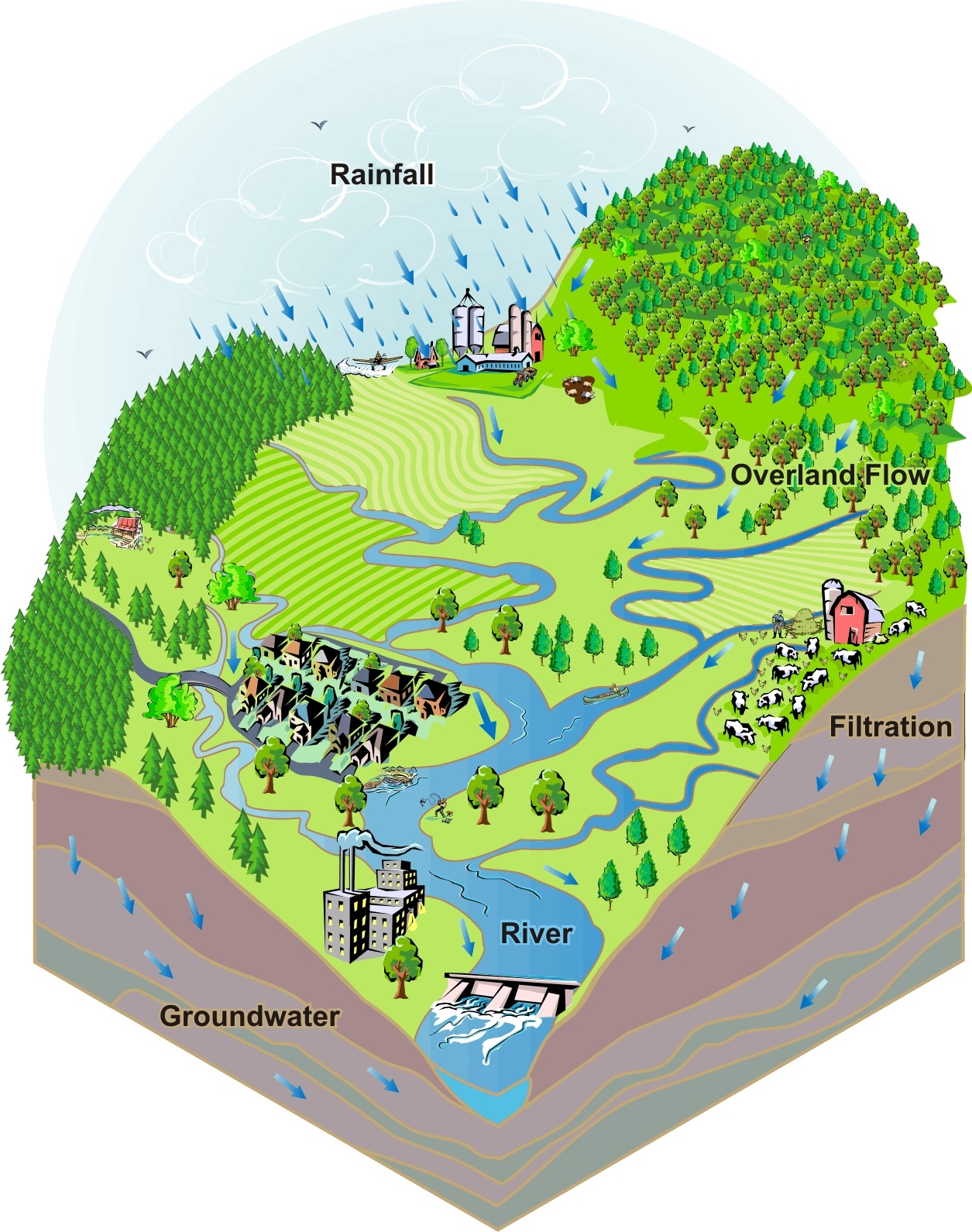
Students learned that watersheds are all the land in an area that drains into the same water body (see diagram, right) and demonstrated good and bad land use practices- in terms of stream/fish health and water quality- by designing two watersheds to reflect those factors.  The ultimate test came at the end, when the two teams had a salmon rely race. They attempted to be the first to “run” their “salmon” (a small fish-y figurine) upstream to the spawning grounds, problem-solving their way around dams, culverts and other fish passage barriers in their rivers, as well as dodging potential predators as represented by heron, sheepdog, and Godzilla figurines.


Building healthy watersheds in the Rolling Rivers display.


On the weekend, the event is open to the public, and people from across the state and of all ages and backgrounds came to learn and play at the Rolling Rivers display.  I got a kick out of the fact that Rolling Rivers really does offer something for everyone!

Thank you to our partners at this event:

Cascade Columbia Fisheries Enhancement Group
Chelan County Natural Resources Department
Trout Unlimited- Washington Water Project
Upper Columbia Salmon Recovery Board
Yakama Nations Fisheries


Riparian Restoration Project with Icicle River Middle School

Pulling invasive vines off of native vegetation.

This October, local landowners, Icicle River Middle School (IRMS), and Cascadia joined forces for a riparian clean-up and restoration project near Leavenworth, WA. 

Riparian zones are the areas of land around streams, lakes, etc. that are directly influenced AND directly influence the adjacent water body (see diagram, below).
 

http://www.globalforestwatch.ca/index.htm


John and Wendy Fishburne own a beautiful piece of property along Chumstick Creek, a historic salmon stream.  After a public works project in 2009 that replaced the large culvert (a major fish passage barrier) with a bridge at North Road, and several projects in the last decade (implemented by Cascadia and Chelan County Natural Resources Department) that replaced upstream culverts with bridges, there is a much greater possibility that the stream will again support healthy salmon populations. (For more info, visit the Chelan County Natural Resources Department website at http://www.co.chelan.wa.us/nr/default.asp).

WCC crew teaches students how to dig out Himalayan
Blackberry "hubs" (taproots).
The Fishburnes have been working with Cascadia since 2008 to devise a management plan for their section of riparian area and the adjacent hillside on their property. The Old Chumstick Hwy (now an overgrown footpath) cuts right through the project site, and there were still significant remains of the consequent dump site. From the beginning, the Fishburnes envisioned this restoration project as a learning opportunity for local youth, and this fall we were able to make that wish a reality!


Student with his find, unearthed out of a historic garbage cache.


Through Hana Butler at the WSU Chelan County Extension office, Cascadia connected with Jodie Tremberth, the 8th grade science teacher at Icicle River Middle School in Leavenworth. We worked together to coordinate a two-part implementation scheme that would get the 8th graders out to do some good work, enjoy the fall sunshine, and learn a bit about conservation in the process.


Bagfuls of invasive weeds were hauled out of the
 project site.
During the two-day clean-up event, over one-hundred 8th graders from IRMS removed old garbage caches from the hillside, learned how to dig out invasive Himalayan blackberry roots with the help of the Washington Conservation Corps (WCC) crew, and hauled bags of invasive weeds out of the project site.  Perhaps the most exciting find was a several-hundred-pound engine part a group of students and teachers managed to drag up the hillside and into the awaiting dumpster.

 
A planting team takes a break amongst newly planted native
trees and shrubs.
Students returned to the site the following week to plant native vegetation. They worked in groups to plant a variety of native trees and shrubs, staked weed matting over the ground around each plant to keep competition with weeds to a minimum, and covered smaller plants with browse guards to prevent excessive grazing by deer and other wildlife.

Over the two-week period, the students learned about the importance of riparian areas for fish and overall stream health.  Positive riparian effects include bank stabilization for decreased erosion, shade for cooling water temperatures, and filtration of pollutants by root systems resulting in improved water quality.
We had beautiful fall weather for all the field days, and other than a few run-ins with ornery stinging insects, we had a blast!  It was really rewarding to overhear the students say things like, “This is the best field trip ever” and, “I want to do this for a living!”

The students plan on returning to the Fishburnes’ to help Cascadia with monitoring the success and progress of the planting site.
We are looking forward to it!

Students worked in teams to drag invasive weeds
 and debris to the dumpster.


Thank you to:

John and Wendy Fishburne
Washington Conservation Corps crew led by Jake Hanson
Icicle River Middle School Principal Kenny Renner-Singer
Icicle River Middle School “8th Grade Team”- Matt Duffy, Todd Gilbert, Jodie Tremberth, and Beau Snow
Dave Holland, Department of Ecology
Kevin Powers and Hana Butler, WSU Chelan County Extension

And a big thank you to the Icicle River Middle School 8th graders for their hard work and enthusiasm!