Showing posts with label kids. Show all posts

Wednesday, May 20, 2015

Kids in the Creek!

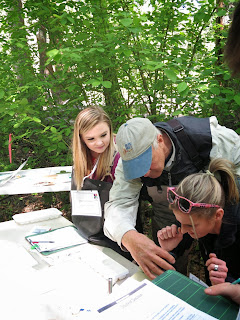
On May 5, 6 and 7 approximately 300 high school students found themselves on the scenic grounds of the Entiat Fish Hatchery for the annual Kids in the Creek event (KITC). KITC is a hands on outdoor education program in which high school biology students study  stream ecology on the Entiat River. Thousands of North Central Washington students have experienced this unique learning opportunity since its inception in 1992.

Each day at KITC students are split into six teams which rotate between six learning stations throughout the day. Each station is led by resource professionals (Cascade Columbia Fisheries Enhancement Group, Chelan County Natural Resources Department, United States Forest Service, Washington Department of Fish and Wildlife, Team Naturaleza, Wenatchee School District, Trout Unlimited, Ponderosa Community, AmeriCorps and the Public Utility District) and focuses on key components of stream ecology.

Invertebrate Investigators- At this station the students dawn baggy, clown-sized waders and take to the stream with nets to collect macro invertebrates. Using microscopes, students compare their samples with identification charts to determine which species they’ve found and get an indication of stream health.

Riparian RX- Students at this station take a walk through the Entiat River’s riparian zone learning about adaptation, the function of riparian zones, stream bank restoration and flora and fauna interrelationships. Students are exposed to field techniques and tools used to determine ground cover, canopy cover and overall riparian health.

Habitat Sense – At habitat sense students examine physical aspects of the river and discuss what good fish habitat looks like. These attributes include riffles, glides, pools, substrate and embeddedness.

Fish Health- As the station title suggests, the focus here is fish health and the environmental factors that affect fish. Students also learn about fish anatomy and environmental stressors.

Stream Flow- At this station students use mathematical equations they’ve learned in the classroom to calculate the stream flow of a side channel of the Entiat River. After calculating the flow, the students discuss what varying flows mean for the ecosystem, especially at extreme high and low flows.

Water Quality- Here, students learn to measure the pH, turbidity, dissolved oxygen and temperature of a river. They then use these measurements to discuss and quantify stream health.


Upon completing each station, at the end of the day, each team is charged with coming up with a management plan for a swath of riverside property. These plans are then presented to peers and several resource professionals who critique each plan.

This year’s KITC was a huge success. Everything went just as planned and everyone involved learned something they could take with them. A few of the participating Wenatchee High School students were asked what they learned at KITC. This is how one replied: “it is important to us to have healthy streams…we really affect our watershed.”

Cascadia would like to thank Entiat Fish Hatchery for providing a beautiful venue, Alcoa and South Douglas Conservation District for their funding, and the Entiat Volunteer Service group for all their hard work and support. We would also like to thank all the resource professionals who came out to share their knowledge with the next generation of land managers!

Below are more Wenatchee High School students’ replies when asked what they learned at KITC.
* How important riparians are; why it is important to us to have healthy streams; how we really affect our watershed.
* Learned it's hard to catch a fish; fish are good at hiding; construction sites are way too dirty.
*That fish need healthy/non-polluted water to live; all streams have different habitat for different bugs; that biologists have very hands on jobs.
* It's very important to keep our environment clean for the Wenatchee watershed.
* That learning can be fun; you don't always learn in classrooms; hands on is good.
* How much the scientists care; how interesting macroinvertebrates are; how fun it was.
* It was fun to learn more stuff about the land; I thought it was going to be boring but it was fun; that fish and trees need to be helped and saved from being turned into stores and homes.


Today's snowpack in North Central Washington is 31% of its 29 year average (ftp://ftp.wcc.nrcs.usda.gov/data/water/wcs/gis/maps/wa_swepctnormal_update.pdf).


Wednesday, May 6, 2015

Wenatchee River Appreciation


Heading into what is sure to be a warmer than usual spring and summer and with such a measly snowpack in the mountains, Cascadia Conservation District and a group of well-intentioned community members headed to the banks of Brender Creek for our annual Wenatchee River Appreciation event. This year’s event was all about repairing the disturbed riparian area along the Wenatchee River tributary.


The banks of Brender Creek, adjacent to the former Cashmere mill site, has been one of Cascadia’s project sites over the winter and into the spring. It’s a site that has seen extensive cleanup efforts over the last few years, with the Port of Chelan fronting the bill for removal of debris and pollution accumulated over years of mill activity, with the intention to sell the land. 

With funding from the Department of Ecology, Cascadia and partnering agencies Chelan County Port District and Cascade Columbia Fisheries Enhancement Group provided about 250 plants (ponderosa, Oregon grape, mock orange and golden currant), planting equipment and refreshments for volunteers. Clad in dusty work clothes and worn leather gloves, nearly 30 community members came out to help plant throughout a couple hundred yards of the Brender Creek riparian.

With so many eager hands getting plants in the ground, the event lasted about two and a half hours, culminating in a raffle in which two Wenatchee High School students won photographs by local artist and Cascadia Project Manager Michael Cushman. Cascadia would like to thank Cascade Quality Water and Crunch Pack for providing refreshments.

Today’s snowpack is 31% of the 34 year average (ftp://ftp.wcc.nrcs.usda.gov/data/water/wcs/gis/maps/wa_swepctnormal_update.pdf).

Wednesday, April 22, 2015

Earth Day Essay Contest Winner: Rylee Hersh

Happy Earth Day! We are happy to announce this year’s Earth Day Essay Contest winner, Rylee Hersh from Sterling Intermediate School. Rylee’s essay answered the question “How can a middle school student be an effective steward of the environment?”

As the winner of the contest, Rylee received a hand painted field journal from local artist Heater A. Wallis Murphy and a day of white water rafting on the Wenatchee River with Orion Expeditions. We are also posting her essay on our website for the public’s edification. Here is Rylee’s essay:

     The enviornment gets worse and worse every year. Trash piles up, the air gets dirtier and dirtier, and plastic that can be recycled is thrown away. Middle school students can make positive changes to help manage the environment. They can manage their trash, do many activities to stop air pollution, and recycle. 
     Students can manage their trash to improve the environment. As Los Angeles Times states, when kids in a Los Angeles school district eat lunch, they take way more than they can eat. This is because of the rule where they enforce kids to take at least on vegetable. Kids don't like vegetables as much, so they throw it away. 18 million dollars worth of food is thrown away in Los Angeles schools. Kids have also made trash art, as Legacy International says. Trash piles up, students can do something about it!
     Students help by doing activities to prevent air pollution. The website EPA Victoria states that the largest cause of air pollution is cars. Cars burn fossil fuels. Car exhaust makes up most of the air pollution in the world. Legacy International describes how many kids have already taken action and decided to ride their bikes to school. Riding a bike to school won't give off the exhaust that cars do, so people can ride bikes to stop pollution in the sky. Middle school students can do many activities to stop air pollution. 
     Students improve the environment by recycling. The website Stage Of Life says that a plastic bottle can sit in a landfill for 500 years before even starting to compost. In other words, Stage Of Life recommends that kids and adults should not drink from plastic water bottles. Instead, use a refillable water bottle to help the environment. The same thing is happening with plastic grocery bags, plastic doesn't start to compost for hundreds of years while in a garbage dump, so use a reusable grocery bag too. Students can make a big difference by recycling. 
     It takes one small act to recycle a bottle rather than throwing it away. It takes a little bit of work to ride a bike instead of hopping in a car. It takes little effort to take food a kid will eat. Small acts lead to a big difference. Middle school students can change the environment positively. They can recycle, do activities to slow air pollution, and manage their trash. 
-Rylee Hersh

Well said and congratulations, Rylee!


Today’s snowpack is 42% of the 34 year average (ftp://ftp.wcc.nrcs.usda.gov/data/water/wcs/gis/maps/wa_swepctnormal_update.pdf).


Thursday, March 12, 2015

Earth Day Essay Contest

What better way to usher in springtime than with an Earth Day essay contest? That’s exactly what we’re doing here at Cascadia. If you’re in grades 6-8 within Chelan or Douglas County, we think you should tell us about being a young environmental steward.

Sadly, we haven’t been able to put on the Earth Day essay contest since 2012. But this year we have sweet prizes from generous local businesses, an early spring for inspiration and a thought provoking prompt: How can a middle school student be an effective steward of the environment?

For added inspiration, here’s the winning essay from 2012. It was written by 7th grader Mariela Morales from Orchard Middle School. She was answering the question “What have you learned from Nature and why is what you've learned important?”

What’s damaging nature? Humans. If we say Earth is our mother, then nature is our sister. Nature teaches us how to survive in her. And we dig holes and drill out stuff from her insides, then burn them causing poisons to fill the atmosphere. That pollutes the air preventing the sun from shining on the fields properly. In nature I learned that you can be free whenever you like. But more importantly I have learned that our lifestyle causes a lot of damage.

We have killed off vast amounts of Earth’s ecology, turning what used to be delicate ecosystems into deserts. So, a question we all should be asking is: how can we help? Walk or bike instead of driving a car- a good walk is a conversation between the walker and the environment. A simple walk through nature can provide hope and inspiration. Plant trees- they absorb carbon dioxide. It sounds cliché but we must act now before it’s too late.
Nature is not only enchanting but healing too. Her pleasures may be plain, but are kindly and she’s native to us. She’s our friend and will provide. Nature is consistent, she’ll grow even when cut. Those who’ve harmed nature have had their day with her beauty; now let our children have theirs with her beauty that remains. If we consider how much we really belong to nature, we shouldn’t care so much for building cities. Nature helps us when we are sick and instead, we are making nature sick. Knowing that nature is part of our only home means knowing we have to take care of her.
Inspired? Often insight is gained through our more simple and innocent citizens- our children. In that vein, American Rivers created a most apt video illustrating a child’s love of rivers.
Entry Form

If you or someone you know would like to submit an essay, here are the particulars:
• The essays should be 500 words or less, size 12 Times New Roman font, and double-spaced.
• Typed essays are preferred, but hand written essays will be accepted provided they are legible.
• Word count should be included in the bottom, right corner of the essay.
• Essays must be turned in with completed entry form (pictured to the right)
• Sorry, electronic submissions will not be accepted.          
• Essays are due Monday April 13, 2015. Essays postmarked April 14th or later will be disqualified.
• Winners will be announced on our website on April 22.
• Send or deliver essays to 14 N Mission St., Wenatchee, WA 98801

If you or someone you know still lacks the inspiration to put ink to paper and drop some stewardship knowledge, consider our awards for the top three entries: A day rafting the Wenatchee River with Orion River Expeditions and a hand painted field journal created by local artist Heather A. Wallis.


Today’s snowpack as a percent of average is a derisory 53% (USDA/NRCS National Water and Climate Center, http://www.wcc.nrcs.usda.gov).

Friday, May 30, 2014

May Wrap Up

May is drawing to a close and I realize that this is the first (and only) blog post for the month. It’s been a busy month with most weeks full of a variety of activities that demanded my attention and kept me out of the office. However, I didn't want to end the month without highlighting a few of the things that occurred, so here they are.
 Several weeks in April and May saw me helping with science field days around Wenatchee. First was a 5th grade shrub steppe experience, next a similar experience for 1st graders, after that a kindergarten walk, and finally at the end of the month a 4th grade science day revolving around fish and hydroelectric power. That seems like a lot, but for the most part I really enjoyed all of it. I helped with plant identification and counting, native wildlife, ecosystems, and fish statistics. It was good that I had a presence there, both as an Americorps member and as a representative of Cascadia. Cascadia has an effect, both directly and indirectly, on many of these ecosystems through their work in conservation and restoration. It’s helpful to be able to introduce the kids to the ideas of natural ecosystems and the organizations that are involved with preserving them.
May’s next event was Kids in the Creek (KITC). KITC is a program put on by Cascadia in partnership with the US Fish & Wildlife Service and the Forest Service, along with many others. The program is designed to get young high school students hands on science through a variety of stations. Half of the stations are ‘dry’ and include: water quality, fish health, and riparian vegetation. The other half are ‘wet’ stations. Requiring the students to don waders and get in the creek (hence the Kids in the Creek). These stations include: invertebrate investigation, stream health, and flow. KITC occurred in early May and brought roughly 300 students through the 3 day program. The overall goal is to connect the classroom science with real-life experiences, showing students that science is not just boring class time.
The third week of May I was out of the office driving halfway across the county to Minnesota to canoe for a week, and then driving back to Washington. I mention this because of some of my observations along the way. In many locations on my drive I noticed fields tilled right up to the water lines on creeks, rivers, and lakes. There was no buffer. Anything applied to the crops could run into the water. Erosion was rampant in spots with 10 foot vertical banks slowly eating into fields because there was no riparian vegetation to secure the soil. It was obvious the natural ecosystem had been destroyed in many areas leaving only countless fields behind.
That’s about it for the month of May. Everything that occurred managed to shrink to a manageable text level, but only because I don’t want to get into all the details. I spent much of my time at education and outreach events, which is great because that’s what I’m here for. I feel like several hundred students learned a little more about the environment through my actions.

Tuesday, September 24, 2013

Fall has Arrived

Sunday marked the official first day of fall for 2013. It’s about time. Summer was long, warm, and, oddly, wet. There were fires, but anymore I expect them during the summer. What I didn't expect was all the rain. That rain led to floods and mudslides in the Clockum and other canyons around the area. The scope of the damage seems surprising at first. But that’s only until you consider the fires from this year and last. Without vegetation the hills had nothing to help soak up the water and hold the soil in place, so down it came—over, under, and through everything in its way.

I say good riddance to summer. It's time for cooler temperatures, shorter days, and changing leaves. Personally, I love fall. I love the smell of damp earth after a quick downpour or a light drizzle. I love wading through a pile of freshly raked leaves.

This time of year always brings to mind apples for me. Harvest is in full swing, and fresh fruit is easily found in abundance. Just stop in at a local fruit stand or the farmer’s market.

All the kids wanted to get in on the action at Salmonfest.
The 23rd annual Wenatchee River Salmon Festival was held last weekend and it seemed to be a good success. Cascadia ran the Rolling Rivers watershed model, and eight different school groups came by for scheduled sessions during the two school days, Thursday and Friday. Saturday was a free-for-all with kids and adults alike stopping by to put their hands in the plastic sand and create watersheds and salmon habitat. At the end of three days, I’m hoping that the few hundred kids learned at least something about the importance of healthy watersheds and the salmon that live in them.

A beautiful sunny morning. This photo would work great for the contest.
Fall is a great time to go out and take some pictures. Head up into the hills and capture some photos of the mountains with the patches of yellow from the western larch, one of the few conifers that drops its needles for the winter. Find an apple orchard and take some pictures of the branches laden with colorful fruit. Hit the trails and snap a picture of a large buck flashing his antlers. And once you get back with your multitude of photos head over to www.picturethewenatchee.com and submit them for the 2013 Picture the Wenatchee photo contest. The top two pictures from each category will end up in Cascadia’s 2014 stewardship calendar. Be quick about it though. The contest closes October 1st. 


Tune in next week for another inspiring article. I hope to spend the next few weeks covering topics that have something to do with the new fall season.


Josh

Tuesday, December 20, 2011

Reduce, Re-use and Recycle your Holiday Waste


http://www.sxc.hu/profile/LotusHead
Did you know…

 “Approximately 33 million live Christmas trees are sold in North America every year…” (EPA)
“…the 2.65 billion Christmas cards sold each year in the U.S. could fill a football field 10 stories high…” (Use Less Stuff)
“About 40 percent of all battery sales occur during the holiday season…” (EPA)
 “Americans throw away 25% more trash in the Thanksgiving to New Year’s than any other time of year.  The extra waste amounts to 25 million tons of garbage…” (Use Less Stuff)


These numbers are staggering, especially when you think of all that “stuff” heading to the landfill. This week’s blog is a collection of thoughts about how to reduce these numbers, courtesy of Cascadia staff and my good friend, the Internet:

http://public.fotki.com/kelvinkay/collection_of_beaut/xmasparty061.html
Reduce:  Bring your cloth grocery bags on your holiday shopping trips or ask for no bag if you can easily carry your purchases out without one. If you happen to forget your reusable shopping bag, ask for paper bags and then use them as wrapping paper.  Opting out of gift boxes provided by clothing stores is a great way to reduce the amount of cardboard used during the holidays.

Buy recycled-content Christmas cards, wrapping paper, and gifts.  If you’re in the market for batteries or battery-operated gadgets, buy rechargeable.  Even better, give the gift of a rechargeable-battery charger!
Save energy and increase the lifespan of your holiday lights by turning them off during the day.  If you are purchasing new lights, choose LED, they will conserve further energy and last longer too.
One of my many hobbies is sewing, and so I wrap presents in fabric from my fabric stash.  I either use pieces I don’t mind losing to a fellow "crafter", or I just simply ask for the fabric back.  The Sunday comics also serve as good wrapping material, as the ink doesn't smudge. 
Kate, a Cascadia Resource Specialist, brought up this good point about Christmas trees:

"Even though fake Christmas trees are reusable, they are often made of petroleum products and discarded after a few years (filling landfills with bulk that takes a long time to degrade). Getting a tree-cutting permit (usually $5 from the Forest Service) and making the trip to cut one from the forest is a better choice. Many of the forests in our area are overstocked with trees and reducing the amount of small trees now will help forest health in the long run. Also, live trees can be chipped and used as mulch in gardens or parks."
Learn where to harvest Christmas trees in Chelan County and good tree-cutting etiquette from the Okanogan-Wenatchee Forest Service. 


Malene Thyssen, http://commons.wikimedia.org/wiki/User:Malene
 Re-use:  Try not to destroy ribbons and wrapping paper- particularly on large packages or those with nice paper- so you can save and use the materials in subsequent years. 

Amanda, Cascadia’s Ed and Outreach Specialist, offers:

"The main way I re-use around Christmas is by “re-bagging.” I always keep Christmas gifts bags for use again next year. We keep a box in the closet full of Christmas bags that we get out every year  rather than buying new ones each time."
At Cascadia’s holiday party, Amanda’s white elephant gift was stolen from her (as part of the game), but she did hang on to the festive bag that it came in!
In addition to stashing away supplies for next year’s gift wrapping, there are plenty of fun, creative activities that incorporate recycled materials.  A lot are great for kids, and are a wonderful way to teach them a valuable lesson in recycling! 
Make ornaments, paper chain garlands, and gift tags out of old holiday cards and wrapping paper.

Christmas lights have that annoying habit of going into the box at the end of the season in working order, and being burned out when you take them out of the box the following year. Instead of throwing them out in a fit of frustration, get crafty!  (If you’re not so inclined, see the recycling section below for other ways to keep strings of lights out of the landfill). Use burned-out Christmas lights (and also regular light bulbs) to make ornaments. Researching this topic on the internet, I came across some really wonderful ideas for penguin, snowmen/women, and reindeer ornaments!  Make jewelry out of small Christmas lights. There are how-to articles about this online too.
If you’ve got the appropriate space, take your Christmas tree out to your yard and create some backyard bird habitat! Birds will appreciate the refuge that the downed tree provides, especially if you’ve got a birdfeeder nearby.  You can also partially submerge your tree in a backyard pond to enhance aquatic habitat.  If you have the means, grind it up and use the woodchips for mulch.


Kris De Curtis http://commons.wikimedia.org/wiki/File:Christmas_tree_bauble.jpg
Recycle:  There are several companies on the web (search for “recycle Christmas lights”) that will take old strands of holiday lights and recycle the parts.  In exchange, they will send you a coupon you can use to buy new ones (brand-specific).

www.Earth911.com is a great resource for reducing, reusing, and recycling! Their database provides information on centers that accept all kinds of materials, from cardboard and glass to technology and industrial products.

In Chelan County, Dolco Packaging (1121 S Columbia Street, Wenatchee) is a 24-hour, free drop-off center that recycles Styrofoam.  Please note: not all Styrofoam is created equal.  You can call (509) 663-8541, or drop by and there may be signs up on site indicating which Styrofoam types they accept. 

Don’t let your tree go to waste!  That tree provided you with holiday cheer, and can now be put towards other good causes.  The Boy Scouts and the Chelan County Public Works' annual tree recycling program is also scheduled this year for Saturdays, December 31 and January 7 at four locations around Chelan County.  See their flyer for the details!
While some of these ideas might be a little too late for this year, there’s always next year!

For a great checklist of more ways to reduce your ecological footprint during the holidays, visit:
http://commons.wikimedia.org/wiki/User:Charlie2301


If you have other ideas, please share them in the comment box below, we’d love to hear from you!


Thanks for reading!

Your Friend in Conservation,
Julia


References:
http://www.allfreecrafts.com/recycling-crafts/lightbulbs/index.shtml
http://www.epa.gov/osw/wycd/funfacts/winter.htm
http://pages.uoregon.edu/recycle/events_topics_holiday_text.htm
http://use-less-stuff.com/ULSDAY/42ways.html
http://greenliving.about.com/od/thegreenfamily/tp/green_christmas.htm

Thursday, December 1, 2011

Reflections on the Chumstick Riparian Restoration Project

IRMS 8th Graders: In their own words
This October, Cascadia and Icicle River Middle School (IRMS) teamed up to do a riparian clean-up and restoration project near Leavenworth, WA.  For all the details of this project, see our October post "Getting Youth Involved."
Everything appeared to go well and the kids seemed to have a good time, but I have been eager to know what bits of knowledge the students retained or how they truly felt about the project.  This week, I was able to swing by the school and pick up the envelope containing a stack of student reflections.  The variety of responses- thoughtful, insightful, entertaining- were wonderful to read, and I thought they should be shared. So, without further ado: 
Reflections...

On riparian areas and their function:
"I learned that Riparian was a habitat near water."

"By growing trees the creek will have more shade.  When the water is colder there is more oxygen for the fish.  I learned that what I just said is called a riparian habitat."
"I learned that if there is more roots in the soil there would be less of a chance of erosion.  So that’s why we took out the blackberries and put in more plants...  Also I learned if the water is colder it produces more oxygen for the fish to breathe."
"I learned that having the right habitat is very important because if you don’t many things can go wrong.  For example, it there aren’t the right plants there that are tall with deep roots, the river won’t get shaded and the roots won’t hold the dirt down."

"I also learned that there’s a lot of value to a riparian environment, fishes enjoy it, you can have fun, and [it’s] a good way to relieve stress."
"Helping the ecosystem was fun because it was “hands on” science."

"I also learned that teamwork, friendship, and care and respect for nature will help not only the environment (as in the creek and such), but give wild animals a home, whether they are 600 lbs. elk, or 16 oz. fish, they need us, and we need them."


On pollution and cleaning up:
"I really loved the restoration project because it felt good to help clean up the environment.  Also it felt good when [we] crossed the creek, got really dirty, and pulled out two tires."
"We had to go in the stream and take rocks out to help the stream flow better.  And that was hard work.  I was the muscle man so I had to take out all of the big rocks."
"I also learned that there is a lot of pollution in the most unexpected places..."
"I learned that grass is heavy.  And we needed to get all the garbage out of the water so the fish will come back."
"One memory from there that I’ll keep forever would have to be when… I found a huge piece of machinery in the ground.  It took like twenty minutes just to get it out of the ground, even with six other people helping me."
"…I learned that even though we can’t always see it, and we don’t really realize it, there was pollution there, and how to quickly remove it."

On Himalayan blackberry:
"I learned that blackberry bushes have one big root but not many small ones.  Blackberry bushes don’t prevent erosion so we had to take the bushes out and plant different plants with smaller (but a numerous amount) roots."

"...I learned about just how overtaking they are.  The stuff was everywhere on the hillside and it was pokey and very stringy too." 

On planting and proper planting technique:
"I thought it was super fun cleaning up, but planting was more fun because we really helped the hill from eroding.  We also planted some trees and bushes that poked me, but it was all worth it." 
"I enjoyed planting the trees because when they grow and [I] see them I’ll be like I planted one of those trees!"
"…my group planted 7 trees and that made a big difference because we will have more wild life." 
"I learned that the hole you dig for a plant has to be twice as wide as the roots and just as deep as them.  I enjoyed planting plants because I can’t wait to see them in a year or so."
"If you put too much dirt or soil on top of the plant, the plant will die because its roots will grow to the surface and not into the ground."
"...I thought it was dig a hole and put [a plant] in it… With the little [plants] you have to protect them from other animals, like deer.  I learned now how to plant really well.  I can do this at home and plant a lot."
"I enjoyed planting the plants and found it interesting the materials used to keep them in the ground.  Everything was biodegradable."


And other thoughts and wisdom:
 "I like working in the wilderness helping make a change in the habitat.  I hope someday the salmon will be able to swim freely in the stream."
(It's happening! Check out the video of salmon in Chumstick Creek!)

"…I learned that that’s kind of what I want to be when I’m
 older."

"I learned to check where the bank ends before I got too close to the creek.  Once I fell in the creek, I learned not to go back."
"I personally really enjoy working outside as opposed to writing papers in class all day."

  "The ladies there were real nice and gave us hot cocoa..."

"In all, it was a great trip, a few unfortunate people fell in the creek, but a good time was had by all."


Thanks again to the IRMS 8th graders for all your great contributions! 
And thank you for reading!

Your Friend in conservation,
Julia