Showing posts with label conservation. Show all posts

Monday, December 18, 2017

Americoprs Story of Service

I was drawn to Washington for the natural beauty and the vast number of environmental education, conservation, and research positions that are here in order to protect and ensure that future generations will be able to experience and appreciate all that Washington has to offer. I have always wanted to see Washington and the Cascades, I never really imagined I would be able to live and serve here as a part of the team working to improve and promote the environmental stewardship of these areas.
  I am serving through Washington Service Corps as the Americorps Intern with Cascadia Conservation District in Wenatchee WA. A portion of my service includes going out to schools across Chelan, Douglas, and Okanogan counties to teach an environmental education program called “Wheat Week” to 4th and 5th grade classes. The program uses wheat as the teaching tool in order to talk about greater environmental issues we face such as storm water runoff, pollution, erosion & soil conservation, and energy production. I am extremely happy to be a part of this program and have the opportunity to teach it, programs like this one are the reason I moved from Wisconsin to Washington with Americorps.
This past week I got the chance to teach at Columbia   Elementary in Wenatchee. I met some awesome teachers and enthusiastic future scientists (maybe)! The students here really looked forward to our daily Wheat Week lessons, they could hardly wait to investigate their terrariums and see how their wheat was changing and growing each day. Every day I would have multiple students run up to me and show off the new roots growing or a stem emerging from the little cup of soil. We recorded these observations in our “Kernel Journals” every day. They are so excited that they remember the names of the different parts of the plant that we labeled on the very first day, I have never heard “look! root hairs” shouted with such enthusiasm before. They took such pride in growing their terrariums and taking care of their wheat plants.
The vast majority of the students I teach are far removed from farming and the ideas and issues brought up during our Wheat Week lessons. When presented to them, these are awe inspiring for many of the students who have never realized how much work goes into farming or the amount of effort that many farmers put into being responsible stewards for their lands. At the very end of our week we write postcards to the Washington Wheat Farmers. Reading through the postcards before I send them out is one of my favorite things. The kids write about their favorite parts of wheat week, tell the farmers what they learned, and ask questions about being a wheat farmer.
Seeing the excitement and the enthusiasm that the students have is what motivates me. I see every classroom as an opportunity to advocate for and educate people about the importance of preserving the natural world and the environment. There is always a balance between us and the environment, which I do my best to explain to the kids. I hope that maybe one of them will find an interest or passion for environmental sciences and maybe someday help to solve some of the issues we face.

For more information about Wheat Week, check out Franklin Conservation District’s website!
https://www.franklincd.org/wheat-weekIf you are interested in having this program at your school for 4th and 5th grade and you are located in Chelan or Douglas counties send an email to americorps@cascadiacd.org. 

Friday, January 20, 2017

Why Are Native Plants Important?

Native plants are an integral part of a healthy landscape. There are a number of reasons why that is, including but not limited to that they are naturally low maintenance because they often require less water than traditional sod. They do not require large amounts of fertilizer or pesticides that plants from other places may need. If the plants are native to your area, they have even coevolved with the wildlife as well. That means that many native bird species also rely on native plants as a food source.

By Akos Kokai (Native plant demonstration garden) [CC BY 2.0 (http://creativecommons.org/licenses/by/2.0)], via Wikimedia Commons


Non-native plants, otherwise known as invasive species, can wreak havoc on a delicate ecosystem.

Below is a list of a few reasons why invasive plants are worse than native plants for your landscape.

http://solveoregon.org/why-we-care/invasive-plants

Air, Noise, Water Pollution
In terms of water conservation and the precious value that water is in an ever growing world, using water wisely is of paramount importance. Unfortunately, watering lawns can contribute to waste of a natural resource, “30 percent of water consumed on the East Coast goes to watering lawns; 60 percent on the West Coast. (Redesigning the American Lawn)” (National Wildlife Federation). Invasive species also require an increased amount of pesticide use that can pollute waterways. 

Harm to Biodiversity
Native plants also provide critical habitat to a variety of pollinators. Certain insects have coevolved to only eat certain plants, and if invasive species have taken over then there is less and less food for those insects to eat. That in turn causes there to be less food for the birds that feast on insects. Check out an excerpt of a film about the important impacts that native plants can have on a landscape:


Consumption of Natural Resources
Invasive plants often outcompete native plants because they usually lack their natural enemies in a foreign environment. As a result, invasive plants can strangle a hillside or choke a waterway easily. Alternatively, native plants natural abundance is due in part to the fact that they are native to your climate, and thus have adaptations for the amount of water and the soil moisture in your particular area (Backyard Conservation...).  

 Impacts to Public Health and Safety
Invasive species do require an increased amount of maintenance. Increased chemical use can lead to harmful effects in wildlife and humans (Benefits of Naturescaping). Extra fertilizer may also be required to maintain a green lawn. If you use native plants, and decide to compost in a natural garden, your soil will not need as many chemicals to provide good nutrients to your plants!

Cost and Labor Intensive
The cost of upkeep for a traditional lawn is about $700 per acre per year, as opposed to the care of a wildflower meadow at $30 per acre per year (About Native Plants). The equipment used in the upkeep of a typical suburban lawn includes lawn mowers, leaf blowers, and the occasional chain saw. These pieces of equipment emit as much hydrocarbon in one hour as a typical auto driven 50 miles. (National Vehicle and Fuel Emissions Lab, Ann Arbor.) Every year, a typical lawn requires 40 hours of maintenance, which is the equivalent of a one-week vacation (Benefits of Naturescaping). The noise pollution from a lawnmower alone can be enough to make anyone upset on an early Sunday morning.

Boring Landscapes
Avoid monoculture! Aesthetic concerns aside, native plants offer a wide variety of shapes, colors, and textures for your yard.

Why spend all of that time maintaining an unnatural landscape? Instead, give native plants a try. You won’t be disappointed!

Below is a preview of an excellent documentary film focused on the dangers of invasive species in Oregon. Washington state deals with a lot of the same resource problems as Oregon, and it is an informative piece on various issues in the Pacific Northwest. 


Convinced that native plants are the way to go? Don't know where to start? Come learn more at Cascadia's FREE Native Planting 101 Workshop!!!

RSVP today for our native plant workshop, Saturday, February 11th from 12:00-4:30 pm at the Wenatchee PUD auditorium!

Our plant sale ends by March 1st, so place your order today to ensure you get what you want. 

To order native plants, download a form HERE!

Cheers!

~ Ava

Works Cited

"About Native Plants." http://www.nwf.org/Garden-For-Wildlife/About/Native-Plants.aspx. National Wildlife Federation. Accessed 1/13/17. 


“Benefits of Naturescaping.” http://www.plantnative.org/how_benefits.htm

Green, Danielle. “Greenacres: Landscaping with Native Plants.” US EPA. https://archive.epa.gov/greenacres/web/html/index.html Last updated on 2/21/2016.

Idaho Native Plant Society. Landscaping with Plants of the Intermountain Region. https://www.blm.gov/style/medialib/blm/id/publications.Par.71153.File.dat/Landscaping-small.pdf

“Let’s stop these silent invaders.” http://solveoregon.org/why-we-care/invasive-plants. Accessed 1/13/17. 

“Why Native Plants Matter” Audubon society http://www.audubon.org/content/why-native-plants-       matter. Bird Friendly Communities Blog. Accessed 1/13/17.


Thursday, December 8, 2016

Little Chumstick Creek Community Tire Clean-Up Day

In the summer of 2016, a property was foreclosed adjacent to Little Chumstick Creek.  During the clean-up process, a non-local contractor avoided dumping fees by disposing of 300-350 tires directly into Little Chumstick Creek.  After several months of frustrated neighbors working with the bank that owns the offending property, and pressuring the responsible contractor to remedy the problem, the neighborhood had little success.  During the recent implementation of a Cascadia Conservation District stream restoration project on adjoining property, the neighbors reached out to see if the CD could assist with removal and disposal of the tires.
Tires illegally dumped in creek

Volunteers hauling tires out of creek
AmeriCorps member Ava is keeping track of signing in volunteers
Little Chumstick Creek is a tributary of Chumstick Creek, which has been identified as critical steelhead and salmon habitat in the Wenatchee River Watershed. Streams were re-opened to fish passage in 2012 after 13 fish barriers were removed and replaced with cast concrete bridges.  Following the barrier removal, endangered steelhead and spring chinook have increased use of the creek which offers protection to juveniles during high water events in the Wenatchee River, and cold water for spawning during peak summer temperatures.


Most of this ~15 mile watershed has been utilized for agriculture throughout the 20th century, which has resulted in severally degraded habitat throughout much of the watershed.  Cascadia Conservation District has partnered with Washington Department of Ecology to make stream restoration a priority in the Chumstick watershed, and this project area represents an excellent example of an area in need of restoration and clean-up to improve habitat as well as water quality and quantity.
Semi-trailer used to haul tires away from site


The district hosts 1-2 volunteer clean up days in each of the Chelan County Watersheds each year. Our efforts are directed towards building relationships within the community we serve, as well as local by-in to continue implementing restoration projects in the area. 


Crew after helping to remove tires from the creek


On Saturday, December 3rd, Cascadia hosted the tire clean-up day. To make the clean-up possible, Chelan County Solid Waste donated use of a 28 foot semi-trailer to haul out tires and pay for the cost of disposal. We had about 18 volunteers attend the event and were able to remove about 350 tires in only two hours! We look forward to continue making progress in habitat restoration throughout Chelan County. 

Monday, September 26, 2016

Cascadia's New AmeriCorps Member


Hello!

My name is Ava Izdepski, and I am the new AmeriCorps member serving at Cascadia Conservation District.

I am originally from Edmonds. I went to college at the University of San Diego, where I was an Environmental Studies major. During my time in San Diego, I was a volunteer with the Ocean Discovery Institute. While volunteering, I was given the chance to help teach environmental education lessons to students in elementary schools. I recently moved back to Washington to be closer to family.  I am looking forward to continuing to teach environmental education with Cascadia, as well as participate in and bring value to the other programs the district implements.

Since starting my term of service, I have had the opportunity to demonstrate our Enviroscape model at the Chelan County Fair, work at the Rolling Rivers display during Salmon Festival in Leavenworth, and complete Wheat Week training in Quincy. I am very excited to continue to learn and grow throughout this year of service. I look forward to taking advantage of all the opportunities this area has to offer!

Thank you for viewing the blog and be sure to stay in touch with questions and/or comments throughout the year. I am looking forward to using the blog to encourage conversation about a variety of topics.

Our Picture Chelan County Photo Contest is still in full swing and accepting submissions until this Saturday, October 1st. You can submit photos of Chelan County for six categories including plants, wildlife, agriculture, recreation, landscapes, and water. You can upload your photos to http://cascadiacd.org/photo-contest_347.html for a chance to be included in the 2017 natural resources stewardship calendar!

~ Ava

Wednesday, December 23, 2015

Let it snow!

Continuing in the tradition of the last few years of AmeriCorps blogs- I’m here to talk about snow! While the aforementioned element of fire has strongly affected my life, of equal importance is the element of water, specifically in the form of snow. As long as I can remember I’ve always had a deep connection to snow. Winters growing up in the Entiat Valley were always full of sledding, snowshoeing, and cross country skiing. After my family’s home burnt down in 1994, we lived in a yurt while re-building on our property. That was the winter of 1996-97, I was three years old and it snowed upwards of 5 feet. We couldn’t be happier as our yurt turned into an igloo and the landscape found relief in the added moisture. When I was six years old, my mom woke me up to show me that it had snowed overnight and I began to cry because I found it so beautiful. And at 14, I fell in love with the sport of alpine skiing at Mission Ridge and have been incredibly hooked on the sport since. I can’t quite put my finger on it; what snow brings that is so magical. Perhaps it is the peacefulness- the muffling of loud sounds, the necessity of moving slower through our day’s errands. Perhaps it is the nostalgia of feeling like a child again- the ageless feeling we get when playing in the snow. For me it is the coldness of the air that brings a sense of clarity and the endorphins I get from skiing, hiking, and playing in the snow. And obviously, it is the holidays that bring us all together- the break from work and school, the importance of reflection and gratitude we feel during this time of year.

The percentage of area in drought status is still higher right
now that it was one year ago.
Besides the joyous wonders of a white holiday season- the effects of a snowy (or dry) winter last long into the summer. Last winter we saw an incredible lack of snow and the ecological and economic effects of that hit hard over the summer. The effects of the biggest wildfire ever in our state’s history led to lack of tourism and loss of important infrastructure. The lack of water led to a weakness in our defense against those fires, it was hard hitting on orchardists and farmers, habitat for important species suffered, the list goes on and on.  Although we are still currently in a drought- the Department of Ecology recently stated that the Drought Emergency Declaration will be ending at the end of the year due to snow levels being at or above 100% of normal for this time of year. For the emergency declaration to be made water supply levels must be below 75%. The month of December has been so good to our area with snow falling up high and a mixture of rain and snow falling down low. I am eager to see where this El Nino season takes us and am hoping that the trend of snow continues. And if it does, I am eager to see the effects of that come summertime.  
Our region is currently at 126% of normal
snow water equivalent.

As a person whose happiness strongly depends on the ability to ski in the winter months I will say that I’ve learned to do it while you can. Mission Ridge is at ~70 inches of snowfall for the month, close to their ~100 inch December snowfall record. Who knows what the rest of the season will bring us- hopefully more of the same, but possibly not. Until it changes, that’s where you’ll find me (and a few others from the Cascadia office)!

As always thanks for stopping by, on behalf of the Cascadia staff, we wish you a very joyous holiday season! Let me know in the comments what your favorite part of a snowy holiday season is!


-McKenzie

Sources:
ftp://ftp.wcc.nrcs.usda.gov/data/water/wcs/gis/maps/wa_swepctnormal_update.pdf
http://www.ecy.wa.gov/drought/index.html
http://droughtmonitor.unl.edu/Home/StateDroughtMonitor.aspx?WA


Monday, October 12, 2015

Engaging in Environmental Education!

One of my main responsibilities as the AmeriCorps intern for Cascadia is to provide environmental education in the district’s local schools. Depending on a teacher’s schedule and planned curriculum, I get to spend anywhere from 1-5 hours with a group of students aged 5-12. In that time I have the opportunity to shape our valley’s young people’s understanding of ecosystems and help them understand the ways in which humans can influence those ecosystem functions. This is a responsibility I do not take lightly, especially in a time where funding for education is getting tighter and the need for a society with an understanding of our planet’s functions and needs is becoming direr. And fortunately, through Cascadia’s partnerships with other organizations and conservation districts, I have access to fun, free science curriculum that incorporates hands-on learning opportunities in every lesson.

Water on Wheels Lessons
The main curriculum that I teach is called Wheat Week. This is a five day program created by the Franklin Conservation District (FCD). Wheat Week uses the wheat plant as a tool to educate 4  th and 5th graders about systems, water, soil, pollution, and energy. During this week, students get to build their own terrariums and grow a wheat plant, experience the water cycle as a water droplet, investigate the different types of soil, create a watershed model, and thresh a wheat plant. Another program I teach, also created by FCD, is called Water on Wheels. This program consists of eight different lessons, which can be taught as a series or individually depending on a teacher’s needs. These lessons educate students, in varying levels of depth depending on their grade level, about soils, the water cycle, animal habitats, and watersheds. Each lesson involves a different science experiment, game, craft, or environment model. All of the FCD’s curriculums meet a number of science and social studies Washington State learning standards. They also incorporate GLAD strategies. GLAD – which stands for Guided Language Acquisition Design- is a program that originated in California and is in its first phase in the Wenatchee School District. It strives to “promote an educational setting that produces effective, literate citizens of a global society.”

I also have opportunities to work with local schools at events like Salmon Fest where we host the Rolling Rivers exhibit, at the Wildfires & Us Field experience put on through the Wenatchee Valley Museum, and at Kids in the Creek where we work with our partner agencies to get kids outside in the Entiat River doing science. Additionally, I coordinate Native Planting 101 (planned for March 5th, 2016!) a workshop open to the public, where anyone of any age can come and learn about effective landscaping and plant care in the Wenatchee area.  

My week of in-class training with the FCD is done and I am currently filling my schedule in with lessons. If you are interested in volunteering at an event, know a teacher who might interested in lessons, or have a question, comment, or nugget of advice- all are welcome in my inbox (americorps@cascadiacd.org)!

Thanks for stopping by!

-McKenzie

Resources:

Wednesday, September 23, 2015

A Sweet Homecoming

Greetings! My name is McKenzie Selden, and I am the new AmeriCorps member serving at Cascadia Conservation District. I've spent my first half hour of work this morning looking back at previous members' blogs and have been thoroughly inspired and excited for the projects and challenges that will be coming my way this year.

I hail from the tiny town of Entiat, about 15 miles north of Wenatchee on the highway, and then another 14 miles up a rural county road. It was a childhood filled with farm animals, dirty fingernails, backpacking trips into the Glacier Peak Wilderness, and homemade applesauce. Growing up here really instilled in me an appreciation for the natural, wild world and left me wondering what I could do to keep it that way. And so, when I found myself at Western Washington University, I chose to focus my studies on learning tactics for regulation of things contributing towards climate change. I also focused my learning on how to communicate the importance and immediacy of a need for action; I majored in Environmental Policy with a minor in Communication Studies.

La Catarata de la Fortuna,
Costa Rica
My last semester of college was spent abroad, studying Sustainable Development with the School for Field Studies in Costa Rica. It was an amazing whirlwind of a semester where I learned how to think critically about tourism, was chased by capuchin monkeys, and made lifelong friends that taught me more, possibly, than any of my actual courses that semester. However, as a girl who lives for Eastern Washington winters, all I could think about at the end of the semester, was how badly I needed to ski. So, I (somewhat reluctantly) returned to the Wenatchee Valley with high hopes of being a ski bum- only to be met with the worst winter in my lifetime. Nonetheless, I worked at Mission Ridge and fell back in love with the valley. I spent my summer working my 3rd season for the Forest Service on a recreation crew and then for interagency dispatch once the fires took over.

Students from Entiat Elementary School
create their own watersheds at Salmon Fest
Heading into my first fall since I had graduated from college, I was still searching for my purpose in the valley. How would I make my time here valuable? That's when I saw the opening for this job. I had always planned on doing a year of service but I had no idea where, how, or when I would do it. Being the AmeriCorps for Cascadia has already served to be rewarding and nostalgic to me. I feel so fortunate to have the opportunity to serve the community that raised me, and perhaps to inspire the minds of young people growing up in this community right now.

My first week, I participated in Salmon Fest where Cascadia hosts the Rolling Rivers exhibit. It was great to dive right into teaching and hands on activities with kids.


One of my duties as the AmeriCorps is to update this blog, so thank you for reading! Please post any conservation related questions or topics you might be interested in reading about and I'll do my best to address them in upcoming posts!

-McKenzie

P.S. A quick reminder that there is only one week left in our Clean Water Campaign photo contest! Photos taken anywhere in Chelan County having to do with recreation, water, plants, wildlife, agriculture, or landscapes can be submitted for a chance to be included in our 2016 natural resources stewardship calendar. Submit your photos by October 1st at cascadiacd.org!

Tuesday, July 14, 2015

Drought in the PNW

Last week I borrowed a standup paddleboard and with a friend enjoyed a lazy float down several miles of the Wenatchee River near Leavenworth. With the temperature in the high 80s and nearly no wind the setting was perfect: no crowds, abundant wildlife and the peaceful sound of water on its journey down, perpetually heading toward the ocean. There was, however, something amiss about this dog day afternoon adventure- the water itself. Typically mountain streams like the Icicle and the Wenatchee are cold enough to keep most of us from jumping in and splashing around for minutes or even hours at a time like one might at the community pool. But on this afternoon the water was so warm we, like many others, swam unhampered by numbed body parts and goose bumps. While it may feel great to us, this warm water spells trouble for fish and wildlife and points to a serious problem: drought.


Surely it’s no surprise to anyone that the entire west coast is experiencing severe drought, but for many of us we’re not sure what exactly that means. How should that influence our daily routine? What are ways we exacerbate or alleviate the effects? How will drought affect me? Fortunately there are plenty of resources answering these questions and more. For starters check out our drought page on our website. For more detailed reports and information see the following sites:

Wednesday, May 6, 2015

Wenatchee River Appreciation


Heading into what is sure to be a warmer than usual spring and summer and with such a measly snowpack in the mountains, Cascadia Conservation District and a group of well-intentioned community members headed to the banks of Brender Creek for our annual Wenatchee River Appreciation event. This year’s event was all about repairing the disturbed riparian area along the Wenatchee River tributary.


The banks of Brender Creek, adjacent to the former Cashmere mill site, has been one of Cascadia’s project sites over the winter and into the spring. It’s a site that has seen extensive cleanup efforts over the last few years, with the Port of Chelan fronting the bill for removal of debris and pollution accumulated over years of mill activity, with the intention to sell the land. 

With funding from the Department of Ecology, Cascadia and partnering agencies Chelan County Port District and Cascade Columbia Fisheries Enhancement Group provided about 250 plants (ponderosa, Oregon grape, mock orange and golden currant), planting equipment and refreshments for volunteers. Clad in dusty work clothes and worn leather gloves, nearly 30 community members came out to help plant throughout a couple hundred yards of the Brender Creek riparian.

With so many eager hands getting plants in the ground, the event lasted about two and a half hours, culminating in a raffle in which two Wenatchee High School students won photographs by local artist and Cascadia Project Manager Michael Cushman. Cascadia would like to thank Cascade Quality Water and Crunch Pack for providing refreshments.

Today’s snowpack is 31% of the 34 year average (ftp://ftp.wcc.nrcs.usda.gov/data/water/wcs/gis/maps/wa_swepctnormal_update.pdf).

Wednesday, April 22, 2015

Earth Day Essay Contest Winner: Rylee Hersh

Happy Earth Day! We are happy to announce this year’s Earth Day Essay Contest winner, Rylee Hersh from Sterling Intermediate School. Rylee’s essay answered the question “How can a middle school student be an effective steward of the environment?”

As the winner of the contest, Rylee received a hand painted field journal from local artist Heater A. Wallis Murphy and a day of white water rafting on the Wenatchee River with Orion Expeditions. We are also posting her essay on our website for the public’s edification. Here is Rylee’s essay:

     The enviornment gets worse and worse every year. Trash piles up, the air gets dirtier and dirtier, and plastic that can be recycled is thrown away. Middle school students can make positive changes to help manage the environment. They can manage their trash, do many activities to stop air pollution, and recycle. 
     Students can manage their trash to improve the environment. As Los Angeles Times states, when kids in a Los Angeles school district eat lunch, they take way more than they can eat. This is because of the rule where they enforce kids to take at least on vegetable. Kids don't like vegetables as much, so they throw it away. 18 million dollars worth of food is thrown away in Los Angeles schools. Kids have also made trash art, as Legacy International says. Trash piles up, students can do something about it!
     Students help by doing activities to prevent air pollution. The website EPA Victoria states that the largest cause of air pollution is cars. Cars burn fossil fuels. Car exhaust makes up most of the air pollution in the world. Legacy International describes how many kids have already taken action and decided to ride their bikes to school. Riding a bike to school won't give off the exhaust that cars do, so people can ride bikes to stop pollution in the sky. Middle school students can do many activities to stop air pollution. 
     Students improve the environment by recycling. The website Stage Of Life says that a plastic bottle can sit in a landfill for 500 years before even starting to compost. In other words, Stage Of Life recommends that kids and adults should not drink from plastic water bottles. Instead, use a refillable water bottle to help the environment. The same thing is happening with plastic grocery bags, plastic doesn't start to compost for hundreds of years while in a garbage dump, so use a reusable grocery bag too. Students can make a big difference by recycling. 
     It takes one small act to recycle a bottle rather than throwing it away. It takes a little bit of work to ride a bike instead of hopping in a car. It takes little effort to take food a kid will eat. Small acts lead to a big difference. Middle school students can change the environment positively. They can recycle, do activities to slow air pollution, and manage their trash. 
-Rylee Hersh

Well said and congratulations, Rylee!


Today’s snowpack is 42% of the 34 year average (ftp://ftp.wcc.nrcs.usda.gov/data/water/wcs/gis/maps/wa_swepctnormal_update.pdf).


Thursday, March 12, 2015

Earth Day Essay Contest

What better way to usher in springtime than with an Earth Day essay contest? That’s exactly what we’re doing here at Cascadia. If you’re in grades 6-8 within Chelan or Douglas County, we think you should tell us about being a young environmental steward.

Sadly, we haven’t been able to put on the Earth Day essay contest since 2012. But this year we have sweet prizes from generous local businesses, an early spring for inspiration and a thought provoking prompt: How can a middle school student be an effective steward of the environment?

For added inspiration, here’s the winning essay from 2012. It was written by 7th grader Mariela Morales from Orchard Middle School. She was answering the question “What have you learned from Nature and why is what you've learned important?”

What’s damaging nature? Humans. If we say Earth is our mother, then nature is our sister. Nature teaches us how to survive in her. And we dig holes and drill out stuff from her insides, then burn them causing poisons to fill the atmosphere. That pollutes the air preventing the sun from shining on the fields properly. In nature I learned that you can be free whenever you like. But more importantly I have learned that our lifestyle causes a lot of damage.

We have killed off vast amounts of Earth’s ecology, turning what used to be delicate ecosystems into deserts. So, a question we all should be asking is: how can we help? Walk or bike instead of driving a car- a good walk is a conversation between the walker and the environment. A simple walk through nature can provide hope and inspiration. Plant trees- they absorb carbon dioxide. It sounds cliché but we must act now before it’s too late.
Nature is not only enchanting but healing too. Her pleasures may be plain, but are kindly and she’s native to us. She’s our friend and will provide. Nature is consistent, she’ll grow even when cut. Those who’ve harmed nature have had their day with her beauty; now let our children have theirs with her beauty that remains. If we consider how much we really belong to nature, we shouldn’t care so much for building cities. Nature helps us when we are sick and instead, we are making nature sick. Knowing that nature is part of our only home means knowing we have to take care of her.
Inspired? Often insight is gained through our more simple and innocent citizens- our children. In that vein, American Rivers created a most apt video illustrating a child’s love of rivers.
Entry Form

If you or someone you know would like to submit an essay, here are the particulars:
• The essays should be 500 words or less, size 12 Times New Roman font, and double-spaced.
• Typed essays are preferred, but hand written essays will be accepted provided they are legible.
• Word count should be included in the bottom, right corner of the essay.
• Essays must be turned in with completed entry form (pictured to the right)
• Sorry, electronic submissions will not be accepted.          
• Essays are due Monday April 13, 2015. Essays postmarked April 14th or later will be disqualified.
• Winners will be announced on our website on April 22.
• Send or deliver essays to 14 N Mission St., Wenatchee, WA 98801

If you or someone you know still lacks the inspiration to put ink to paper and drop some stewardship knowledge, consider our awards for the top three entries: A day rafting the Wenatchee River with Orion River Expeditions and a hand painted field journal created by local artist Heather A. Wallis.


Today’s snowpack as a percent of average is a derisory 53% (USDA/NRCS National Water and Climate Center, http://www.wcc.nrcs.usda.gov).

Monday, February 23, 2015

What Cascadia Does, Part II

Two weeks ago we took a look at how Cascadia Conservation District is an asset to the community through its Landowner Owner Assistance Program. Continuing with that theme, we’re going to take a quick look at the Family Forest Fish Passage Program, which is run by the Washington State Department of Natural Resources- one of Cascadia’s partnering organizations. Cascadia’s roll in this program is to help Chelan County landowners determine eligibility, file the application and finally oversee implementation once funding is made available by the DNR.
Culverts like these block fish passage,
especially for juvenile fish.

A good portion of Washington’s forested land, 3.2 million acres (http://www.dnr.wa.gov), is privately owned by small forest landowners. These 3.2 million acres are an important habitat component in a state with federally protected anadromous fish populations. This is where the Family Forest Fish Passage Program comes in.

Working with qualified landowners, the purpose of the Family Forest Fish Passage Program is to replace culverts and other barriers with new structures that allow fish easy passage and reduce habitat degradation while improving access for land owners. Common culprits, culverts can degrade and dissect fish habitat in several ways. A culvert can deter fish passage if there is a drop, similar to a water fall, from the output of the culvert. Similarly, a culvert can become a barrier if it is undersized, creating high water velocity and pressure so great it prevents fish, especially juveniles, from advancing upstream.

Unlike our Landowner Assistance Program, there are several conditions for eligibility. You must be a private small forest landowner and harvest less than 2 million board feet of timber annually from your property. The barrier must be associated with a road and on forested land capable of supporting a merchantable stand of timber. Finally, the barrier must be in a fish-bearing stream, typically wider than 2 feet with a gradient less than 20%.

If you’d like to learn more about this program, visit the Washington State Department of Natural Resources website, call our office at (509) 436-1601 or come to our office at 15 N Mission St. Wenatchee, WA.

Today’s snowpack in North Central Washington is down to 55% of the 34 year average (http://www.wcc.nrcs.usda.gov).


Thursday, February 12, 2015

What Cascadia Does

“Oh yeah, the conservation district… That must be, uh, some interesting work?” Verbatim, my loquacious uncle’s reply when I told him what I’ve been up to and where I’m working. Like most, my uncle had no idea what a conservation district is. Surprisingly, I’ve had a hard time getting people to understand just what a conservation district does. There is no easy elevator speech for conservation districts. So I’d like to use the next few blog posts to highlight some of our programs.

 Officially, from the National Association of Conservation Districts’ website,"Conservation districts are local units of government established under state law to carry out natural resource management programs at the local level. Districts work with millions of cooperating landowners and operators to help them manage and protect land and water resources on all private lands and many public lands in the United States" (http://www.nacdnet.org/). In short, it is an organization that seeks to help people take care of the land and environment around us. Cascadia’s landowner assistance program is one of several ways we do this.

A hedgerow, planted to attract pollinators and other beneficial insects.
 The landowner assistance program is for landowners in Chelan County, excluding those within Wenatchee and Chelan city limits, who are looking for technical and/or financial assistance in installing best management practices (land use practices which mitigate environmental degradation). This could mean replacing outdated irrigation, restoring buffers or riparian zones or even soil testing. Because of this area’s predominant agriculture industry, its proximity to anadromous fish habitat and its proclivity for wildfires, much of our landowner assistance is for landowners with streamside, farmland, orchard or forested property. That said, if your land does not fall in one of these categories, it does not disqualify you for such assistance.

An excellent example of landowners who not only took advantage of our landowner assistance program, but also became role models for environmental stewardship, was highlighted in a blogpost of ours from November 21, 2011.

If you’d like more information on landowner assistance you can call us at (509) 436-1601, email us at www.cascadiacd.org or just come by our office at 14 N Mission St. Landowner assistance is only a fraction of what we do here at Cascadia, so please come back next week for a look at the Family Forest Fish Passage Program.


With all of the warm weather and rain we’ve had in the last week, today’s snow pack in our area is a measly 63% of the 34 year average.  

Thursday, January 29, 2015

Icons of North Central Washington


With this post we’ll conclude our look at the native plants offered by the Cascadia Conservation District. If you’d like to see the full plant list, make an order or get more information please visit our website.

These final two plants are symbols of our region. The grand ponderosa pine (Pinus ponderosa) and the vine maple often come to mind when thinking of healthy ecosystems in our area.

My favorite tree of all time, icon of the west and reigning top seller in our plant sale is the ponderosa pine tree. Ponderosa pine, colloquially ‘pondo’, is characterized by its orange, scaly, plate-like bark and long green needles which are typically borne in bundles of three. Growing to around 100 feet in mostly open stands, ponderosas often have the appearance of dominating their surroundings. They are also known for smelling like vanilla.

Very well adapted for our climate east of the Cascades, ponderosa pine isn’t just fire tolerant, it depends on fire. With its thick bark a large ponderosa can handle the low intensity fires that were ubiquitous to this area prior to modern forest management. These fires eliminated the pondo’s resource competitors, allowing it proper exposure and sufficient resources. Since management plans have included enthusiastic fire suppression, shade tolerant trees and shrubs have moved into ponderosa stands throughout the west, lending such stands the characteristics necessary for the increasingly large scale fires we’ve been seeing as of late.

As for conservation uses, ponderosa is commonly used in shelterbelts, living snow fences and in riparian restoration. Ponderosa stands make great habitat for squirrels, birds and bats and provide shelter for big game. Because ponderosa needs exposure, it is a seral species which, when mature, can provide the necessary shade for shade tolerant species to return after a significant disturbance. This makes it an excellent native plant choice for post fire restoration.

Vine maple (Acer circinatum) is another iconic native plant in our region. It is a deciduous tree with red and white flowers in the spring, and brilliant red to subdued yellow broadleaves in the fall. Typically vine maple will grow between 10 and 30 feet tall, with shaded specimens reaching the upper end of that range readily and exposed specimens on the shorter side.

Vine maple grows best along streams and moist sites. It prefers shady sites, but can tolerate some exposure.  In more exposed sites it often takes a single-stemmed tree form, while in shade it usually grows as a shrub in clumps and thickets.

With its white and red flowers in the spring and showy colors in the fall, vine maple is a common choice for those looking to use native species to beautify their landscaping. It is also used as a streamside stabilizer, as a pioneering species at disturbed sites and is an important food source for birds and large and small mammals alike.

Again, if you’re interested in ordering any of our plants, need more information or would like to sign up for our native planting workshop, please see our website.

Today’s Central Columbia River area snowpack is currently at 63% of its 29 year average (USDA/NRCS National Water and Climate Center, http://www.wcc.nrcs.usda.gov).

Friday, April 11, 2014

Plant Sale Wrap Up

We've finished up the plant sale for the year (most of the way at least), and I feel like doing a short recap of the related activities over the past few weeks. The plant sale has provided ups and downs throughout the year with its time commitments. Early in the fall preparing the outreach materials and order forms, and then again recently with the bundling and distribution have been time intensive. Late fall and winter were fairly easy with only the occasional order to enter in the computer. We sold all our stock except for a few quaking aspens. There were even a few species that were so popular that we had to order in more of them.

A few weeks ago in March we held our bundling event. Plants are shipped to us in large bags with a single species per bag. We have to take the plants out of those bags and fill our customer orders. Not all the plants are shipped in the correct sizes either. Some plants are shipped 50 to a bundle, which means we have to pull apart those bundles and shrink them to our sale size of 10 plants per bundle. Once all plants are in the correct bundle size we fill the orders by placing the plants into large garbage bags. Damp sawdust is added to each bag to help moisten the roots. A name tag is attached and the finished bundle is placed in a bin. Once all the orders are filled the bins are put back into the cold room to await the distribution day.
 Last Saturday marked the distribution/pick up day for our Native Plant Sale. Customers that had placed orders with us throughout the fall and winter were finally able to receive their much awaited plants. We arrived early to lay out all the plants alphabetically so we didn't have to waste time digging through the bins trying to find a certain order. All but a few people arrived during our three hour time slot to pick up their plants, and we've been working to get the last few orders into their owner’s hands. Hopefully by the end of this week all the orders will be accounted for.


So with the end of the plant sale in sight I can say I’m glad to be wrapping it up for the year and putting it on the shelf. I’ll add in my thoughts and any advice I can think of, and I’ll leave it in the binder for next year’s Americorps to have fun with.

Friday, January 24, 2014

Plant Native Things and Watch them Flourish

As we near our Native Planting 101 workshop and the deadline for placing an order for the Native Plant Sale I felt it was good time to write a blog looking at native plants. Planting native can save you a lot of things. Time, effort, and money are probably the three biggest. I’ll take a look at a few different tasks involved in gardening and then explain how natives save you time, effort, and/or money for each task.

Watering is probably the most important chore when it comes to gardening. If you hand water this can be a long and tedious chore requiring you to daily visit each plant in the middle of a scorching summer. Natives require minimal watering on your part. Once established, native plants should survive primarily on water available on site without extra from you. (Of course this assumes you get the right plant for the right area. A native plant normally found next to a creek may not thrive on an exposed slope.) They’ve survived in this climate for hundreds of years without human intervention, so why would they need you to water them now? The first year or two they might need watering to establish a solid root system, but after that they’re good to go. Of course, if you have a sprinkler system you probably won’t notice a drop in your time or effort. However, in both cases you’ll save money using natives. No longer will you have to spend money to water plants. Natives don’t need your water.
Fertilizer is another big item. Natives don’t need fertilizer to flourish. They’ve grown in these conditions before, whether that’s a sandy slope with minimal nutrients, or the side of a creek with an overabundance of water. Find the plant native to those conditions and you won’t need to fertilize it. This will save you time, effort, and especially money. Fertilizer is not cheap, and it’s a task that often requires applications over and over again, year after year. Natives don’t need it.
Pruning or thinning in your garden can take up a large amount of time. Natives can cut down on the time and effort. Natives don't need constant pruning and thinning to grow healthily. They grow well if just left alone. Whereas introduced species may require pruning or thinning to maintain the health of the plant. Native plants will survive just fine if left alone.

Cascadia is still taking orders for its Native Plant Sale. We have availability on all 12 plant species, but some are selling faster than others. To make sure that you don’t miss out on any of the plants you’ve been mulling over buying make sure to order yours today! Visit our website for a brochure outlining some of the highlights of all 12 plants, or read the 3 blog posts that cover each of the 12 plants in a little more detail. First. Second. Third. Our deadline for ordering plants is set for February 14, so three weeks is all the time that’s left to order bushels of plants perfect for your landscaping or restoration needs.

Cascadia is also sponsoring a Native Planting 101 workshop on Saturday, February 8. We encourage anyone that wants to use native plants in their yard, or that’s just generally interested in native plants to attend. Our speakers will cover topics including restoration, yardscaping, pollinators, and weeds. All four of our presenters have presented at previous Native Planting 101 workshops and have plenty of useful and interesting information to share with you! Visit our website for more information and to RSVP.

Thursday, January 2, 2014

Water, Water, Everywhere

Water controls our lives. The earliest civilizations in the world grew around rivers: Nile, Euphrates, Tigris, Yellow, and Indus. Water remains necessary for growing food. (Just try growing something without water, and tell me how it works out for you.) We remain slaves to it. When we’re thirsty water dominates our thoughts. All we can think about is clear, liquid gold crossing our lips and quenching our parched mouths. Try to go a day without drinking anything. It won’t be easy. Go outside in hot weather and see if you can last an hour or two before the cravings kick in. Water is the single most necessary substance for our survival. The only other thing that comes close is the sun. And the benefits of the sun can be somewhat compensated for by manmade contraptions (heat, photosynthesis, vitamin D). As far as I know we haven’t invented a water substitute yet.
Water flows in a cycle. The amount of water on the Earth right now is pretty close to the same amount that’s always been here. When it rains the water collects on the ground. The ground absorbs some of the moisture, but once the ground reaches saturation the rain that keeps falling starts to flow. And where does it flow? Downhill of course! First the rain forms trickles, and these trickles merge together to form rivulets. Rivulets flow until they meet other rivulets and come together to make creeks. Creeks pour into other creeks and form rivers. Rivers combine to make even larger rivers. Rivers surge into the world’s oceans. From here the water evaporates into the air and is used to form clouds. These clouds then drift back over the land until they release water on the ground below. The cycle continues.
This shows the flowing of water through the system. From the oceans to the 
clouds to precipitation to flowing water and back into the ocean. 
The cycle is in continuous operation.
The cycle can be interrupted. The water might take a detour, but eventually it will get back into the circle. Consider the water in your home. That water was pulled out of a river, stream, lake, aquifer, or well and pumped into the water system. This water flows through pipes until it comes out of the faucet in your home. You fill a glass with water, drink it, and after some time you expel it back out. From there it flows into sewer system, travels to a sewage plant, and after treatment it’s released back into the water system. Water very rarely permanently leaves the cycle. The water you just drank could very well be the water a dinosaur drank millions of years ago.
Most of the water that flows down our rivers doesn't come from rain though. It comes from snow that accumulates through the winter and slowly melts off during the rest of the year. Without the snow pack our rivers would be a lot smaller and may even cease to exist except as seasonal water flows during wetter times of the year. Every time you look outside and dread the snow falling because it makes a mess of driving try to think instead of the benefits of snow. Snow enables us to take this area that’s basically a desert and turn it into lush farmland.
I would guess that most of us take water for granted. We turn the faucet on and expect water to flow out. But where does our water come from? If you live in Wenatchee and surrounding parts of Chelan County your water comes from the Eastbank Aquifer, located under parts of Lincoln Rock State Park and extending south to Rocky Reach Dam. Cashmere draws their water from wells and some surface water from the Wenatchee River. Leavenworth pulls their water from Icicle Creek and wells drilled near the golf course. Chelan pulls its water from Lake Chelan. Entiat pulls its water from community wells.
The three main watersheds in Chelan County. Wenatchee on the left, Entiat in the middle, and Lake Chelan on the right.
All three flow into the Columbia River.
How do we keep track of all this water moving around? We divide areas up into various watersheds. Watersheds encompass an area where all the surface water drains to a single point. They are usually bounded by ridges that separate neighboring watersheds. Chelan County is composed of roughly four different watersheds. The Wenatchee River watershed encompasses all the water that flows into the Wenatchee River. The Entiat River watershed takes in all the water draining into the Entiat River. Lake Chelan is its own watershed. The last watershed is made up of water draining from Stemilt Hill and Squilchuck. All of these watersheds drain into a larger watershed, the Columbia River, which drains parts of Washington, Idaho, Montana, Wyoming, Nevada, Utah, Oregon, and British Columbia. The Columbia then flows into the Pacific Ocean on the border between Washington and Oregon.
It would seem that if the cycle is cyclic that there would be no need to conserve water, right? Regardless of how much we use it will just keep flowing through the cycle and return again as rain or snow. If only it were that simple. The issue isn’t that the water stops cycling. It’s more an issue of minimal disruption to the natural flow. The amount of water present every year is not always the same as the previous year. There are averages, but an average comes from several years of data. There’s no guarantee it will reach that level each year. There are so many facets to contend with. Fish, farms, cities, you, and I all rely on water. Do any of us have more right to it than another? The short answer is no. This is why it’s important to conserve, protect, and share our water resources.
For more information on some simple ways to conserve water and protect our waterways head over to http://picturethewenatchee.com/.
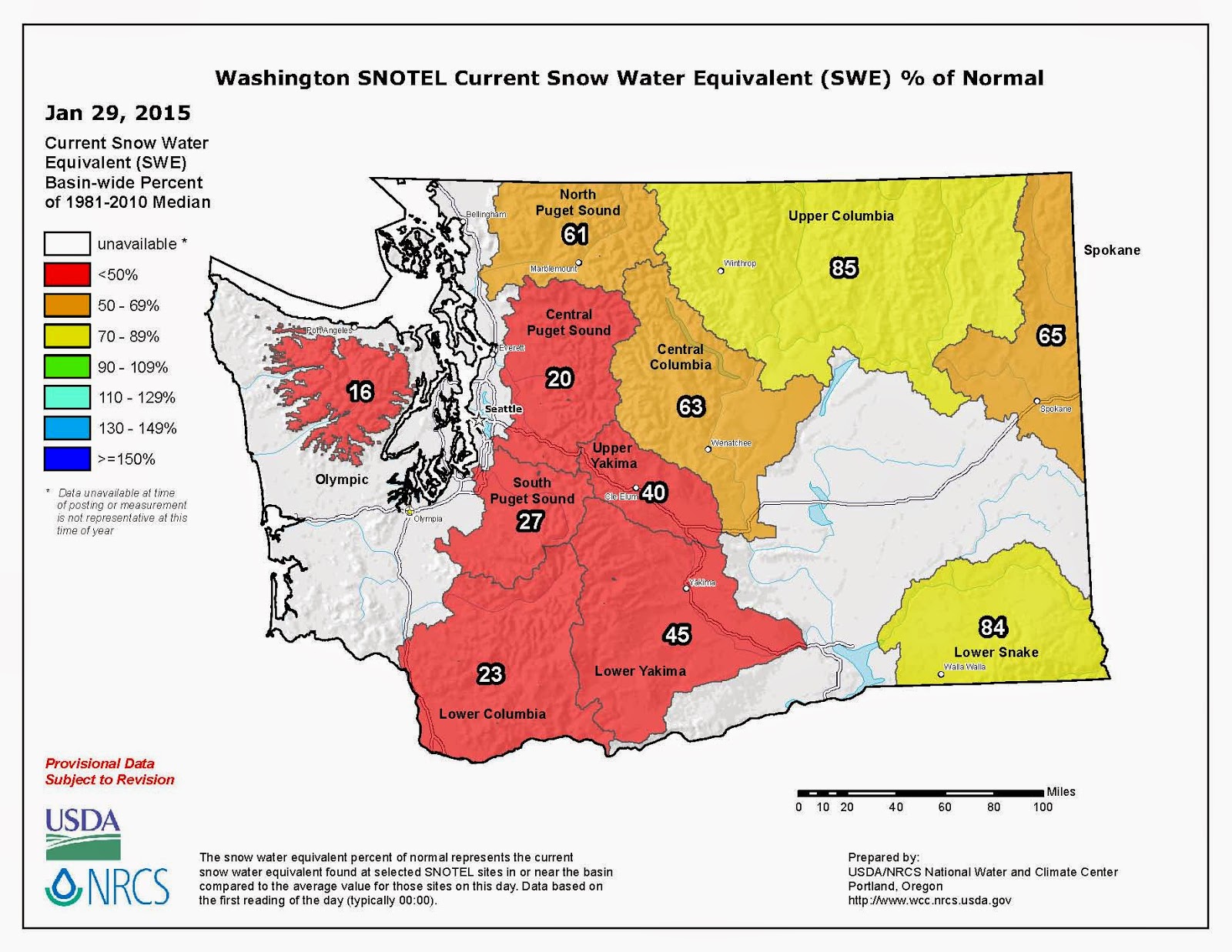
A map showing the snowpack of Washington as a percent of a 30 year average. As you can see all of the state
is below average with several areas having less than half of normal amounts.