Showing posts with label natural resources. Show all posts

Monday, January 22, 2018

Washington Agriculture


As the new Americorps Intern at Cascadia Conservation District, I have taken over teaching our environmental education programs, Wheat Week and the Water on Wheels, in the schools throughout Chelan, Douglas and Okanogan Counties. I really enjoy being able to get out and teach these lessons, not only because they are educating students about crucial environmental concepts, but also because they are teaching the students about farming. Farming is something we have become further removed from as the number of small family farms have decreased across the country.
                However there is hope! In Washington, 89% of our farms are small farms. This is much higher than the national average where only 49% of farms are considered small farms. This impressive figure helps to bridge the gap between the production of food, fuels, and fibers and the consumer. Being aware of what goes into the production and the hard work, dedication, and care put in by farmers is extremely important. This is one of the many concepts I try to teach and convey to my students. It is not just going to the grocery store. I try to get them to think on a larger scale.
     Between crops and livestock, Washington agricultural products were valued around $10.7 billion for 2015. That figure represents only the products that are grown and raised here in Washington, it does not include the food processing industry that is also crucial, contributing more than $20 billion to the economy. Apples are a huge part of the agriculture industry here. Washington produces 70% of the apples in the USA. Here in Wenatchee, the apple capital of the world, we have rich volcanic soils combined with irrigation fueled by the Columbia River basin, providing quality growing conditions for ample yields.
                Farmers are not just growing the food that will end up on our tables, they are growing the fuel we use and the fibers we need. Farmers are crucial to our society and we are lucky to have as many amazing farmers as we do in our state. We depend on the agricultural industry not only to provide us with the food, fibers, and fuel for our day to day lives but we also rely on them for environmental stewardship, as they are caring for and managing many acres of land.
                Taking good care of the land is critical to farmers. They depend on healthy productive lands to grow their crops and keep their operations sustainable into the future. By implementing environmentally sound practices more commonly referred to as “Best Management Practices” or BMPs, farmers are protecting our soil, water, and even the air we breathe. 

If you are a famer and are interested in making improvements to your land by implementing some more Best Management Practices, check out our landowner assistance page on our website,  http://cascadiacd.org/landowner-assistance_239.html and see if any of the cost share programs might be for you and your land. Contact Sandy Letzing at (509) 436-1601 or sandyl@cascadiacd.org if you have any questions regarding the landowner assistance programs.

If you are missing the amazing farmers markets that we have here in Washington, check out http://wafarmersmarkets.org/washingtonfarmersmarketdirectory/ for more information on where to find farmers markets during the year and look forward to the spring to come.


Thank you for reading, please leave any comments, questions, or concerns below!

-Justine 


Did you Know?


The modern domestic apple originated from what is now Kazakhstan in the Tien Shan Mountains.


The only apple native to North America is the crab apple.


Works Cited

Friday, January 20, 2017

Why Are Native Plants Important?

Native plants are an integral part of a healthy landscape. There are a number of reasons why that is, including but not limited to that they are naturally low maintenance because they often require less water than traditional sod. They do not require large amounts of fertilizer or pesticides that plants from other places may need. If the plants are native to your area, they have even coevolved with the wildlife as well. That means that many native bird species also rely on native plants as a food source.

By Akos Kokai (Native plant demonstration garden) [CC BY 2.0 (http://creativecommons.org/licenses/by/2.0)], via Wikimedia Commons


Non-native plants, otherwise known as invasive species, can wreak havoc on a delicate ecosystem.

Below is a list of a few reasons why invasive plants are worse than native plants for your landscape.

http://solveoregon.org/why-we-care/invasive-plants

Air, Noise, Water Pollution
In terms of water conservation and the precious value that water is in an ever growing world, using water wisely is of paramount importance. Unfortunately, watering lawns can contribute to waste of a natural resource, “30 percent of water consumed on the East Coast goes to watering lawns; 60 percent on the West Coast. (Redesigning the American Lawn)” (National Wildlife Federation). Invasive species also require an increased amount of pesticide use that can pollute waterways. 

Harm to Biodiversity
Native plants also provide critical habitat to a variety of pollinators. Certain insects have coevolved to only eat certain plants, and if invasive species have taken over then there is less and less food for those insects to eat. That in turn causes there to be less food for the birds that feast on insects. Check out an excerpt of a film about the important impacts that native plants can have on a landscape:


Consumption of Natural Resources
Invasive plants often outcompete native plants because they usually lack their natural enemies in a foreign environment. As a result, invasive plants can strangle a hillside or choke a waterway easily. Alternatively, native plants natural abundance is due in part to the fact that they are native to your climate, and thus have adaptations for the amount of water and the soil moisture in your particular area (Backyard Conservation...).  

 Impacts to Public Health and Safety
Invasive species do require an increased amount of maintenance. Increased chemical use can lead to harmful effects in wildlife and humans (Benefits of Naturescaping). Extra fertilizer may also be required to maintain a green lawn. If you use native plants, and decide to compost in a natural garden, your soil will not need as many chemicals to provide good nutrients to your plants!

Cost and Labor Intensive
The cost of upkeep for a traditional lawn is about $700 per acre per year, as opposed to the care of a wildflower meadow at $30 per acre per year (About Native Plants). The equipment used in the upkeep of a typical suburban lawn includes lawn mowers, leaf blowers, and the occasional chain saw. These pieces of equipment emit as much hydrocarbon in one hour as a typical auto driven 50 miles. (National Vehicle and Fuel Emissions Lab, Ann Arbor.) Every year, a typical lawn requires 40 hours of maintenance, which is the equivalent of a one-week vacation (Benefits of Naturescaping). The noise pollution from a lawnmower alone can be enough to make anyone upset on an early Sunday morning.

Boring Landscapes
Avoid monoculture! Aesthetic concerns aside, native plants offer a wide variety of shapes, colors, and textures for your yard.

Why spend all of that time maintaining an unnatural landscape? Instead, give native plants a try. You won’t be disappointed!

Below is a preview of an excellent documentary film focused on the dangers of invasive species in Oregon. Washington state deals with a lot of the same resource problems as Oregon, and it is an informative piece on various issues in the Pacific Northwest. 


Convinced that native plants are the way to go? Don't know where to start? Come learn more at Cascadia's FREE Native Planting 101 Workshop!!!

RSVP today for our native plant workshop, Saturday, February 11th from 12:00-4:30 pm at the Wenatchee PUD auditorium!

Our plant sale ends by March 1st, so place your order today to ensure you get what you want. 

To order native plants, download a form HERE!

Cheers!

~ Ava

Works Cited

"About Native Plants." http://www.nwf.org/Garden-For-Wildlife/About/Native-Plants.aspx. National Wildlife Federation. Accessed 1/13/17. 


“Benefits of Naturescaping.” http://www.plantnative.org/how_benefits.htm

Green, Danielle. “Greenacres: Landscaping with Native Plants.” US EPA. https://archive.epa.gov/greenacres/web/html/index.html Last updated on 2/21/2016.

Idaho Native Plant Society. Landscaping with Plants of the Intermountain Region. https://www.blm.gov/style/medialib/blm/id/publications.Par.71153.File.dat/Landscaping-small.pdf

“Let’s stop these silent invaders.” http://solveoregon.org/why-we-care/invasive-plants. Accessed 1/13/17. 

“Why Native Plants Matter” Audubon society http://www.audubon.org/content/why-native-plants-       matter. Bird Friendly Communities Blog. Accessed 1/13/17.


Thursday, February 12, 2015

What Cascadia Does

“Oh yeah, the conservation district… That must be, uh, some interesting work?” Verbatim, my loquacious uncle’s reply when I told him what I’ve been up to and where I’m working. Like most, my uncle had no idea what a conservation district is. Surprisingly, I’ve had a hard time getting people to understand just what a conservation district does. There is no easy elevator speech for conservation districts. So I’d like to use the next few blog posts to highlight some of our programs.

 Officially, from the National Association of Conservation Districts’ website,"Conservation districts are local units of government established under state law to carry out natural resource management programs at the local level. Districts work with millions of cooperating landowners and operators to help them manage and protect land and water resources on all private lands and many public lands in the United States" (http://www.nacdnet.org/). In short, it is an organization that seeks to help people take care of the land and environment around us. Cascadia’s landowner assistance program is one of several ways we do this.

A hedgerow, planted to attract pollinators and other beneficial insects.
 The landowner assistance program is for landowners in Chelan County, excluding those within Wenatchee and Chelan city limits, who are looking for technical and/or financial assistance in installing best management practices (land use practices which mitigate environmental degradation). This could mean replacing outdated irrigation, restoring buffers or riparian zones or even soil testing. Because of this area’s predominant agriculture industry, its proximity to anadromous fish habitat and its proclivity for wildfires, much of our landowner assistance is for landowners with streamside, farmland, orchard or forested property. That said, if your land does not fall in one of these categories, it does not disqualify you for such assistance.

An excellent example of landowners who not only took advantage of our landowner assistance program, but also became role models for environmental stewardship, was highlighted in a blogpost of ours from November 21, 2011.

If you’d like more information on landowner assistance you can call us at (509) 436-1601, email us at www.cascadiacd.org or just come by our office at 14 N Mission St. Landowner assistance is only a fraction of what we do here at Cascadia, so please come back next week for a look at the Family Forest Fish Passage Program.


With all of the warm weather and rain we’ve had in the last week, today’s snow pack in our area is a measly 63% of the 34 year average.  

Thursday, January 29, 2015

Icons of North Central Washington


With this post we’ll conclude our look at the native plants offered by the Cascadia Conservation District. If you’d like to see the full plant list, make an order or get more information please visit our website.

These final two plants are symbols of our region. The grand ponderosa pine (Pinus ponderosa) and the vine maple often come to mind when thinking of healthy ecosystems in our area.

My favorite tree of all time, icon of the west and reigning top seller in our plant sale is the ponderosa pine tree. Ponderosa pine, colloquially ‘pondo’, is characterized by its orange, scaly, plate-like bark and long green needles which are typically borne in bundles of three. Growing to around 100 feet in mostly open stands, ponderosas often have the appearance of dominating their surroundings. They are also known for smelling like vanilla.

Very well adapted for our climate east of the Cascades, ponderosa pine isn’t just fire tolerant, it depends on fire. With its thick bark a large ponderosa can handle the low intensity fires that were ubiquitous to this area prior to modern forest management. These fires eliminated the pondo’s resource competitors, allowing it proper exposure and sufficient resources. Since management plans have included enthusiastic fire suppression, shade tolerant trees and shrubs have moved into ponderosa stands throughout the west, lending such stands the characteristics necessary for the increasingly large scale fires we’ve been seeing as of late.

As for conservation uses, ponderosa is commonly used in shelterbelts, living snow fences and in riparian restoration. Ponderosa stands make great habitat for squirrels, birds and bats and provide shelter for big game. Because ponderosa needs exposure, it is a seral species which, when mature, can provide the necessary shade for shade tolerant species to return after a significant disturbance. This makes it an excellent native plant choice for post fire restoration.

Vine maple (Acer circinatum) is another iconic native plant in our region. It is a deciduous tree with red and white flowers in the spring, and brilliant red to subdued yellow broadleaves in the fall. Typically vine maple will grow between 10 and 30 feet tall, with shaded specimens reaching the upper end of that range readily and exposed specimens on the shorter side.

Vine maple grows best along streams and moist sites. It prefers shady sites, but can tolerate some exposure.  In more exposed sites it often takes a single-stemmed tree form, while in shade it usually grows as a shrub in clumps and thickets.

With its white and red flowers in the spring and showy colors in the fall, vine maple is a common choice for those looking to use native species to beautify their landscaping. It is also used as a streamside stabilizer, as a pioneering species at disturbed sites and is an important food source for birds and large and small mammals alike.

Again, if you’re interested in ordering any of our plants, need more information or would like to sign up for our native planting workshop, please see our website.

Today’s Central Columbia River area snowpack is currently at 63% of its 29 year average (USDA/NRCS National Water and Climate Center, http://www.wcc.nrcs.usda.gov).

Friday, May 30, 2014

May Wrap Up

May is drawing to a close and I realize that this is the first (and only) blog post for the month. It’s been a busy month with most weeks full of a variety of activities that demanded my attention and kept me out of the office. However, I didn't want to end the month without highlighting a few of the things that occurred, so here they are.
 Several weeks in April and May saw me helping with science field days around Wenatchee. First was a 5th grade shrub steppe experience, next a similar experience for 1st graders, after that a kindergarten walk, and finally at the end of the month a 4th grade science day revolving around fish and hydroelectric power. That seems like a lot, but for the most part I really enjoyed all of it. I helped with plant identification and counting, native wildlife, ecosystems, and fish statistics. It was good that I had a presence there, both as an Americorps member and as a representative of Cascadia. Cascadia has an effect, both directly and indirectly, on many of these ecosystems through their work in conservation and restoration. It’s helpful to be able to introduce the kids to the ideas of natural ecosystems and the organizations that are involved with preserving them.
May’s next event was Kids in the Creek (KITC). KITC is a program put on by Cascadia in partnership with the US Fish & Wildlife Service and the Forest Service, along with many others. The program is designed to get young high school students hands on science through a variety of stations. Half of the stations are ‘dry’ and include: water quality, fish health, and riparian vegetation. The other half are ‘wet’ stations. Requiring the students to don waders and get in the creek (hence the Kids in the Creek). These stations include: invertebrate investigation, stream health, and flow. KITC occurred in early May and brought roughly 300 students through the 3 day program. The overall goal is to connect the classroom science with real-life experiences, showing students that science is not just boring class time.
The third week of May I was out of the office driving halfway across the county to Minnesota to canoe for a week, and then driving back to Washington. I mention this because of some of my observations along the way. In many locations on my drive I noticed fields tilled right up to the water lines on creeks, rivers, and lakes. There was no buffer. Anything applied to the crops could run into the water. Erosion was rampant in spots with 10 foot vertical banks slowly eating into fields because there was no riparian vegetation to secure the soil. It was obvious the natural ecosystem had been destroyed in many areas leaving only countless fields behind.
That’s about it for the month of May. Everything that occurred managed to shrink to a manageable text level, but only because I don’t want to get into all the details. I spent much of my time at education and outreach events, which is great because that’s what I’m here for. I feel like several hundred students learned a little more about the environment through my actions.

Friday, January 17, 2014

Beware a Mild Winter

I grab my jacket and slide it on as I step outside. I walk a few paces and realize I’m already too warm. It’s halfway through January and the temperatures outside are hovering around 50o. It’s only snowed in town a couple times all winter. The sun is shining, and it seems like spring is just around the corner. Too bad it’s not. Winter will be back. However, it’s still nice for a break, right? It may feel nice, but this weather is not without consequences. What might those consequences be? Well, let’s take a look.

First, the lack of snow is a big problem. Yes, I love having clear roads as much as anyone else. The headache of waking up with six inches of new snow and realizing I’m going to spend an hour or two of my day shoveling/plowing just to clear my driveway and paths is not pleasant. Neither is dealing with slick roads and all the other people out on the slick roads. (Funny how everyone always thinks it’s the other person that’s the bad driver.) I love being able to travel the mountain passes with peace of mind.
So why is the lack of snow such a problem? We receive very little precipitation throughout the year. What precipitation we do receive mainly comes as snow in the winter months. That buildup of snow in the mountains provides a water source for the rest of the year. When spring arrives and the temperatures begin to rise in the mountains the snowpack starts to melt. This melt feeds creeks, rivers, and lakes throughout the spring and summer, and starts to taper off in the fall. Without winter snow the snowpack won’t build up. Without a proper snowpack water flows will be hampered.
What happens when there’s less water? Well, that’s what we call a drought. Water suddenly becomes a hot commodity. Let me list a few things that rely on water flowing from the snowpack: dams, crops, orchards, lawns, drinking water, animals, fish, forests, and water recreation. I could keep going. The point is when there’s not enough water available everything loses. First go the unnecessary items. You’ll be asked to conserve water by watering your lawns and gardens less (or stopping all together if it’s severe enough), showering more efficiently, etc. Next, farmers with newer water rights may have to water their fields and orchards less. Of course someone could keep pulling out water and further lower the water levels, but that starts to affect the fish. Less water means streams, rivers, and lakes have less area to swim in. Less water means that the water will warm up quicker and get hotter than normal. Fish like cool water. An almost afterthought to most of us is the forests. Our forests do most of their growing in the spring from the influx of water from the snowpack. The less there is and the sooner it melts off leads to dry forests earlier in the year, increasing the chance of and severity of forest fires. Less water in the rivers lowers the amount of power that dams can generate.
Starting to get the picture? Snow is necessary. We must embrace the winter in order to enjoy the spring, summer, and fall. Without the winter snow, the rest of the year may be miserable.

My second point revolves around this warm weather we’re experiencing at the moment. A warm, sunny day seems nice, and one or two might not be that harmful, but extended warmth can lead to problems. Why?
Most plants go into dormancy for the winter. That means they shut down most of their natural processes. They flood their cells with chemicals that protect themselves from the winter cold, and wait it out. Generally, they wait until early spring to start the growth process. But what triggers their growth? We label March 20 as the first day of spring because it’s the spring equinox. (Our seasons change on the equinoxes and solstices.) However, a plant can’t read a calendar and decide when to break dormancy by a calendar date. A plant breaks dormancy on external cues. Mainly cues involving temperature.
See where I’m going with this? If the weather stays warm for too long in the middle of winter the plants might be tricked into thinking it’s time to break dormancy. They start their new growth leading to tender new shoots and flowers. The weather then crashes back down to normal winter temperatures. The new plant tissue can’t handle freezing temperatures and therefore dies.
Field crops might not be affected by this at all. A farmer realizes that these warm temperatures aren’t sustainable, and therefore doesn’t plant anything until spring. But trees aren’t this smart. They start to grow and head towards blooming. When the temperature crashes the new buds are killed off. No blossoms that year, and thus no fruit.


A mild winter like this seems nice, one with a warm, sunny week in the middle of January, and only a day or two of snowfall in town. You may be reveling in the decent driving conditions and your snow shovel gathering dust in the garage. But you shouldn’t be. This lack of snow and warm temperatures are only going to cause much bigger headaches later in the year than a normal winter causes on its own. I’m hoping that the temperatures drop to normal and we get massive snow falls the rest of January, February, and into March. Otherwise it’s going to be a dry rest of the year. 
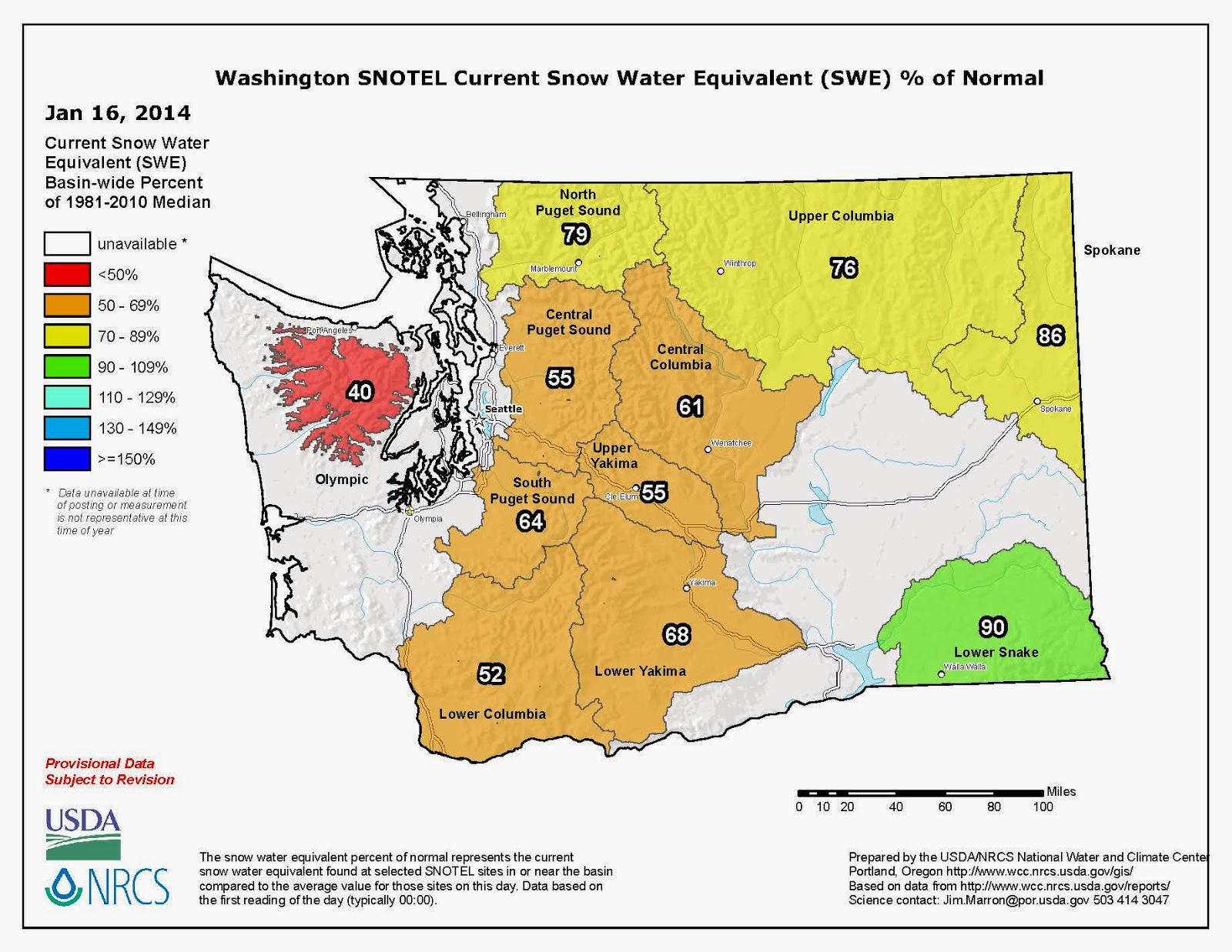
The numbers are starting to look up from previous measurements, but are still far below where they should be.

Thursday, January 2, 2014

Water, Water, Everywhere

Water controls our lives. The earliest civilizations in the world grew around rivers: Nile, Euphrates, Tigris, Yellow, and Indus. Water remains necessary for growing food. (Just try growing something without water, and tell me how it works out for you.) We remain slaves to it. When we’re thirsty water dominates our thoughts. All we can think about is clear, liquid gold crossing our lips and quenching our parched mouths. Try to go a day without drinking anything. It won’t be easy. Go outside in hot weather and see if you can last an hour or two before the cravings kick in. Water is the single most necessary substance for our survival. The only other thing that comes close is the sun. And the benefits of the sun can be somewhat compensated for by manmade contraptions (heat, photosynthesis, vitamin D). As far as I know we haven’t invented a water substitute yet.
Water flows in a cycle. The amount of water on the Earth right now is pretty close to the same amount that’s always been here. When it rains the water collects on the ground. The ground absorbs some of the moisture, but once the ground reaches saturation the rain that keeps falling starts to flow. And where does it flow? Downhill of course! First the rain forms trickles, and these trickles merge together to form rivulets. Rivulets flow until they meet other rivulets and come together to make creeks. Creeks pour into other creeks and form rivers. Rivers combine to make even larger rivers. Rivers surge into the world’s oceans. From here the water evaporates into the air and is used to form clouds. These clouds then drift back over the land until they release water on the ground below. The cycle continues.
This shows the flowing of water through the system. From the oceans to the 
clouds to precipitation to flowing water and back into the ocean. 
The cycle is in continuous operation.
The cycle can be interrupted. The water might take a detour, but eventually it will get back into the circle. Consider the water in your home. That water was pulled out of a river, stream, lake, aquifer, or well and pumped into the water system. This water flows through pipes until it comes out of the faucet in your home. You fill a glass with water, drink it, and after some time you expel it back out. From there it flows into sewer system, travels to a sewage plant, and after treatment it’s released back into the water system. Water very rarely permanently leaves the cycle. The water you just drank could very well be the water a dinosaur drank millions of years ago.
Most of the water that flows down our rivers doesn't come from rain though. It comes from snow that accumulates through the winter and slowly melts off during the rest of the year. Without the snow pack our rivers would be a lot smaller and may even cease to exist except as seasonal water flows during wetter times of the year. Every time you look outside and dread the snow falling because it makes a mess of driving try to think instead of the benefits of snow. Snow enables us to take this area that’s basically a desert and turn it into lush farmland.
I would guess that most of us take water for granted. We turn the faucet on and expect water to flow out. But where does our water come from? If you live in Wenatchee and surrounding parts of Chelan County your water comes from the Eastbank Aquifer, located under parts of Lincoln Rock State Park and extending south to Rocky Reach Dam. Cashmere draws their water from wells and some surface water from the Wenatchee River. Leavenworth pulls their water from Icicle Creek and wells drilled near the golf course. Chelan pulls its water from Lake Chelan. Entiat pulls its water from community wells.
The three main watersheds in Chelan County. Wenatchee on the left, Entiat in the middle, and Lake Chelan on the right.
All three flow into the Columbia River.
How do we keep track of all this water moving around? We divide areas up into various watersheds. Watersheds encompass an area where all the surface water drains to a single point. They are usually bounded by ridges that separate neighboring watersheds. Chelan County is composed of roughly four different watersheds. The Wenatchee River watershed encompasses all the water that flows into the Wenatchee River. The Entiat River watershed takes in all the water draining into the Entiat River. Lake Chelan is its own watershed. The last watershed is made up of water draining from Stemilt Hill and Squilchuck. All of these watersheds drain into a larger watershed, the Columbia River, which drains parts of Washington, Idaho, Montana, Wyoming, Nevada, Utah, Oregon, and British Columbia. The Columbia then flows into the Pacific Ocean on the border between Washington and Oregon.
It would seem that if the cycle is cyclic that there would be no need to conserve water, right? Regardless of how much we use it will just keep flowing through the cycle and return again as rain or snow. If only it were that simple. The issue isn’t that the water stops cycling. It’s more an issue of minimal disruption to the natural flow. The amount of water present every year is not always the same as the previous year. There are averages, but an average comes from several years of data. There’s no guarantee it will reach that level each year. There are so many facets to contend with. Fish, farms, cities, you, and I all rely on water. Do any of us have more right to it than another? The short answer is no. This is why it’s important to conserve, protect, and share our water resources.
For more information on some simple ways to conserve water and protect our waterways head over to http://picturethewenatchee.com/.
A map showing the snowpack of Washington as a percent of a 30 year average. As you can see all of the state
is below average with several areas having less than half of normal amounts.

Wednesday, December 18, 2013

Energy: The Lifeblood of the World

Our lives revolve around power. Power we rely on to charge cell phones, light rooms, and heat homes. Without power you wouldn’t be reading these words right now. (How sad would that be?) Electricity courses through conduits across the earth, the blood of our modern world. Where blood flows there must be a heart to pump it. And the hearts of our electric blood are power plants, making the earth a giant, multi-hearted beast.
Hearts vary across the planet. Small solar panels attached to a roof, struggling to produce enough power to supply a single home. Large dams spanning mighty rivers, feeding entire cities with a constant electrical rhythm. Wind turbines soaring into the sky. Their electric output a slave to the fickle wind. Coal hearts, burning harvested chunks of the planet and polluting the earth with each shovelful. Nuclear reactors, consuming uranium to give us power, but leaving us with radioactive leftovers that we struggle to safely dispose. These plants range from clean, renewable sources with minimal negative effects, to others burning a finite resource that poison the air, water, and ground both near and far.

Grand Coulee Dam. It produces over 7,000 MW at
peak operation.
We are lucky. Most of our power comes from a clean, renewable source. Hydroelectricity supplies most of Washington State with power. Roughly ¾ of all power generated in the state is from dams. Washington generates nearly 1/3 of all the hydroelectric power in the country. The next closest state is Oregon, and it produces less than half that amount.
I really like hydropower. I think it’s a good, long term source of power. Albeit one with a few flaws that people are working on solutions for.  I realize that not everyone feels the same way about hydropower and the dams that supply it. It blocks the natural flow of rivers and impedes the movement of fish. Silt piles up behind it and at times needs dredging. The river ecosystem both above and below a dam is forever altered. Raised water levels flooded towns. People were forced out of their homes and had to retreat to high ground. But I ask you this. Do you have a solution?
If we tore out the dams what would you suggest we replace their power generation with? Coal or natural gas plants that burn limited fossil fuels, and pump CO2 into the air and contribute to global warming? Nuclear plants that don’t pollute the air, but leave us with barrels of radioactive waste that remains harmful for thousands of years? I’ve heard a lot of people complain about the negative impacts of dams, but I’ve not heard many sensible solutions. Dams remain the lesser of evils.

There are other clean, renewable energy sources available. Solar and wind power remain underutilized. Geothermal energy remains viable in areas with geology that allows its use. Tidal generation is available on certain ocean coasts.
Even though a wind farm covers large areas of land most of
it remains usable for agriculture or wildlife.
Wind power is renewable, clean, and relatively harmless. Some birds and bats die each year when they run into the large blades (it averages out to a few birds per turbine per year), but it’s just a modern day evolutionary selector. Its impact to the ground it sits on is minimal. A wind farm may cover several thousand acres of land, but after construction is complete, the impacted area is a small fraction of that amount. Another concern is aesthetics, not everyone likes to see an army of spinning blades in their panoramas of the landscape. The biggest issue with wind turbines is supply. The wind doesn’t always blow. Even when placed in an area of fairly constant wind there will be days with no wind. Wind power requires a backup if the wind is still. This often takes the form of another operating power plant capable of taking up the slack when necessary.
Part of the solar array at Nellis Solar Power Plant.
Solar power takes a variety of forms. From photovoltaic cells (which directly convert sunlight into electricity) to concentrated solar power (which focus the sunlight and use it to heat a substance and from there function similarly to other power plants).
Photovoltaic cells are the generic form of solar power. They’re the panels that can be seen on some roofs or as free standing structures. They can be a little expensive, but the costs have gone down from their original prices as well as the efficiency going up. The biggest downfall is when they work. The sun has to be out. Effectiveness decreases under cloud cover and they stop working completely at night. Surplus power must either be stored (in batteries) or an alternate power source must be used during times of low or no generation.
Concentrated solar power relies on heat, as does most generated power. A very basic explanation of how they work is as follows. A field of mirrors (picture one or more football fields) would reflect the sunlight either onto a single tower and heat a substance to a molten flowing state (several hundred degrees), or it would reflect on several different pipes running through the field. This molten substance then is piped through water heating it until it boils, produces steam, and builds pressure. (At this point it becomes like almost all other types of power generation.) This steam is then used to spin a turbine, which spins a generator and produces electricity. (Hydro power is similar except it uses liquid water to spin the turbine instead of steam.) This type of solar power has the benefit of being able to continue working after the sun goes down due to the stored heat in the substance.
A depiction of the different styles of
concentrated solar power.
Tidal power relies on tides flowing back and forth to produce hydroelectric power in ways similar to a dam across a river. Geothermal power uses heat from the earth at active geological sites to produce steam and generate power.

Size also remains a factor. Picture Rocky Reach Dam, it looks pretty big, right? Let’s say the dam and associated electrical equipment takes up ~100 acres. It also creates a reservoir behind it 43 miles long with a surface area of 98,000 acres, almost all of it usable for water activities, irrigation, and other uses. Rocky Reach has a max output of 1300 MW (1 MW is enough to power 225 to 300 homes). So 1300 MW would power anywhere from 292,500 homes up to 390,000 homes. Wenatchee has a population of ~32,000 people. If an average household is 4 people that means there are ~ 8,000 homes in Wenatchee. (Of course I’m leaving out apartments, businesses, etc.)
The Wild Horse Wind Farm outside Ellensburg covers ~10,000 acres and has a max output of 273 MW with 149 wind turbines, enough power for 61,425 to 81,900 homes. It would take nearly 5 wind farms of that size to produce the power of that one dam.
Nellis Solar Power Plant in Nevada produces 14 MW on 140 acres, roughly the size of Rocky Reach Dam. This output is enough to power 3,150 to 4,200 homes. There would need to be nearly 93 plants of similar size to produce the same power as that one dam. And it would need to cover an area of ~20 square miles. Picture the entire city of Wenatchee replaced with fields of solar panels.

A view from the back of Grand Coulee.
My point to all this is threefold. One, there are lots of options for producing power that aren’t as environmentally harmful as current methods. Several options are renewable, clean (more or less), and environmentally friendly (mostly). Second, almost all power generation is going to have people on both sides of the argument. People will be wholeheartedly in favor and vehemently opposed. Third, size is a factor. The fact is some of these options aren’t viable in all location because of the space necessary.


Tuesday, December 10, 2013

Our World Supplied by Trees

Taiga forest in Alaska. Taiga forests exist in northern 
latitudes and consist mainly of coniferous trees.
Look out the window and consider what you see outside. There’s a good chance a tree is on that list. Trees can be found almost anywhere. They cover huge tracts of land in areas ranging from the equator to arctic regions. How often do you stop and think of everything that trees provide? Take a guess at the number of products derived from one species of a tree or another. Would you say 100? 500? 1000? The actual number is nearer to 5000. That’s right. 5000 products rely on a product derived from a tree. Industries ranging from construction to health care rely on trees.
Peeling bark from a Pacific yew.
When I say health care relies on trees, I don’t mean wooden tongue depressors. Several drugs found their origins in chemicals produced by trees. Aspirin was first isolated from the bark of a willow tree. The cancer drug, Taxol, was found in the bark of the Pacific yew. Quinine, an antimalarial drug, is derived from the bark of the cinchona tree. Eucalyptus oil, used in many cold medicines, is extracted from the leaves of the eucalyptus. I could keep listing more drugs, but I think you get the idea. The amazing thing is this is just a fraction of the possibilities. There are still countless tree species that have yet to be studied for their medicinal properties.
Trees supply our paper. The list of products that use paper is astounding. Books, newspapers, posters, brochures, etc. are all produced from paper. Paper gave us the means before computers to spread information around the world and make it available to the masses. Cardboard is produced in much the same process and is just as useful. And regardless of whether you consider paper environmentally friendly, it does remain a completely renewable resource. Computers, however, are not renewable. Every computer is built out of materials that are finite. Think about that next time you’re trying to save the environment reading the news on your tablet instead of on newsprint.
A log being rough cut into lumber.
How many buildings could we build without a ready supply of wood? Not many. And they’d probably look a lot different. I realize that many large buildings are constructed from other base materials, but houses still rely a great deal on wood. Lumber cut straight out of the tree is used to frame the house. Added to the wood needed for framing is the collection of plywood, particleboard, fiberboard, I-joists, and glulam beams used in other parts of the construction. All of these are made from processed wood parts. Most of it is wood that would be unusable otherwise, and is processed with an adhesive to create these uniform products.
What about all the food we get from trees? I realize we don’t generally eat the wood itself, but trees produce many of our favorite foods. Apples, cherries, pears, oranges, and several other fruits grow on trees. Walnuts, pecans, almonds, and other nuts do as well. These crops represent an important portion of our diets and for those that grow them an important source of income.
Latex flowing out of tree bark into a collection vessel.
Rubber comes from the refined sap of a few species of trees, but the most common tree is the Pará rubber tree. Granted the majority of rubber doesn’t come from trees. Most of it is produced from petroleum. But rubber trees represent a renewable source of rubber. On the other hand removing natural habitat to grow these trees is not a viable option either. Rubber is used for car tires, without it what would we drive on? We use it to put soles on our shoes. Bouncy balls are made out of rubber, and who doesn’t love a bouncy ball?
A view of the Amazon Rainforest.
Obviously this is just a very small sampling of the vast number of products that come from trees. And while I’ve only listed a few I hope these stand out and show the importance of trees in our everyday lives. Without trees what would we have? Not much. Consider the importance of wood in just two items: lumber and paper. Where would our society be without these two things? Would we have advanced to this point without them? My guess is no.
I realize that many products have switched from wood to other materials. Sometimes this is because the other material is better for that use. Other times it’s because the other material is cheaper. But how often is that other product renewable? Unless it’s also a product that grows it’s probably not sustainable. I’m not saying to run out and start cutting down trees because they’re so awesome and can be used for many things. Improperly managed trees will not remain a renewable resource for long. But proper management and utilization of trees can allow us to keep using the plethora of items that are produced from them.

Come back next week for another post.

Josh


Wednesday, November 27, 2013

Happy Thanksgiving

Sunshine's first peak through the trees on a summer morning up in Entiat Meadows.


A view of some of our wonderful shrub steppe.


As Thanksgiving Day approaches it’sappropriate to think about everything that we have to be thankful for. There’s always the old, traditional choices of friends, family, good health, home, food, etc. Nothing wrong with those options of course, but what of the other options we don’t always think about? Things like trees, rivers, lakes, snow, rocks, sunshine, and mountains. All these things are a product of our environment and where we live. And it’s worth taking the time to look at them and appreciate what they offer us.
Imagine the world. Think of the variety between places. Freezing snowscapes where the snow lies as a blanket much of the year. Barren desertscapes covered in sand, the wind constantly reshaping the ground. Watery oceanscapes where you’d need gills to fully appreciate the life under the surface.
Snow lining a creek in late winter.
When you stop and think about all the options out there you realize what we have here is not something to forget and ignore. It’s something to appreciate and be thankful for. We live in an area with a great abundance and variety of natural resources. Our ecosystems range from shrub steppe to mountain to forest to alpine to freshwater. There’s a little of it all here.

What use are the rocks and the mountains you may wonder? They provide us with vistas and sceneries to ponder. Being so tall they also trap the snow. And keep it up high where it can accumulate. The snow provides us with a winter playground perfect for skiing, snowshoeing, and sledding. But it also melts in the spring, filling creeks, lakes, and rivers with fresh water all year long. This water in turn provides for us in many more ways. It provides a home for the fish that we like to catch. A source for our water hungry crops, which in turn provide us with the food we enjoy eating. This water also provides us with our low cost, renewable, and relatively clean power supply.
The last vestige of snow in Cow Creek Meadows.
The trees in the forest provide for us too. They give us lumber to build our homes and fuel for our fireplaces. We get to enjoy their beauty from afar and up close. They shade us from the sun’s heat by a remote lake or creek. And perhaps most importantly they provide us with oxygen to breathe—while at the same time pulling carbon dioxide out of the air.
The sunshine is perhaps the most useful of all. For without it nothing would live here either big or small. The sun warms us with its soft, yellow rays. Though it may not seem like it on a cold winter day. Without the sun nothing could grow. For the plants need it to photosynthesize as many of you know. The sun gives us our glorious summer. But it can also burn you, which is a small bummer.

When Thursday comes round and you’re ready to eat. And you’re starting to carve your favorite roast meat. Just remember all the things that our outside around you. And maybe this year try to give thanks for them too.


Snowmelt flowing down Ingalls Creek.
Remember all that Cascadia is offering right now. There’s the Native Plant Sale that still has plenty of plants left to choose from. We’re also hosting a Native Planting 101 workshop on February 8, 2014 from 12:00 PM - 4:30 PM. It’s a perfect opportunity to learn about ways to use all the native plants you can purchase from the Plant Sale. Last, but not least, we have 2014 Picture the Wenatchee Watershed Calendars. The calendars feature winning photographs from our photo contest earlier this year. Visit our website, www.cascadiacd.org, and click on the links down the right side to find more information about these three things as well as order forms to order your native plants and calendars.
The beginning of the Entiat River.