Showing posts with label watershed. Show all posts

Thursday, December 8, 2016

Little Chumstick Creek Community Tire Clean-Up Day

In the summer of 2016, a property was foreclosed adjacent to Little Chumstick Creek.  During the clean-up process, a non-local contractor avoided dumping fees by disposing of 300-350 tires directly into Little Chumstick Creek.  After several months of frustrated neighbors working with the bank that owns the offending property, and pressuring the responsible contractor to remedy the problem, the neighborhood had little success.  During the recent implementation of a Cascadia Conservation District stream restoration project on adjoining property, the neighbors reached out to see if the CD could assist with removal and disposal of the tires.
Tires illegally dumped in creek

Volunteers hauling tires out of creek
AmeriCorps member Ava is keeping track of signing in volunteers
Little Chumstick Creek is a tributary of Chumstick Creek, which has been identified as critical steelhead and salmon habitat in the Wenatchee River Watershed. Streams were re-opened to fish passage in 2012 after 13 fish barriers were removed and replaced with cast concrete bridges.  Following the barrier removal, endangered steelhead and spring chinook have increased use of the creek which offers protection to juveniles during high water events in the Wenatchee River, and cold water for spawning during peak summer temperatures.


Most of this ~15 mile watershed has been utilized for agriculture throughout the 20th century, which has resulted in severally degraded habitat throughout much of the watershed.  Cascadia Conservation District has partnered with Washington Department of Ecology to make stream restoration a priority in the Chumstick watershed, and this project area represents an excellent example of an area in need of restoration and clean-up to improve habitat as well as water quality and quantity.
Semi-trailer used to haul tires away from site


The district hosts 1-2 volunteer clean up days in each of the Chelan County Watersheds each year. Our efforts are directed towards building relationships within the community we serve, as well as local by-in to continue implementing restoration projects in the area. 


Crew after helping to remove tires from the creek


On Saturday, December 3rd, Cascadia hosted the tire clean-up day. To make the clean-up possible, Chelan County Solid Waste donated use of a 28 foot semi-trailer to haul out tires and pay for the cost of disposal. We had about 18 volunteers attend the event and were able to remove about 350 tires in only two hours! We look forward to continue making progress in habitat restoration throughout Chelan County. 

Wednesday, May 20, 2015

Kids in the Creek!

On May 5, 6 and 7 approximately 300 high school students found themselves on the scenic grounds of the Entiat Fish Hatchery for the annual Kids in the Creek event (KITC). KITC is a hands on outdoor education program in which high school biology students study  stream ecology on the Entiat River. Thousands of North Central Washington students have experienced this unique learning opportunity since its inception in 1992.

Each day at KITC students are split into six teams which rotate between six learning stations throughout the day. Each station is led by resource professionals (Cascade Columbia Fisheries Enhancement Group, Chelan County Natural Resources Department, United States Forest Service, Washington Department of Fish and Wildlife, Team Naturaleza, Wenatchee School District, Trout Unlimited, Ponderosa Community, AmeriCorps and the Public Utility District) and focuses on key components of stream ecology.

Invertebrate Investigators- At this station the students dawn baggy, clown-sized waders and take to the stream with nets to collect macro invertebrates. Using microscopes, students compare their samples with identification charts to determine which species they’ve found and get an indication of stream health.

Riparian RX- Students at this station take a walk through the Entiat River’s riparian zone learning about adaptation, the function of riparian zones, stream bank restoration and flora and fauna interrelationships. Students are exposed to field techniques and tools used to determine ground cover, canopy cover and overall riparian health.

Habitat Sense – At habitat sense students examine physical aspects of the river and discuss what good fish habitat looks like. These attributes include riffles, glides, pools, substrate and embeddedness.

Fish Health- As the station title suggests, the focus here is fish health and the environmental factors that affect fish. Students also learn about fish anatomy and environmental stressors.

Stream Flow- At this station students use mathematical equations they’ve learned in the classroom to calculate the stream flow of a side channel of the Entiat River. After calculating the flow, the students discuss what varying flows mean for the ecosystem, especially at extreme high and low flows.

Water Quality- Here, students learn to measure the pH, turbidity, dissolved oxygen and temperature of a river. They then use these measurements to discuss and quantify stream health.


Upon completing each station, at the end of the day, each team is charged with coming up with a management plan for a swath of riverside property. These plans are then presented to peers and several resource professionals who critique each plan.

This year’s KITC was a huge success. Everything went just as planned and everyone involved learned something they could take with them. A few of the participating Wenatchee High School students were asked what they learned at KITC. This is how one replied: “it is important to us to have healthy streams…we really affect our watershed.”

Cascadia would like to thank Entiat Fish Hatchery for providing a beautiful venue, Alcoa and South Douglas Conservation District for their funding, and the Entiat Volunteer Service group for all their hard work and support. We would also like to thank all the resource professionals who came out to share their knowledge with the next generation of land managers!

Below are more Wenatchee High School students’ replies when asked what they learned at KITC.
* How important riparians are; why it is important to us to have healthy streams; how we really affect our watershed.
* Learned it's hard to catch a fish; fish are good at hiding; construction sites are way too dirty.
*That fish need healthy/non-polluted water to live; all streams have different habitat for different bugs; that biologists have very hands on jobs.
* It's very important to keep our environment clean for the Wenatchee watershed.
* That learning can be fun; you don't always learn in classrooms; hands on is good.
* How much the scientists care; how interesting macroinvertebrates are; how fun it was.
* It was fun to learn more stuff about the land; I thought it was going to be boring but it was fun; that fish and trees need to be helped and saved from being turned into stores and homes.


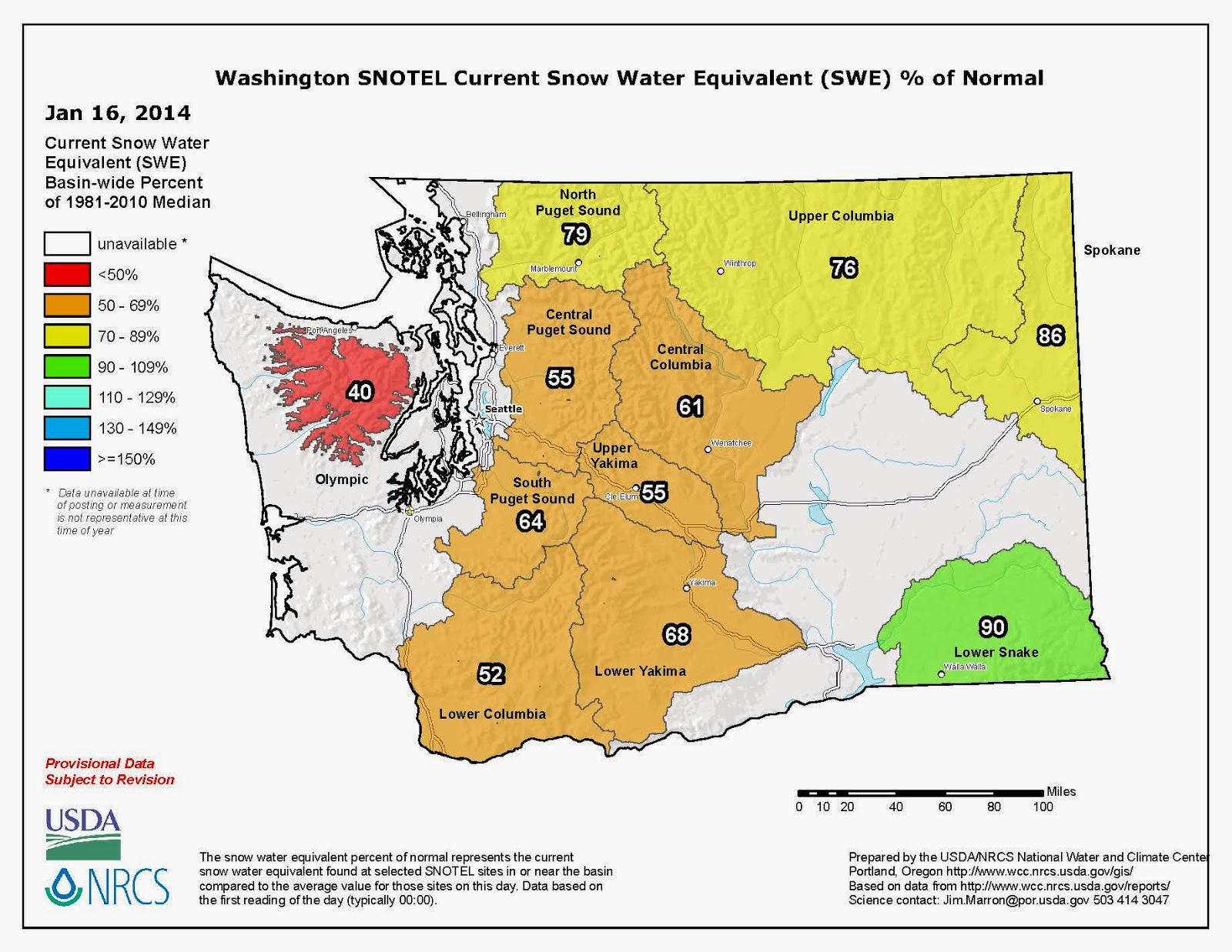
Today's snowpack in North Central Washington is 31% of its 29 year average (ftp://ftp.wcc.nrcs.usda.gov/data/water/wcs/gis/maps/wa_swepctnormal_update.pdf).


Friday, January 17, 2014

Beware a Mild Winter

I grab my jacket and slide it on as I step outside. I walk a few paces and realize I’m already too warm. It’s halfway through January and the temperatures outside are hovering around 50o. It’s only snowed in town a couple times all winter. The sun is shining, and it seems like spring is just around the corner. Too bad it’s not. Winter will be back. However, it’s still nice for a break, right? It may feel nice, but this weather is not without consequences. What might those consequences be? Well, let’s take a look.

First, the lack of snow is a big problem. Yes, I love having clear roads as much as anyone else. The headache of waking up with six inches of new snow and realizing I’m going to spend an hour or two of my day shoveling/plowing just to clear my driveway and paths is not pleasant. Neither is dealing with slick roads and all the other people out on the slick roads. (Funny how everyone always thinks it’s the other person that’s the bad driver.) I love being able to travel the mountain passes with peace of mind.
So why is the lack of snow such a problem? We receive very little precipitation throughout the year. What precipitation we do receive mainly comes as snow in the winter months. That buildup of snow in the mountains provides a water source for the rest of the year. When spring arrives and the temperatures begin to rise in the mountains the snowpack starts to melt. This melt feeds creeks, rivers, and lakes throughout the spring and summer, and starts to taper off in the fall. Without winter snow the snowpack won’t build up. Without a proper snowpack water flows will be hampered.
What happens when there’s less water? Well, that’s what we call a drought. Water suddenly becomes a hot commodity. Let me list a few things that rely on water flowing from the snowpack: dams, crops, orchards, lawns, drinking water, animals, fish, forests, and water recreation. I could keep going. The point is when there’s not enough water available everything loses. First go the unnecessary items. You’ll be asked to conserve water by watering your lawns and gardens less (or stopping all together if it’s severe enough), showering more efficiently, etc. Next, farmers with newer water rights may have to water their fields and orchards less. Of course someone could keep pulling out water and further lower the water levels, but that starts to affect the fish. Less water means streams, rivers, and lakes have less area to swim in. Less water means that the water will warm up quicker and get hotter than normal. Fish like cool water. An almost afterthought to most of us is the forests. Our forests do most of their growing in the spring from the influx of water from the snowpack. The less there is and the sooner it melts off leads to dry forests earlier in the year, increasing the chance of and severity of forest fires. Less water in the rivers lowers the amount of power that dams can generate.
Starting to get the picture? Snow is necessary. We must embrace the winter in order to enjoy the spring, summer, and fall. Without the winter snow, the rest of the year may be miserable.

My second point revolves around this warm weather we’re experiencing at the moment. A warm, sunny day seems nice, and one or two might not be that harmful, but extended warmth can lead to problems. Why?
Most plants go into dormancy for the winter. That means they shut down most of their natural processes. They flood their cells with chemicals that protect themselves from the winter cold, and wait it out. Generally, they wait until early spring to start the growth process. But what triggers their growth? We label March 20 as the first day of spring because it’s the spring equinox. (Our seasons change on the equinoxes and solstices.) However, a plant can’t read a calendar and decide when to break dormancy by a calendar date. A plant breaks dormancy on external cues. Mainly cues involving temperature.
See where I’m going with this? If the weather stays warm for too long in the middle of winter the plants might be tricked into thinking it’s time to break dormancy. They start their new growth leading to tender new shoots and flowers. The weather then crashes back down to normal winter temperatures. The new plant tissue can’t handle freezing temperatures and therefore dies.
Field crops might not be affected by this at all. A farmer realizes that these warm temperatures aren’t sustainable, and therefore doesn’t plant anything until spring. But trees aren’t this smart. They start to grow and head towards blooming. When the temperature crashes the new buds are killed off. No blossoms that year, and thus no fruit.


A mild winter like this seems nice, one with a warm, sunny week in the middle of January, and only a day or two of snowfall in town. You may be reveling in the decent driving conditions and your snow shovel gathering dust in the garage. But you shouldn’t be. This lack of snow and warm temperatures are only going to cause much bigger headaches later in the year than a normal winter causes on its own. I’m hoping that the temperatures drop to normal and we get massive snow falls the rest of January, February, and into March. Otherwise it’s going to be a dry rest of the year. 
The numbers are starting to look up from previous measurements, but are still far below where they should be.

Thursday, January 2, 2014

Water, Water, Everywhere

Water controls our lives. The earliest civilizations in the world grew around rivers: Nile, Euphrates, Tigris, Yellow, and Indus. Water remains necessary for growing food. (Just try growing something without water, and tell me how it works out for you.) We remain slaves to it. When we’re thirsty water dominates our thoughts. All we can think about is clear, liquid gold crossing our lips and quenching our parched mouths. Try to go a day without drinking anything. It won’t be easy. Go outside in hot weather and see if you can last an hour or two before the cravings kick in. Water is the single most necessary substance for our survival. The only other thing that comes close is the sun. And the benefits of the sun can be somewhat compensated for by manmade contraptions (heat, photosynthesis, vitamin D). As far as I know we haven’t invented a water substitute yet.
Water flows in a cycle. The amount of water on the Earth right now is pretty close to the same amount that’s always been here. When it rains the water collects on the ground. The ground absorbs some of the moisture, but once the ground reaches saturation the rain that keeps falling starts to flow. And where does it flow? Downhill of course! First the rain forms trickles, and these trickles merge together to form rivulets. Rivulets flow until they meet other rivulets and come together to make creeks. Creeks pour into other creeks and form rivers. Rivers combine to make even larger rivers. Rivers surge into the world’s oceans. From here the water evaporates into the air and is used to form clouds. These clouds then drift back over the land until they release water on the ground below. The cycle continues.
This shows the flowing of water through the system. From the oceans to the 
clouds to precipitation to flowing water and back into the ocean. 
The cycle is in continuous operation.
The cycle can be interrupted. The water might take a detour, but eventually it will get back into the circle. Consider the water in your home. That water was pulled out of a river, stream, lake, aquifer, or well and pumped into the water system. This water flows through pipes until it comes out of the faucet in your home. You fill a glass with water, drink it, and after some time you expel it back out. From there it flows into sewer system, travels to a sewage plant, and after treatment it’s released back into the water system. Water very rarely permanently leaves the cycle. The water you just drank could very well be the water a dinosaur drank millions of years ago.
Most of the water that flows down our rivers doesn't come from rain though. It comes from snow that accumulates through the winter and slowly melts off during the rest of the year. Without the snow pack our rivers would be a lot smaller and may even cease to exist except as seasonal water flows during wetter times of the year. Every time you look outside and dread the snow falling because it makes a mess of driving try to think instead of the benefits of snow. Snow enables us to take this area that’s basically a desert and turn it into lush farmland.
I would guess that most of us take water for granted. We turn the faucet on and expect water to flow out. But where does our water come from? If you live in Wenatchee and surrounding parts of Chelan County your water comes from the Eastbank Aquifer, located under parts of Lincoln Rock State Park and extending south to Rocky Reach Dam. Cashmere draws their water from wells and some surface water from the Wenatchee River. Leavenworth pulls their water from Icicle Creek and wells drilled near the golf course. Chelan pulls its water from Lake Chelan. Entiat pulls its water from community wells.
The three main watersheds in Chelan County. Wenatchee on the left, Entiat in the middle, and Lake Chelan on the right.
All three flow into the Columbia River.
How do we keep track of all this water moving around? We divide areas up into various watersheds. Watersheds encompass an area where all the surface water drains to a single point. They are usually bounded by ridges that separate neighboring watersheds. Chelan County is composed of roughly four different watersheds. The Wenatchee River watershed encompasses all the water that flows into the Wenatchee River. The Entiat River watershed takes in all the water draining into the Entiat River. Lake Chelan is its own watershed. The last watershed is made up of water draining from Stemilt Hill and Squilchuck. All of these watersheds drain into a larger watershed, the Columbia River, which drains parts of Washington, Idaho, Montana, Wyoming, Nevada, Utah, Oregon, and British Columbia. The Columbia then flows into the Pacific Ocean on the border between Washington and Oregon.
It would seem that if the cycle is cyclic that there would be no need to conserve water, right? Regardless of how much we use it will just keep flowing through the cycle and return again as rain or snow. If only it were that simple. The issue isn’t that the water stops cycling. It’s more an issue of minimal disruption to the natural flow. The amount of water present every year is not always the same as the previous year. There are averages, but an average comes from several years of data. There’s no guarantee it will reach that level each year. There are so many facets to contend with. Fish, farms, cities, you, and I all rely on water. Do any of us have more right to it than another? The short answer is no. This is why it’s important to conserve, protect, and share our water resources.
For more information on some simple ways to conserve water and protect our waterways head over to http://picturethewenatchee.com/.
A map showing the snowpack of Washington as a percent of a 30 year average. As you can see all of the state
is below average with several areas having less than half of normal amounts.

Tuesday, September 24, 2013

Fall has Arrived

Sunday marked the official first day of fall for 2013. It’s about time. Summer was long, warm, and, oddly, wet. There were fires, but anymore I expect them during the summer. What I didn't expect was all the rain. That rain led to floods and mudslides in the Clockum and other canyons around the area. The scope of the damage seems surprising at first. But that’s only until you consider the fires from this year and last. Without vegetation the hills had nothing to help soak up the water and hold the soil in place, so down it came—over, under, and through everything in its way.

I say good riddance to summer. It's time for cooler temperatures, shorter days, and changing leaves. Personally, I love fall. I love the smell of damp earth after a quick downpour or a light drizzle. I love wading through a pile of freshly raked leaves.

This time of year always brings to mind apples for me. Harvest is in full swing, and fresh fruit is easily found in abundance. Just stop in at a local fruit stand or the farmer’s market.

All the kids wanted to get in on the action at Salmonfest.
The 23rd annual Wenatchee River Salmon Festival was held last weekend and it seemed to be a good success. Cascadia ran the Rolling Rivers watershed model, and eight different school groups came by for scheduled sessions during the two school days, Thursday and Friday. Saturday was a free-for-all with kids and adults alike stopping by to put their hands in the plastic sand and create watersheds and salmon habitat. At the end of three days, I’m hoping that the few hundred kids learned at least something about the importance of healthy watersheds and the salmon that live in them.

A beautiful sunny morning. This photo would work great for the contest.
Fall is a great time to go out and take some pictures. Head up into the hills and capture some photos of the mountains with the patches of yellow from the western larch, one of the few conifers that drops its needles for the winter. Find an apple orchard and take some pictures of the branches laden with colorful fruit. Hit the trails and snap a picture of a large buck flashing his antlers. And once you get back with your multitude of photos head over to www.picturethewenatchee.com and submit them for the 2013 Picture the Wenatchee photo contest. The top two pictures from each category will end up in Cascadia’s 2014 stewardship calendar. Be quick about it though. The contest closes October 1st. 


Tune in next week for another inspiring article. I hope to spend the next few weeks covering topics that have something to do with the new fall season.


Josh

Monday, December 19, 2011

Staying Warm and Happy: Part Two


Winter Safety
 
The view west from Echo Ridge, Chelan Washington  (Photo by J. Leach).

It feels like just yesterday we were enjoying nice, mild fall weather here in central Washington, and now, with our first snowstorm behind us, winter is well on its way.  This week’s blog is devoted to ways that we can all stay safe this winter.

First off, it’s confusing trying to keep track of the different types of warnings that news programs broadcast (along with dramatic scenes of weather-caused chaos) to inform you about weather that is coming your way.  Here’s an explanation of the various winter weather terms (from NOAA's National Weather Service website):


http://commons.wikimedia.org/wiki/File:Snow.jpg

WINTER STORM WATCH: Severe winter conditions, such as heavy snow and/or ice, are possible within the next day or two. Prepare now!

WINTER STORM WARNING: Severe winter conditions have begun or are about to begin in your area. Stay indoors!
 
BLIZZARD WARNING: Snow and strong winds will combine to produce a blinding snow (near zero visibility), deep drifts, and life-threatening wind chill.  Seek refuge immediately!
 
WINTER WEATHER ADVISORY: conditions are expected to cause significant inconveniences and may be hazardous. If caution is exercised, these situations should not become life- threatening. The greatest hazard is often to motorists.

FROST/FREEZE WARNING: Below freezing temperatures are expected and may cause significant damage to plants, crops, or fruit trees.


If you do venture out in stormy weather and have the misfortune of getting stuck in your vehicle…

(From http://www.osha.gov/SLTC/emergencypreparedness/guides/winterstorms.html)

Stay in the vehicle. Do not leave the vehicle to search for assistance unless help is visible within 100 yards. You may become disoriented and lost in blowing and drifting snow. Display a trouble sign by hanging a brightly colored cloth on the radio antenna and raising the hood. Turn on the vehicle's engine for about 10 minutes each hour and run the heat to keep warm. Also, turn on the vehicle's dome light when the vehicle is running as an additional signal. Beware of carbon monoxide poisoning. Keep the exhaust pipe clear of snow, and open a downwind window slightly for ventilation. Watch for signs of frostbite and hypothermia. Do minor exercises to keep up circulation. Clap hands and move arms and legs occasionally. Try not to stay in one position for too long. If more than one person is in the vehicle, take turns sleeping. For warmth, huddle together. Use newspapers, maps, and even the removable car mats for added insulation. Avoid overexertion since cold weather puts an added strain on the heart. Unaccustomed exercise such as shoveling snow or pushing a vehicle can bring on a heart attack or make other medical conditions worse. Be aware of symptoms of dehydration.

And make sure that when you do head outside– whether for snow-filled fun or just to run errands– to dress appropriately (because you just never know!)…

(From http://www.nws.noaa.gov/om/winterstorm/winterstorms.pdf)

Wear loose-fitting, light-weight, warm clothing in several layers. Trapped air insulates. Layers can be removed to avoid perspiration and subsequent chill. Outer garments should be tightly woven, water repellent, and hooded. Wear a hat. Half your body heat loss can be from the head. Cover your mouth to protect your lungs from extreme cold. Mittens, snug at the wrist, are better than gloves. Try to stay dry.


http://commons.wikimedia.org/wiki/File:Field-with-snow-champ-enneige.jpg (photo by E. Boutet)


There is plenty you can do at the beginning of winter to be prepared:
  • Be sure to have an emergency kit in your house AND in your car (and also check for kits at work, your child’s daycare, etc.).  For a list of kit supplies, and much more about winter preparedness, visit these websites:
  • Know ahead of time what you should do to help elderly or disabled friends or neighbors
  •  Keep fire extinguishers on hand, and make sure everyone in your house knows how to use them. House fires pose an additional risk as more people tend to enjoy and/or depend on alternate heating sources without taking the necessary safety precautions.
  • Make sure all your animals have access to a good supply of non-frozen drinking water, as dehydration is one of the main dangers to animals during the winter season.

commons.wikimedia.org/wiki/File:Montreal_-_Plateau,_day_of_snow
_-_200312.jpg
Another way to be prepared for whatever nature might throw your way (regardless of the time of year), is to create a plan for what to do if family members get separated during a disaster.  One main component of a family disaster plan is choosing an emergency contact.  This should be someone who lives out-of-area, as local lines often get tied up during an emergency. A back-up emergency contact should also be chosen and all family members should know where and how to access that person’s contact information.


Find all the information you will need to create a plan in the Red Cross “Family Disaster Plan” publication.


A word from “Picture the Wenatchee”
photo by J. Leach

Ice can be a real safety hazard.  I’ve already taken a few good falls walking down my road this year!  As you deliberate on how to deal with icy conditions this winter, please consider this:

Rock salt and similar de-icing compounds can be very detrimental to the environment, our vehicles and bridges, our gardens and lawns, our pets, even us.  These compounds, when concentrated (as they are in de-icing agents) are toxic to plants (note the brown vegetation along the highways), and stick around in soils, hindering water-uptake in plants and soil-dwelling organisms.  They seep into waterways and cause issues for aquatic animals and plants. They can seep into our groundwater supplies.  Some can be corrosive to metal, and cause burns on skin and pet paws. And if you’ve got a dog (or a child for that matter) who likes to eat everything, ingested de-icing compounds can make them miserably sick.

So, what to do?!

The best thing, of course, is to not use de-icers at all!


o   Try to keep up with snowfall, and shovel or sweep paths and driveways clear before that snow compacts and turns to ice.
o   Break up ice manually.  It’s a great workout!
o   Use sand instead.  It won’t melt the ice, but will provide traction.  Be sure to sweep and dispose of it when it is no longer needed, as sand can accumulate pollutants that can be transferred to our waterways via runoff.
o   Invest in some attachable traction devices for your shoes.  And I use the word “invest” lightly; most of these products cost $20 and under, and work amazingly well!

If you do still decide to de-ice chemically…

o   Follow the manufacturer instructions and know the maximum amount to apply to avoid over-application (start slow, you may not need nearly the amount specified).
o   Choose a product with a mixture of chemicals to minimize the accumulation of any one compound.
o   Throw down a small amount of de-icer BEFORE a significant snow fall to help reduce the amount of product needed. 
o   Once the product loosens up the ice or snow pack, shovel the area so it won’t refreeze (the snowmelt will dilute the effectiveness of the chemicals if you just let it sit). Then keep the pavement dry so you won’t need to do another application.
o   On dry days, sweep up and dispose of loose salt and de-icer to prevent the excess being washed into nearby waterways.
o   Learn more about the products you are using. There’s some great information online. (You can start by looking at the “De-icer” references at the end of this post).

Changing your de-icing habits is another way to be a watershed steward! Visit our "Picture the Wenatchee" website to learn about other things you can do to improve water quality in your watershed!


And with that, have a safe AND happy winter!

Your Friend in Conservation,
Julia


References:

Winter Safety
http://www.ready.gov/america/beinformed/winter.html
http://www.nws.noaa.gov/om/winter/index.shtml
http://www.osha.gov/SLTC/emergencypreparedness/guides/winterstorms.html
http://www.redcross.org/images/pdfs/code/family_disaster_plan.pdf

De-icer
http://www.greenlivingonline.com/article/alternatives-rock-salt
http://ag.udel.edu/ncc/jm-icemelt.html
http://www.oneprojectcloser.com/rock-salt-alternatives/
http://www.epa.gov/dfe/pubs/projects/gfcp/index.htm#icemelt


Thursday, December 8, 2011

Staying Warm and Happy: Part One

Winterization
Winter on the Wenatchee River, Leavenworth, WA. (Photo by J. Leach)

This is only my second winter on the eastside, so I am still figuring out how to be properly prepared for the long stretch of snowy months.  Taking a little time in the fall to winterize your house and car might just make the difference between a cozy winter season and a rather miserable one (I learned that lesson last year)!  Plus, a few steps can save significant money and resources and, here at Cascadia, we are all for conservation!
The following lists were adapted from:
  • “Winter Storms and Extreme Cold.”  Ready.gov.  Federal Emergency Management Agency.  http://www.ready.gov/winter.
  • “19 Easy Home Winterization Projects” The Daily Green.  2011.  http://www.thedailygreen.com/green-homes/latest/winterize-home-tips-energy-461008.

  YOUR CAR
http://commons.wikimedia.org/wiki/File:A_car_under_snow_in_Norilsk.jpg

Keep your gas tank full, in
case you have to leave, and
also to prevent water from
getting in and freezing in
the tank and fuel lines.  In
addition, check or have a
mechanic check the
following items on your car:

  Antifreeze levels
  Battery and ignition system
  Brakes
  Exhaust system - check for leaks and crimped pipes. Carbon monoxide is deadly and hard to detect!
  Fuel and air filters
  Heater and defroster.
  Lights and flashing hazard lights
  Oil levels
  Thermostat
  Tires - make sure the tires have adequate tread. Consider snow tires if you live somewhere  particularly snowy/icy, and carry chains with you at all times.
  Windshield wiper equipment

      Note: It is important to fix engine leaks to for a car's health, but also for our lakes and streams!  Runoff still occurs in the winter, and is especially amplified during thaws, when all the pollutants that have been building up in the snow run all at once into our waterways.

  Another note:  Cars tend to get really dirty in the winter, with all the dirt, pollutants, and snow mixing on the roads.  If you do decide your car needs a clean-up, take it to a commercial carwash.   The water from a commercial car wash flows into the sewer system and is treated at a wastewater treatment plant before it enters local waterways. Plus, who wants to haul out a hose in the middle of winter?
  

    Sign up to receive car wash tokens and learn more about what you can do to improve water quality in Chelan County by visiting our "Picture the Wenatchee" campaign website: http://www.picturethewenatchee.com/!


YOUR HOUSE

  • Poor insulation and drafts can waste 5-30 percent of your energy use.  Make sure your home is well insulated and that you have weather stripping around doors and windowsills to keep the warm air inside. 

  • Consider installing energy efficient windows and glass doors.

Seem like an expensive project? Chelan County PUD has a Weatherization Incentives program! They offer cash incentives to customers who add insulation and install energy-efficient windows and glass doors.  According to their website, customers can receive as much as $2,500 back.  Not to mention the money saved on heating costs and benefits of other factors- like enjoying a draft-free house!

Two of our staff here at Cascadia are participating in this program this year.  One is just beginning the process:
"I was really looking forward to the improved heat retention in the house and a reduced heating bill. The diminished noise from outside traffic and improved the view of Lake Entiat were unexpected bonuses. Not to mention, I found the Chelan County PUD incentive program to be a very simple process and staff were extremely helpful."
My supervisor, Phylisha, has completed the process and received her rebate:
"I’m still in the process of getting new windows put in.  From what I understand, the windows need to go in first, then [I] apply to the PUD for the rebate.  The folks that put the windows in need to be on the approved PUD list, and the windows need to be E-Star energy efficient...All the windows should be in by January."
She also includes a warning about not forgetting to apply for your rebate:

"[The rebate deadline] was 90 days from project completion. I know this because of my procrastination, I nearly missed the deadline. I would have lost out on over $440!"
 For more information, visit http://chelanpud.org/Weatherization-Incentives.html

  • Further decrease energy loss through windows by installing plastic window insulation kits (found at most home improvement stores). They’re easy to use, and do make a difference!

  • For those of you who have a ceiling fan, look for a switch that will reverse the direction of the blades.  This will cause the fan to circulate warm air (because warm air rises, right?) back down to the “living space.”
  • Insulate pipes with insulation or newspapers and plastic and allow faucets to drip a little during cold weather to avoid freezing.
  • Learn how to shut off your water valves (in case a pipe bursts).   

  • Hire a contractor to check the structural stability of your roof to sustain unusually heavy weight from the accumulation of snow or water, and make sure drains (on flat roofs) and gutters are clear of debris.

And with that, have an enjoyable winter!
Your Friend in Conservation,
Julia