Showing posts with label salmon. Show all posts

Tuesday, July 14, 2015

Drought in the PNW

Last week I borrowed a standup paddleboard and with a friend enjoyed a lazy float down several miles of the Wenatchee River near Leavenworth. With the temperature in the high 80s and nearly no wind the setting was perfect: no crowds, abundant wildlife and the peaceful sound of water on its journey down, perpetually heading toward the ocean. There was, however, something amiss about this dog day afternoon adventure- the water itself. Typically mountain streams like the Icicle and the Wenatchee are cold enough to keep most of us from jumping in and splashing around for minutes or even hours at a time like one might at the community pool. But on this afternoon the water was so warm we, like many others, swam unhampered by numbed body parts and goose bumps. While it may feel great to us, this warm water spells trouble for fish and wildlife and points to a serious problem: drought.


Surely it’s no surprise to anyone that the entire west coast is experiencing severe drought, but for many of us we’re not sure what exactly that means. How should that influence our daily routine? What are ways we exacerbate or alleviate the effects? How will drought affect me? Fortunately there are plenty of resources answering these questions and more. For starters check out our drought page on our website. For more detailed reports and information see the following sites:

Monday, February 23, 2015

What Cascadia Does, Part II

Two weeks ago we took a look at how Cascadia Conservation District is an asset to the community through its Landowner Owner Assistance Program. Continuing with that theme, we’re going to take a quick look at the Family Forest Fish Passage Program, which is run by the Washington State Department of Natural Resources- one of Cascadia’s partnering organizations. Cascadia’s roll in this program is to help Chelan County landowners determine eligibility, file the application and finally oversee implementation once funding is made available by the DNR.
Culverts like these block fish passage,
especially for juvenile fish.

A good portion of Washington’s forested land, 3.2 million acres (http://www.dnr.wa.gov), is privately owned by small forest landowners. These 3.2 million acres are an important habitat component in a state with federally protected anadromous fish populations. This is where the Family Forest Fish Passage Program comes in.

Working with qualified landowners, the purpose of the Family Forest Fish Passage Program is to replace culverts and other barriers with new structures that allow fish easy passage and reduce habitat degradation while improving access for land owners. Common culprits, culverts can degrade and dissect fish habitat in several ways. A culvert can deter fish passage if there is a drop, similar to a water fall, from the output of the culvert. Similarly, a culvert can become a barrier if it is undersized, creating high water velocity and pressure so great it prevents fish, especially juveniles, from advancing upstream.

Unlike our Landowner Assistance Program, there are several conditions for eligibility. You must be a private small forest landowner and harvest less than 2 million board feet of timber annually from your property. The barrier must be associated with a road and on forested land capable of supporting a merchantable stand of timber. Finally, the barrier must be in a fish-bearing stream, typically wider than 2 feet with a gradient less than 20%.

If you’d like to learn more about this program, visit the Washington State Department of Natural Resources website, call our office at (509) 436-1601 or come to our office at 15 N Mission St. Wenatchee, WA.

Today’s snowpack in North Central Washington is down to 55% of the 34 year average (http://www.wcc.nrcs.usda.gov).


Thursday, February 12, 2015

What Cascadia Does

“Oh yeah, the conservation district… That must be, uh, some interesting work?” Verbatim, my loquacious uncle’s reply when I told him what I’ve been up to and where I’m working. Like most, my uncle had no idea what a conservation district is. Surprisingly, I’ve had a hard time getting people to understand just what a conservation district does. There is no easy elevator speech for conservation districts. So I’d like to use the next few blog posts to highlight some of our programs.

 Officially, from the National Association of Conservation Districts’ website,"Conservation districts are local units of government established under state law to carry out natural resource management programs at the local level. Districts work with millions of cooperating landowners and operators to help them manage and protect land and water resources on all private lands and many public lands in the United States" (http://www.nacdnet.org/). In short, it is an organization that seeks to help people take care of the land and environment around us. Cascadia’s landowner assistance program is one of several ways we do this.

A hedgerow, planted to attract pollinators and other beneficial insects.
 The landowner assistance program is for landowners in Chelan County, excluding those within Wenatchee and Chelan city limits, who are looking for technical and/or financial assistance in installing best management practices (land use practices which mitigate environmental degradation). This could mean replacing outdated irrigation, restoring buffers or riparian zones or even soil testing. Because of this area’s predominant agriculture industry, its proximity to anadromous fish habitat and its proclivity for wildfires, much of our landowner assistance is for landowners with streamside, farmland, orchard or forested property. That said, if your land does not fall in one of these categories, it does not disqualify you for such assistance.

An excellent example of landowners who not only took advantage of our landowner assistance program, but also became role models for environmental stewardship, was highlighted in a blogpost of ours from November 21, 2011.

If you’d like more information on landowner assistance you can call us at (509) 436-1601, email us at www.cascadiacd.org or just come by our office at 14 N Mission St. Landowner assistance is only a fraction of what we do here at Cascadia, so please come back next week for a look at the Family Forest Fish Passage Program.


With all of the warm weather and rain we’ve had in the last week, today’s snow pack in our area is a measly 63% of the 34 year average.  

Tuesday, September 24, 2013

Fall has Arrived

Sunday marked the official first day of fall for 2013. It’s about time. Summer was long, warm, and, oddly, wet. There were fires, but anymore I expect them during the summer. What I didn't expect was all the rain. That rain led to floods and mudslides in the Clockum and other canyons around the area. The scope of the damage seems surprising at first. But that’s only until you consider the fires from this year and last. Without vegetation the hills had nothing to help soak up the water and hold the soil in place, so down it came—over, under, and through everything in its way.

I say good riddance to summer. It's time for cooler temperatures, shorter days, and changing leaves. Personally, I love fall. I love the smell of damp earth after a quick downpour or a light drizzle. I love wading through a pile of freshly raked leaves.

This time of year always brings to mind apples for me. Harvest is in full swing, and fresh fruit is easily found in abundance. Just stop in at a local fruit stand or the farmer’s market.

All the kids wanted to get in on the action at Salmonfest.
The 23rd annual Wenatchee River Salmon Festival was held last weekend and it seemed to be a good success. Cascadia ran the Rolling Rivers watershed model, and eight different school groups came by for scheduled sessions during the two school days, Thursday and Friday. Saturday was a free-for-all with kids and adults alike stopping by to put their hands in the plastic sand and create watersheds and salmon habitat. At the end of three days, I’m hoping that the few hundred kids learned at least something about the importance of healthy watersheds and the salmon that live in them.

A beautiful sunny morning. This photo would work great for the contest.
Fall is a great time to go out and take some pictures. Head up into the hills and capture some photos of the mountains with the patches of yellow from the western larch, one of the few conifers that drops its needles for the winter. Find an apple orchard and take some pictures of the branches laden with colorful fruit. Hit the trails and snap a picture of a large buck flashing his antlers. And once you get back with your multitude of photos head over to www.picturethewenatchee.com and submit them for the 2013 Picture the Wenatchee photo contest. The top two pictures from each category will end up in Cascadia’s 2014 stewardship calendar. Be quick about it though. The contest closes October 1st. 


Tune in next week for another inspiring article. I hope to spend the next few weeks covering topics that have something to do with the new fall season.


Josh

Thursday, December 1, 2011

Reflections on the Chumstick Riparian Restoration Project

IRMS 8th Graders: In their own words
This October, Cascadia and Icicle River Middle School (IRMS) teamed up to do a riparian clean-up and restoration project near Leavenworth, WA.  For all the details of this project, see our October post "Getting Youth Involved."
Everything appeared to go well and the kids seemed to have a good time, but I have been eager to know what bits of knowledge the students retained or how they truly felt about the project.  This week, I was able to swing by the school and pick up the envelope containing a stack of student reflections.  The variety of responses- thoughtful, insightful, entertaining- were wonderful to read, and I thought they should be shared. So, without further ado: 
Reflections...

On riparian areas and their function:
"I learned that Riparian was a habitat near water."

"By growing trees the creek will have more shade.  When the water is colder there is more oxygen for the fish.  I learned that what I just said is called a riparian habitat."
"I learned that if there is more roots in the soil there would be less of a chance of erosion.  So that’s why we took out the blackberries and put in more plants...  Also I learned if the water is colder it produces more oxygen for the fish to breathe."
"I learned that having the right habitat is very important because if you don’t many things can go wrong.  For example, it there aren’t the right plants there that are tall with deep roots, the river won’t get shaded and the roots won’t hold the dirt down."

"I also learned that there’s a lot of value to a riparian environment, fishes enjoy it, you can have fun, and [it’s] a good way to relieve stress."
"Helping the ecosystem was fun because it was “hands on” science."

"I also learned that teamwork, friendship, and care and respect for nature will help not only the environment (as in the creek and such), but give wild animals a home, whether they are 600 lbs. elk, or 16 oz. fish, they need us, and we need them."


On pollution and cleaning up:
"I really loved the restoration project because it felt good to help clean up the environment.  Also it felt good when [we] crossed the creek, got really dirty, and pulled out two tires."
"We had to go in the stream and take rocks out to help the stream flow better.  And that was hard work.  I was the muscle man so I had to take out all of the big rocks."
"I also learned that there is a lot of pollution in the most unexpected places..."
"I learned that grass is heavy.  And we needed to get all the garbage out of the water so the fish will come back."
"One memory from there that I’ll keep forever would have to be when… I found a huge piece of machinery in the ground.  It took like twenty minutes just to get it out of the ground, even with six other people helping me."
"…I learned that even though we can’t always see it, and we don’t really realize it, there was pollution there, and how to quickly remove it."

On Himalayan blackberry:
"I learned that blackberry bushes have one big root but not many small ones.  Blackberry bushes don’t prevent erosion so we had to take the bushes out and plant different plants with smaller (but a numerous amount) roots."

"...I learned about just how overtaking they are.  The stuff was everywhere on the hillside and it was pokey and very stringy too." 

On planting and proper planting technique:
"I thought it was super fun cleaning up, but planting was more fun because we really helped the hill from eroding.  We also planted some trees and bushes that poked me, but it was all worth it." 
"I enjoyed planting the trees because when they grow and [I] see them I’ll be like I planted one of those trees!"
"…my group planted 7 trees and that made a big difference because we will have more wild life." 
"I learned that the hole you dig for a plant has to be twice as wide as the roots and just as deep as them.  I enjoyed planting plants because I can’t wait to see them in a year or so."
"If you put too much dirt or soil on top of the plant, the plant will die because its roots will grow to the surface and not into the ground."
"...I thought it was dig a hole and put [a plant] in it… With the little [plants] you have to protect them from other animals, like deer.  I learned now how to plant really well.  I can do this at home and plant a lot."
"I enjoyed planting the plants and found it interesting the materials used to keep them in the ground.  Everything was biodegradable."


And other thoughts and wisdom:
 "I like working in the wilderness helping make a change in the habitat.  I hope someday the salmon will be able to swim freely in the stream."
(It's happening! Check out the video of salmon in Chumstick Creek!)

"…I learned that that’s kind of what I want to be when I’m
 older."

"I learned to check where the bank ends before I got too close to the creek.  Once I fell in the creek, I learned not to go back."
"I personally really enjoy working outside as opposed to writing papers in class all day."

  "The ladies there were real nice and gave us hot cocoa..."

"In all, it was a great trip, a few unfortunate people fell in the creek, but a good time was had by all."


Thanks again to the IRMS 8th graders for all your great contributions! 
And thank you for reading!

Your Friend in conservation,
Julia


Monday, November 7, 2011

Riparian Restoration Project with Icicle River Middle School: This Just In!


This video was just sent to us from the Fishburnes, hosts of our Chumstick Creek restoration project with IRMS 8th graders!
(For more details, see the previous blog post "Getting Youth Involved").

I believe these are coho salmon, due to the historic data (Chumstick creek used to host an abundance of coho) and also due to the light lower gumline seen on the most brightly colored salmon. If I'm wrong, please do correct me!

Very cool!

Tuesday, November 1, 2011

Getting Youth Involved

We’ve been busy and have been having lots of fun this fall!


Wenatchee River Salmon Festival

Cascadia headed up to Leavenworth, WA, during the last days of September to take part in “Salmonfest,” an annual celebration marking the return of the salmon to our rivers and streams. 


Students take part in Rolling Rivers, an interactive
watershed model.

During the two schooldays of Salmonfest, 3rd and 4th grade classes came from all over north central Washington to learn about the cultural, economic, and environmental significance of Pacific salmon.  Cascadia ran the Rolling Rivers watershed model, which is essentially a large sandbox with two outflows (“headwaters”) at one end and a drain (“the ocean”) at the other.  Water flows from the headwaters down to the ocean, carving out channels and responding in a variety of ways as objects are added or taken out of the system, much like real rivers.

http://beavercountyconservationdistrict.org

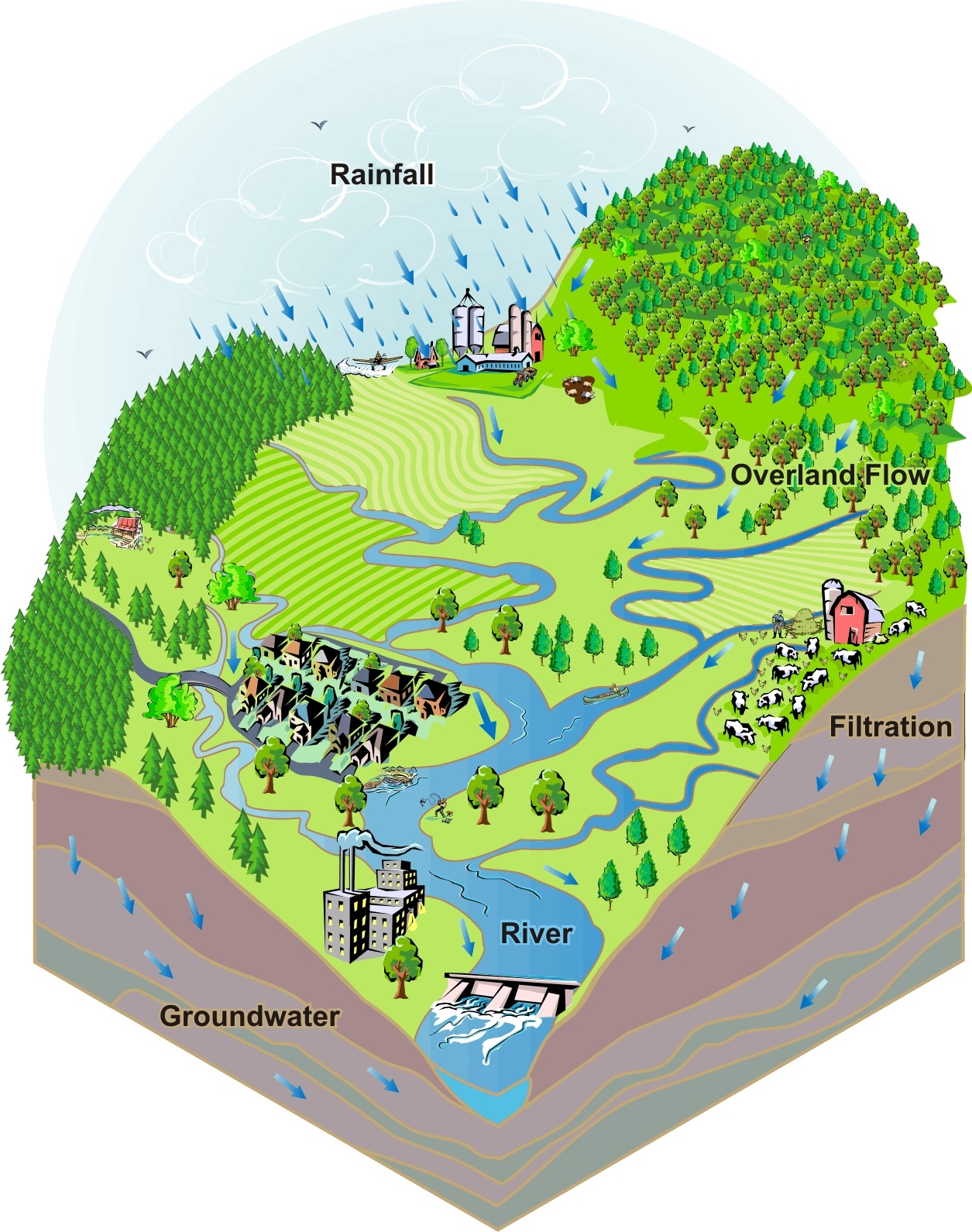
Students learned that watersheds are all the land in an area that drains into the same water body (see diagram, right) and demonstrated good and bad land use practices- in terms of stream/fish health and water quality- by designing two watersheds to reflect those factors.  The ultimate test came at the end, when the two teams had a salmon rely race. They attempted to be the first to “run” their “salmon” (a small fish-y figurine) upstream to the spawning grounds, problem-solving their way around dams, culverts and other fish passage barriers in their rivers, as well as dodging potential predators as represented by heron, sheepdog, and Godzilla figurines.


Building healthy watersheds in the Rolling Rivers display.


On the weekend, the event is open to the public, and people from across the state and of all ages and backgrounds came to learn and play at the Rolling Rivers display.  I got a kick out of the fact that Rolling Rivers really does offer something for everyone!

Thank you to our partners at this event:

Cascade Columbia Fisheries Enhancement Group
Chelan County Natural Resources Department
Trout Unlimited- Washington Water Project
Upper Columbia Salmon Recovery Board
Yakama Nations Fisheries


Riparian Restoration Project with Icicle River Middle School

Pulling invasive vines off of native vegetation.

This October, local landowners, Icicle River Middle School (IRMS), and Cascadia joined forces for a riparian clean-up and restoration project near Leavenworth, WA. 

Riparian zones are the areas of land around streams, lakes, etc. that are directly influenced AND directly influence the adjacent water body (see diagram, below).
 

http://www.globalforestwatch.ca/index.htm


John and Wendy Fishburne own a beautiful piece of property along Chumstick Creek, a historic salmon stream.  After a public works project in 2009 that replaced the large culvert (a major fish passage barrier) with a bridge at North Road, and several projects in the last decade (implemented by Cascadia and Chelan County Natural Resources Department) that replaced upstream culverts with bridges, there is a much greater possibility that the stream will again support healthy salmon populations. (For more info, visit the Chelan County Natural Resources Department website at http://www.co.chelan.wa.us/nr/default.asp).

WCC crew teaches students how to dig out Himalayan
Blackberry "hubs" (taproots).
The Fishburnes have been working with Cascadia since 2008 to devise a management plan for their section of riparian area and the adjacent hillside on their property. The Old Chumstick Hwy (now an overgrown footpath) cuts right through the project site, and there were still significant remains of the consequent dump site. From the beginning, the Fishburnes envisioned this restoration project as a learning opportunity for local youth, and this fall we were able to make that wish a reality!


Student with his find, unearthed out of a historic garbage cache.


Through Hana Butler at the WSU Chelan County Extension office, Cascadia connected with Jodie Tremberth, the 8th grade science teacher at Icicle River Middle School in Leavenworth. We worked together to coordinate a two-part implementation scheme that would get the 8th graders out to do some good work, enjoy the fall sunshine, and learn a bit about conservation in the process.


Bagfuls of invasive weeds were hauled out of the
 project site.
During the two-day clean-up event, over one-hundred 8th graders from IRMS removed old garbage caches from the hillside, learned how to dig out invasive Himalayan blackberry roots with the help of the Washington Conservation Corps (WCC) crew, and hauled bags of invasive weeds out of the project site.  Perhaps the most exciting find was a several-hundred-pound engine part a group of students and teachers managed to drag up the hillside and into the awaiting dumpster.

 
A planting team takes a break amongst newly planted native
trees and shrubs.
Students returned to the site the following week to plant native vegetation. They worked in groups to plant a variety of native trees and shrubs, staked weed matting over the ground around each plant to keep competition with weeds to a minimum, and covered smaller plants with browse guards to prevent excessive grazing by deer and other wildlife.

Over the two-week period, the students learned about the importance of riparian areas for fish and overall stream health.  Positive riparian effects include bank stabilization for decreased erosion, shade for cooling water temperatures, and filtration of pollutants by root systems resulting in improved water quality.
We had beautiful fall weather for all the field days, and other than a few run-ins with ornery stinging insects, we had a blast!  It was really rewarding to overhear the students say things like, “This is the best field trip ever” and, “I want to do this for a living!”

The students plan on returning to the Fishburnes’ to help Cascadia with monitoring the success and progress of the planting site.
We are looking forward to it!

Students worked in teams to drag invasive weeds
 and debris to the dumpster.


Thank you to:

John and Wendy Fishburne
Washington Conservation Corps crew led by Jake Hanson
Icicle River Middle School Principal Kenny Renner-Singer
Icicle River Middle School “8th Grade Team”- Matt Duffy, Todd Gilbert, Jodie Tremberth, and Beau Snow
Dave Holland, Department of Ecology
Kevin Powers and Hana Butler, WSU Chelan County Extension

And a big thank you to the Icicle River Middle School 8th graders for their hard work and enthusiasm!