Friday, February 14, 2014

Happy Mid-February Friday

Happy Friday to everyone out there, and a Happy Valentine's Day to anyone that's into that sort of thing... This week is going to offer another short and sweet blog post as we're busy packing up our office in preparation for our move. Everyone in the office is generally excited for the move into downtown Wenatchee. It will shorten the commute for some of us and put us closer to many things in town we often make us of. I realize that on the other hand it may be viewed as a negative direction change because it moves us further from the citizens we serve along the Wenatchee River, Entiat River, and Lake Chelan. However, the added time is barely ten minutes, so it's not much of a change. And since we're moving we'll shortly need to change our phone numbers and email addresses. All our information will be updated on our website once we make the move in a few weeks.
The Native Planting 101 workshop was this last weekend, and I like to think that it went pretty well. The workshop lasted about four hours, and all four of our presenters did an excellent job with their presentations. The workshop would not have been possible without their donation of their valuable time and knowledge. We had a little over 30 people show up for the workshop, and the reviews I received afterwards were almost all positive. I'd like to thank everyone that showed up. Hopefully, they'll use the information to incorporate native plants in all their restoration and landscaping needs.
Today also marks the cutoff for our Native Plant Sale. Ponderosa pine, rocky mountain maple, and golden currant were very popular this year, and have mostly sold out. However, we still have many other options besides those three plants left if you want to try and sneak your order in before the deadline. Our pickup date for plants is set as April 5 from 10 am-1 pm. We also will be bundling the plants on March 22. Anyone that would like to volunteer on either of these days is welcome to do so.
That's all I have for today. Hopefully next week I can get back into my in-depth blogs on particular topics. Until then though this blog will have to suffice. I for one am looking forward to a long weekend, and I'm hoping many of the rest of you get to enjoy one as well.

Wednesday, February 5, 2014

Early February Observations

This week and, really, the whole month, bring busy times here at Cascadia. Many of us in the office are busy sorting and packing in anticipation of moving from our current location in the lower level of the Okanogan-Wenatchee National Forest Headquarters and into new office space in downtown Wenatchee. Thankfully, I don’t have much to do with that until it comes time to load up boxes and equipment and then unload it again in our new location. (Americorps members get all the good jobs.) However, the Native Planting 101 workshop is also coming up this Saturday, February 8, and I’m rushing a little to finish up all the final touches for the workshop. With limited time something has to give, and so the blog this week is going to be a little shorter and less in-depth than normal. There won’t be much of a theme. Probably just some pretty pictures and a few observations.
How about that snow? I realize it’s not a lot, but it sure helps brighten up the landscape, bathing the hills in bright white with splotches of gray, brown, and green poking through. Every little bit of moisture helps. Hopefully it keeps up and we can avoid a dry spring, summer, and fall. Besides, winter is far too dreary without snow on the ground. It keeps everything looking clean and covers up the dirt and grime that coats much of the land during the winter and early spring months.
Hopefully this cold isn’t upsetting too many people. I was little surprised when it came on. That’s my own fault though because I don’t often look at the forecast. My theory being that the weather is going to show up regardless if I know about it or not. It’s amazing how much going from a high of 35 degrees down to a high of 18 degrees changes how it feels to be outside. Anything above 30 and I can usually leave my hands out walking outside. Now it’s almost too cold for them buried deep in my pockets. Any exposed skin can quickly go numb and ache with the cold. These cold days make me happy that I decided to grow a beard for the winter, and at times I wish it went further and covered the tops of my checks and nose. For those of you without a beard, I recommend a scarf if the cold bothers you.
So that’s all I’ve got for this week, time to go back to preparations for Saturday’s workshop. Make sure to sign up for the workshop if you live in or around Wenatchee and Chelan County and have an interest in native plants. It’ll run from 12-4:30 PM at the Chelan County PUD Auditorium. Topics covered will include restoration, pollinators, yardscaping, and noxious weeds. It promises to provide lots of useful and interesting information.


Thursday, January 30, 2014

Beavers

I was wandering around the woods the other day and came across a beaver dam. It wasn’t the first I’ve seen. It won’t be the last. It wasn’t even an impressively large dam either. I stopped though. I stared and I contemplated. I realized something. Beavers are cool. They construct. They shape and morph the world around them to meet their needs. Many animals simply react to the world. A deer runs when it feels threatened. It will wander around looking for food, never choosing one location as “home.” Of course other animals build dens and nests, and they may often return to them time after time. But they choose sites that fit what they need.
A beaver changes the environment around it to make a better home for themselves. They build dams to flood the area around their lodge in order to protect themselves. They build their structures using a mixture of logs, sticks, and mud. They gnaw a ring around a tree until it weakens enough to collapse. (Their teeth continually grow, making it a necessity for them to gnaw on something.) Once a tree is felled they set upon it and bite it into smaller, usable pieces. Dams are built from the bottom up. First, sticks are stuck into the bottom to provide a foundation. Next, they add sticks slowly raising the height of the dam. Mud is added to fill any gaps that might let too much water through. They continue this process of sticks and mud until the dam has reached its desired height and is strong enough to hold back the flow of water.
A beaver dam near human housing.
Beavers build dams for their own sake. But the ecological effects of these dams spread beyond them. Their dams provide a whole list of positive changes in an ecosystem. Let’s look further.

Beaver dams have the ability to flood their surrounding areas. Spreading water out over the landscape has the potential to create or increase the area of wetlands (basically an area that retains standing water throughout the year). Why are wetlands good? Wetlands are one of the most important types of ecosystem on the planet. They filter the water that comes through, removing sediment, excess nutrients, and other contaminants. Wetlands provide habitat for many species of plants, animals, insects, and bacteria. Many of which wouldn’t survive without access to wetlands.
Wetlands trap and store water. These are important effects. This helps control flooding by trapping water during periods of high flow, especially during spring snow melt. Later in the summer when the water flow drops this stored water is slowly released back into the stream system. In this way wetlands help lower the flow of water during high water times, and also raise the flow of water during low water times. They balance the flow of water throughout the year.
A crosscut of a beaver lodge. Beavers
build dams to create a pool of water deep enough 
that it doesn't freeze solid in the winter so they can 
enter their lodges all year round.
Flooded areas help recharge groundwater by increasing the surface area of water in contact with the ground. This increase in groundwater helps plants grow along the stream which in turn increases the stability of stream banks and decreases erosion.
Beavers create fish habitat. The dams slow the water down, allowing the fish to have an easier time swimming, and the pools are deep enough to not freeze. This provides winter habitat for certain fish species. (This slower water speed has added benefit of reducing streambank erosion.) The random assortment of sticks and logs in and around the dam provide protection for young fish from predators. Dams also catch plant material, which in turn can help increase the presence of aquatic insects, food for the fish. The increase of plant growth along the streambank helps shade the water. This helps keep the water cool for the fish in the hot summer.
Beavers gnaw around a tree fairly evenly
until it weakens enough to fall.
Trapped plant material plus any excess nutrients in the water can lead to increase in the amount of bacteria in the water. Bacteria usually seem like a bad thing, but in this case they’re doing a favor by removing excess nutrients in the water. Excess nutrients lead to an increase in algae present, which clouds the water. Fish prefer clear, cool water that’s free from algae and other growths. These bacteria can also metabolize some of the pollutants that may find their way into the water.

I often hear about the negative things beavers do. They remove trees near their water sources. While that is true, the damage can be mitigated by wrapping the trees with wire mesh. Also, many of their favored species of trees to use for dam building and for eating will resprout from their roots. So even if the tree is cut down by a beaver, a new one will often sprout from the roots. Beaver dams don’t block the passage of fish as much as it would seem. Many fish are able to jump over the beaver dams. Regardless of the direction they’re traveling.
The negative effects we associate with beavers are more a matter of human perception than anything else. We look at what they do in a negative light because it interferes with what we want to do in an area. Decreases in the number of fish are more from human impacts than they are from a beaver dam blocking the stream. Fields flooded by a beaver dam may indicate that the field was too close to the stream to begin with. Plant enough trees that beavers prefer and they’ll probably leave your prized tree alone. 
Beavers are cool. There are so many positive benefits from their presence that it seems silly to not embrace them. Current beaver counts in North America range anywhere from 10 to 15 million, which is decent considering they were nearly wiped out for their pelts in the 19th century, but that number is still a fraction of the nearly 100 million that are estimated to have been present at one time. Beavers are second only to humans in their ability to impact and shape their environment. Next time you see a beaver dam or lodge think about the positive impact of them on the ecosystem.

Friday, January 24, 2014

Plant Native Things and Watch them Flourish

As we near our Native Planting 101 workshop and the deadline for placing an order for the Native Plant Sale I felt it was good time to write a blog looking at native plants. Planting native can save you a lot of things. Time, effort, and money are probably the three biggest. I’ll take a look at a few different tasks involved in gardening and then explain how natives save you time, effort, and/or money for each task.

Watering is probably the most important chore when it comes to gardening. If you hand water this can be a long and tedious chore requiring you to daily visit each plant in the middle of a scorching summer. Natives require minimal watering on your part. Once established, native plants should survive primarily on water available on site without extra from you. (Of course this assumes you get the right plant for the right area. A native plant normally found next to a creek may not thrive on an exposed slope.) They’ve survived in this climate for hundreds of years without human intervention, so why would they need you to water them now? The first year or two they might need watering to establish a solid root system, but after that they’re good to go. Of course, if you have a sprinkler system you probably won’t notice a drop in your time or effort. However, in both cases you’ll save money using natives. No longer will you have to spend money to water plants. Natives don’t need your water.
Fertilizer is another big item. Natives don’t need fertilizer to flourish. They’ve grown in these conditions before, whether that’s a sandy slope with minimal nutrients, or the side of a creek with an overabundance of water. Find the plant native to those conditions and you won’t need to fertilize it. This will save you time, effort, and especially money. Fertilizer is not cheap, and it’s a task that often requires applications over and over again, year after year. Natives don’t need it.
Pruning or thinning in your garden can take up a large amount of time. Natives can cut down on the time and effort. Natives don't need constant pruning and thinning to grow healthily. They grow well if just left alone. Whereas introduced species may require pruning or thinning to maintain the health of the plant. Native plants will survive just fine if left alone.

Cascadia is still taking orders for its Native Plant Sale. We have availability on all 12 plant species, but some are selling faster than others. To make sure that you don’t miss out on any of the plants you’ve been mulling over buying make sure to order yours today! Visit our website for a brochure outlining some of the highlights of all 12 plants, or read the 3 blog posts that cover each of the 12 plants in a little more detail. First. Second. Third. Our deadline for ordering plants is set for February 14, so three weeks is all the time that’s left to order bushels of plants perfect for your landscaping or restoration needs.

Cascadia is also sponsoring a Native Planting 101 workshop on Saturday, February 8. We encourage anyone that wants to use native plants in their yard, or that’s just generally interested in native plants to attend. Our speakers will cover topics including restoration, yardscaping, pollinators, and weeds. All four of our presenters have presented at previous Native Planting 101 workshops and have plenty of useful and interesting information to share with you! Visit our website for more information and to RSVP.

Friday, January 17, 2014

Beware a Mild Winter

I grab my jacket and slide it on as I step outside. I walk a few paces and realize I’m already too warm. It’s halfway through January and the temperatures outside are hovering around 50o. It’s only snowed in town a couple times all winter. The sun is shining, and it seems like spring is just around the corner. Too bad it’s not. Winter will be back. However, it’s still nice for a break, right? It may feel nice, but this weather is not without consequences. What might those consequences be? Well, let’s take a look.

First, the lack of snow is a big problem. Yes, I love having clear roads as much as anyone else. The headache of waking up with six inches of new snow and realizing I’m going to spend an hour or two of my day shoveling/plowing just to clear my driveway and paths is not pleasant. Neither is dealing with slick roads and all the other people out on the slick roads. (Funny how everyone always thinks it’s the other person that’s the bad driver.) I love being able to travel the mountain passes with peace of mind.
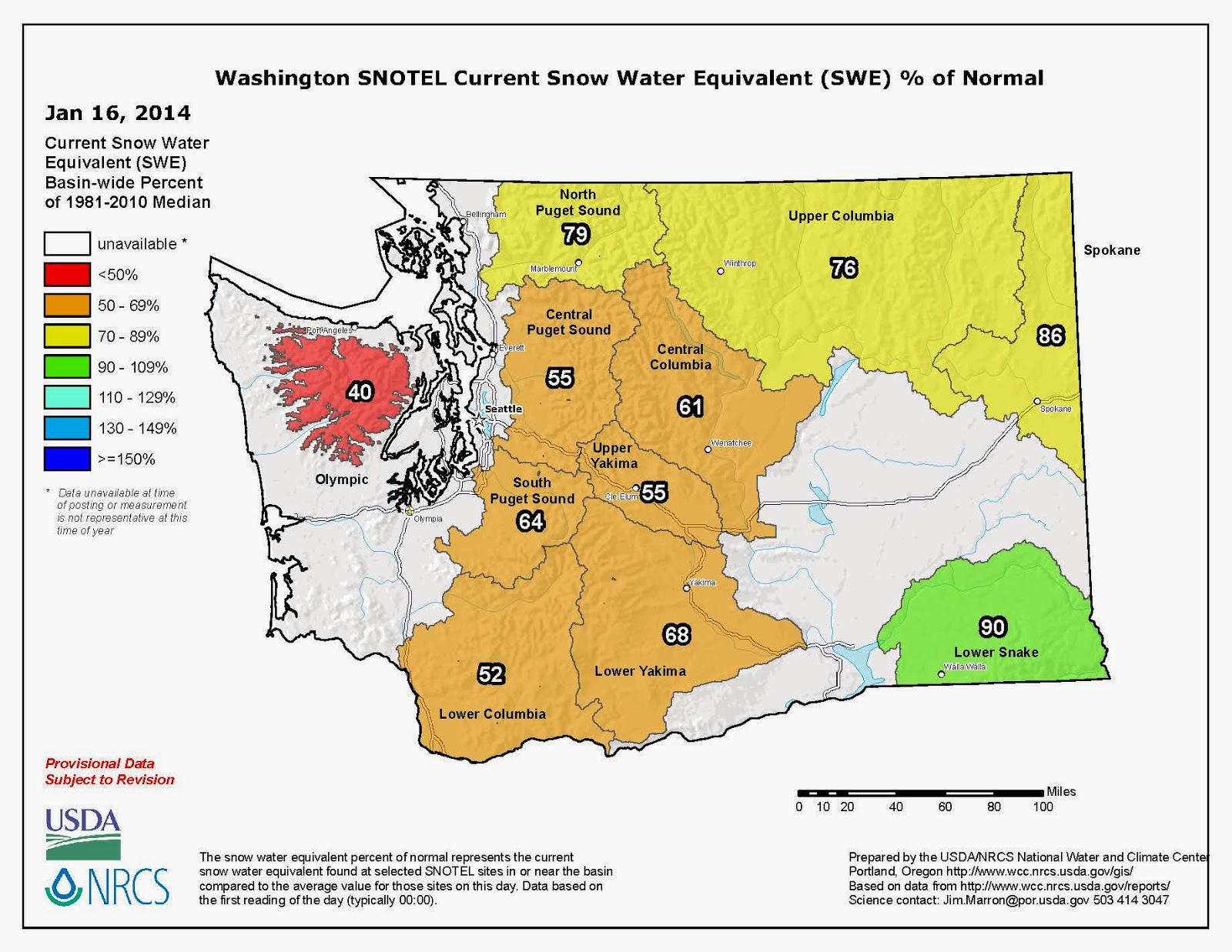
So why is the lack of snow such a problem? We receive very little precipitation throughout the year. What precipitation we do receive mainly comes as snow in the winter months. That buildup of snow in the mountains provides a water source for the rest of the year. When spring arrives and the temperatures begin to rise in the mountains the snowpack starts to melt. This melt feeds creeks, rivers, and lakes throughout the spring and summer, and starts to taper off in the fall. Without winter snow the snowpack won’t build up. Without a proper snowpack water flows will be hampered.
What happens when there’s less water? Well, that’s what we call a drought. Water suddenly becomes a hot commodity. Let me list a few things that rely on water flowing from the snowpack: dams, crops, orchards, lawns, drinking water, animals, fish, forests, and water recreation. I could keep going. The point is when there’s not enough water available everything loses. First go the unnecessary items. You’ll be asked to conserve water by watering your lawns and gardens less (or stopping all together if it’s severe enough), showering more efficiently, etc. Next, farmers with newer water rights may have to water their fields and orchards less. Of course someone could keep pulling out water and further lower the water levels, but that starts to affect the fish. Less water means streams, rivers, and lakes have less area to swim in. Less water means that the water will warm up quicker and get hotter than normal. Fish like cool water. An almost afterthought to most of us is the forests. Our forests do most of their growing in the spring from the influx of water from the snowpack. The less there is and the sooner it melts off leads to dry forests earlier in the year, increasing the chance of and severity of forest fires. Less water in the rivers lowers the amount of power that dams can generate.
Starting to get the picture? Snow is necessary. We must embrace the winter in order to enjoy the spring, summer, and fall. Without the winter snow, the rest of the year may be miserable.

My second point revolves around this warm weather we’re experiencing at the moment. A warm, sunny day seems nice, and one or two might not be that harmful, but extended warmth can lead to problems. Why?
Most plants go into dormancy for the winter. That means they shut down most of their natural processes. They flood their cells with chemicals that protect themselves from the winter cold, and wait it out. Generally, they wait until early spring to start the growth process. But what triggers their growth? We label March 20 as the first day of spring because it’s the spring equinox. (Our seasons change on the equinoxes and solstices.) However, a plant can’t read a calendar and decide when to break dormancy by a calendar date. A plant breaks dormancy on external cues. Mainly cues involving temperature.
See where I’m going with this? If the weather stays warm for too long in the middle of winter the plants might be tricked into thinking it’s time to break dormancy. They start their new growth leading to tender new shoots and flowers. The weather then crashes back down to normal winter temperatures. The new plant tissue can’t handle freezing temperatures and therefore dies.
Field crops might not be affected by this at all. A farmer realizes that these warm temperatures aren’t sustainable, and therefore doesn’t plant anything until spring. But trees aren’t this smart. They start to grow and head towards blooming. When the temperature crashes the new buds are killed off. No blossoms that year, and thus no fruit.


A mild winter like this seems nice, one with a warm, sunny week in the middle of January, and only a day or two of snowfall in town. You may be reveling in the decent driving conditions and your snow shovel gathering dust in the garage. But you shouldn’t be. This lack of snow and warm temperatures are only going to cause much bigger headaches later in the year than a normal winter causes on its own. I’m hoping that the temperatures drop to normal and we get massive snow falls the rest of January, February, and into March. Otherwise it’s going to be a dry rest of the year. 
The numbers are starting to look up from previous measurements, but are still far below where they should be.

Thursday, January 9, 2014

Native Plant Sale: Part 3

It’s the first week of January. The weather doesn’t feel much like winter though. The last few days have brought temperatures in the low to mid 40s, and the snow has been lacking. It feels more like November or February outside right now. Regardless, it’s time to take a look at the last four plants in this year’s Native Plant Sale.
Blue elderberry is the sixth shrub for sale this year. The range of this shrub covers the western parts of North America north into British Columbia and south into the northern parts of Mexico. They favor damp areas along streams, rivers, and other open, wet locations. They grow best on moist, well-drained, and sunny locations. It works well as a stream bank and eroded site stabilizer. The blossoms on elderberry are white and will bloom between May and July depending on local climate. The berries that mature in late summer into the fall are quite edible and have been used for makes preserves, pies, and wine. Click here to read a previous blog outlining some of these uses. Many birds and animals will also eat the berries. It can reach sizes of up to 25 feet tall, but is more common to reach sizes around 10 feet. 
Red osier dogwood is the seventh shrub available this year. This dogwood is present in most of the US and Canada. The only area it’s not present is in the South East US stretching over to Texas. They are usually found growing in moist soils along rivers, swamps, creeks, and lakes. Even though they prefer moist soils they don’t like completely saturated soil for long periods of time. Red osier is useful for stream bank stabilization. The plant is most noticeable in the winter when its bright red bark adds color to a winter landscape. It flowers in late spring with clumps of small, white flowers. It is also useful as forage for animals in the winter, and its berries are eaten by some bird species. It can reach heights of 20 feet, and will often grow in thickets due to the rooting ability of its stems. A more in depth look at red osier can be found here.
Tall Oregon grape is the final shrub offered this year. Its distribution ranges throughout the Northwestern US and extends up into British Columbia. It can grow in a variety of soil and terrain types, from dry to moist, and from sunny to shady. Oregon grape can be found as an understory species in wooded areas, or as the one of the first species growing in a disturbed area. The plant develops a large root system with time, so it can be useful for soil stabilization. Many rodents and birds enjoy the berries, and young stems and leaves may be eaten by deer and elk. It also has many ornamental qualities including bright yellow flowers in spring, purple berries in late summer, and reddish green leaves throughout the year. It will grow to roughly 10 feet in height, with an approximately equal amount of spread.
Kinnikinnick is the only ground cover for sale this year. Its range covers Canada and much of the Northern and Southwest US. It grows best in course soil that is well drained. It grows in forests and on sand dunes, acting as a very effective soil stabilizer due to its spreading nature. It tolerates cold very well. The fruits on the kinnikinnick are eaten by some birds and game animals. Deer may browse it lightly as well. Its leaves are dark, shiny green. The flowers are small and white to pink in color, blooming in late spring. It is a low growing plant, generally staying under 6 inches in height, but it can spread out 15 feet.
This concludes my look at all 12 plants offered for sale this year with our Native Plant Sale. If any of these plants sound intriguing make sure to order some today! There’s a little bit of everything available. Conifers, deciduous trees, shrubs, and ground cover will provide everything you need to landscape or restore your property. Click here to visit our Native Plant Sale page.

Come back next week for another article.

Thursday, January 2, 2014

Water, Water, Everywhere

Water controls our lives. The earliest civilizations in the world grew around rivers: Nile, Euphrates, Tigris, Yellow, and Indus. Water remains necessary for growing food. (Just try growing something without water, and tell me how it works out for you.) We remain slaves to it. When we’re thirsty water dominates our thoughts. All we can think about is clear, liquid gold crossing our lips and quenching our parched mouths. Try to go a day without drinking anything. It won’t be easy. Go outside in hot weather and see if you can last an hour or two before the cravings kick in. Water is the single most necessary substance for our survival. The only other thing that comes close is the sun. And the benefits of the sun can be somewhat compensated for by manmade contraptions (heat, photosynthesis, vitamin D). As far as I know we haven’t invented a water substitute yet.
Water flows in a cycle. The amount of water on the Earth right now is pretty close to the same amount that’s always been here. When it rains the water collects on the ground. The ground absorbs some of the moisture, but once the ground reaches saturation the rain that keeps falling starts to flow. And where does it flow? Downhill of course! First the rain forms trickles, and these trickles merge together to form rivulets. Rivulets flow until they meet other rivulets and come together to make creeks. Creeks pour into other creeks and form rivers. Rivers combine to make even larger rivers. Rivers surge into the world’s oceans. From here the water evaporates into the air and is used to form clouds. These clouds then drift back over the land until they release water on the ground below. The cycle continues.
This shows the flowing of water through the system. From the oceans to the 
clouds to precipitation to flowing water and back into the ocean. 
The cycle is in continuous operation.
The cycle can be interrupted. The water might take a detour, but eventually it will get back into the circle. Consider the water in your home. That water was pulled out of a river, stream, lake, aquifer, or well and pumped into the water system. This water flows through pipes until it comes out of the faucet in your home. You fill a glass with water, drink it, and after some time you expel it back out. From there it flows into sewer system, travels to a sewage plant, and after treatment it’s released back into the water system. Water very rarely permanently leaves the cycle. The water you just drank could very well be the water a dinosaur drank millions of years ago.
Most of the water that flows down our rivers doesn't come from rain though. It comes from snow that accumulates through the winter and slowly melts off during the rest of the year. Without the snow pack our rivers would be a lot smaller and may even cease to exist except as seasonal water flows during wetter times of the year. Every time you look outside and dread the snow falling because it makes a mess of driving try to think instead of the benefits of snow. Snow enables us to take this area that’s basically a desert and turn it into lush farmland.
I would guess that most of us take water for granted. We turn the faucet on and expect water to flow out. But where does our water come from? If you live in Wenatchee and surrounding parts of Chelan County your water comes from the Eastbank Aquifer, located under parts of Lincoln Rock State Park and extending south to Rocky Reach Dam. Cashmere draws their water from wells and some surface water from the Wenatchee River. Leavenworth pulls their water from Icicle Creek and wells drilled near the golf course. Chelan pulls its water from Lake Chelan. Entiat pulls its water from community wells.
The three main watersheds in Chelan County. Wenatchee on the left, Entiat in the middle, and Lake Chelan on the right.
All three flow into the Columbia River.
How do we keep track of all this water moving around? We divide areas up into various watersheds. Watersheds encompass an area where all the surface water drains to a single point. They are usually bounded by ridges that separate neighboring watersheds. Chelan County is composed of roughly four different watersheds. The Wenatchee River watershed encompasses all the water that flows into the Wenatchee River. The Entiat River watershed takes in all the water draining into the Entiat River. Lake Chelan is its own watershed. The last watershed is made up of water draining from Stemilt Hill and Squilchuck. All of these watersheds drain into a larger watershed, the Columbia River, which drains parts of Washington, Idaho, Montana, Wyoming, Nevada, Utah, Oregon, and British Columbia. The Columbia then flows into the Pacific Ocean on the border between Washington and Oregon.
It would seem that if the cycle is cyclic that there would be no need to conserve water, right? Regardless of how much we use it will just keep flowing through the cycle and return again as rain or snow. If only it were that simple. The issue isn’t that the water stops cycling. It’s more an issue of minimal disruption to the natural flow. The amount of water present every year is not always the same as the previous year. There are averages, but an average comes from several years of data. There’s no guarantee it will reach that level each year. There are so many facets to contend with. Fish, farms, cities, you, and I all rely on water. Do any of us have more right to it than another? The short answer is no. This is why it’s important to conserve, protect, and share our water resources.
For more information on some simple ways to conserve water and protect our waterways head over to http://picturethewenatchee.com/.
A map showing the snowpack of Washington as a percent of a 30 year average. As you can see all of the state
is below average with several areas having less than half of normal amounts.

Wednesday, December 18, 2013

Energy: The Lifeblood of the World

Our lives revolve around power. Power we rely on to charge cell phones, light rooms, and heat homes. Without power you wouldn’t be reading these words right now. (How sad would that be?) Electricity courses through conduits across the earth, the blood of our modern world. Where blood flows there must be a heart to pump it. And the hearts of our electric blood are power plants, making the earth a giant, multi-hearted beast.
Hearts vary across the planet. Small solar panels attached to a roof, struggling to produce enough power to supply a single home. Large dams spanning mighty rivers, feeding entire cities with a constant electrical rhythm. Wind turbines soaring into the sky. Their electric output a slave to the fickle wind. Coal hearts, burning harvested chunks of the planet and polluting the earth with each shovelful. Nuclear reactors, consuming uranium to give us power, but leaving us with radioactive leftovers that we struggle to safely dispose. These plants range from clean, renewable sources with minimal negative effects, to others burning a finite resource that poison the air, water, and ground both near and far.

Grand Coulee Dam. It produces over 7,000 MW at
peak operation.
We are lucky. Most of our power comes from a clean, renewable source. Hydroelectricity supplies most of Washington State with power. Roughly ¾ of all power generated in the state is from dams. Washington generates nearly 1/3 of all the hydroelectric power in the country. The next closest state is Oregon, and it produces less than half that amount.
I really like hydropower. I think it’s a good, long term source of power. Albeit one with a few flaws that people are working on solutions for.  I realize that not everyone feels the same way about hydropower and the dams that supply it. It blocks the natural flow of rivers and impedes the movement of fish. Silt piles up behind it and at times needs dredging. The river ecosystem both above and below a dam is forever altered. Raised water levels flooded towns. People were forced out of their homes and had to retreat to high ground. But I ask you this. Do you have a solution?
If we tore out the dams what would you suggest we replace their power generation with? Coal or natural gas plants that burn limited fossil fuels, and pump CO2 into the air and contribute to global warming? Nuclear plants that don’t pollute the air, but leave us with barrels of radioactive waste that remains harmful for thousands of years? I’ve heard a lot of people complain about the negative impacts of dams, but I’ve not heard many sensible solutions. Dams remain the lesser of evils.

There are other clean, renewable energy sources available. Solar and wind power remain underutilized. Geothermal energy remains viable in areas with geology that allows its use. Tidal generation is available on certain ocean coasts.
Even though a wind farm covers large areas of land most of
it remains usable for agriculture or wildlife.
Wind power is renewable, clean, and relatively harmless. Some birds and bats die each year when they run into the large blades (it averages out to a few birds per turbine per year), but it’s just a modern day evolutionary selector. Its impact to the ground it sits on is minimal. A wind farm may cover several thousand acres of land, but after construction is complete, the impacted area is a small fraction of that amount. Another concern is aesthetics, not everyone likes to see an army of spinning blades in their panoramas of the landscape. The biggest issue with wind turbines is supply. The wind doesn’t always blow. Even when placed in an area of fairly constant wind there will be days with no wind. Wind power requires a backup if the wind is still. This often takes the form of another operating power plant capable of taking up the slack when necessary.
Part of the solar array at Nellis Solar Power Plant.
Solar power takes a variety of forms. From photovoltaic cells (which directly convert sunlight into electricity) to concentrated solar power (which focus the sunlight and use it to heat a substance and from there function similarly to other power plants).
Photovoltaic cells are the generic form of solar power. They’re the panels that can be seen on some roofs or as free standing structures. They can be a little expensive, but the costs have gone down from their original prices as well as the efficiency going up. The biggest downfall is when they work. The sun has to be out. Effectiveness decreases under cloud cover and they stop working completely at night. Surplus power must either be stored (in batteries) or an alternate power source must be used during times of low or no generation.
Concentrated solar power relies on heat, as does most generated power. A very basic explanation of how they work is as follows. A field of mirrors (picture one or more football fields) would reflect the sunlight either onto a single tower and heat a substance to a molten flowing state (several hundred degrees), or it would reflect on several different pipes running through the field. This molten substance then is piped through water heating it until it boils, produces steam, and builds pressure. (At this point it becomes like almost all other types of power generation.) This steam is then used to spin a turbine, which spins a generator and produces electricity. (Hydro power is similar except it uses liquid water to spin the turbine instead of steam.) This type of solar power has the benefit of being able to continue working after the sun goes down due to the stored heat in the substance.
A depiction of the different styles of
concentrated solar power.
Tidal power relies on tides flowing back and forth to produce hydroelectric power in ways similar to a dam across a river. Geothermal power uses heat from the earth at active geological sites to produce steam and generate power.

Size also remains a factor. Picture Rocky Reach Dam, it looks pretty big, right? Let’s say the dam and associated electrical equipment takes up ~100 acres. It also creates a reservoir behind it 43 miles long with a surface area of 98,000 acres, almost all of it usable for water activities, irrigation, and other uses. Rocky Reach has a max output of 1300 MW (1 MW is enough to power 225 to 300 homes). So 1300 MW would power anywhere from 292,500 homes up to 390,000 homes. Wenatchee has a population of ~32,000 people. If an average household is 4 people that means there are ~ 8,000 homes in Wenatchee. (Of course I’m leaving out apartments, businesses, etc.)
The Wild Horse Wind Farm outside Ellensburg covers ~10,000 acres and has a max output of 273 MW with 149 wind turbines, enough power for 61,425 to 81,900 homes. It would take nearly 5 wind farms of that size to produce the power of that one dam.
Nellis Solar Power Plant in Nevada produces 14 MW on 140 acres, roughly the size of Rocky Reach Dam. This output is enough to power 3,150 to 4,200 homes. There would need to be nearly 93 plants of similar size to produce the same power as that one dam. And it would need to cover an area of ~20 square miles. Picture the entire city of Wenatchee replaced with fields of solar panels.

A view from the back of Grand Coulee.
My point to all this is threefold. One, there are lots of options for producing power that aren’t as environmentally harmful as current methods. Several options are renewable, clean (more or less), and environmentally friendly (mostly). Second, almost all power generation is going to have people on both sides of the argument. People will be wholeheartedly in favor and vehemently opposed. Third, size is a factor. The fact is some of these options aren’t viable in all location because of the space necessary.


Tuesday, December 10, 2013

Our World Supplied by Trees

Taiga forest in Alaska. Taiga forests exist in northern 
latitudes and consist mainly of coniferous trees.
Look out the window and consider what you see outside. There’s a good chance a tree is on that list. Trees can be found almost anywhere. They cover huge tracts of land in areas ranging from the equator to arctic regions. How often do you stop and think of everything that trees provide? Take a guess at the number of products derived from one species of a tree or another. Would you say 100? 500? 1000? The actual number is nearer to 5000. That’s right. 5000 products rely on a product derived from a tree. Industries ranging from construction to health care rely on trees.
Peeling bark from a Pacific yew.
When I say health care relies on trees, I don’t mean wooden tongue depressors. Several drugs found their origins in chemicals produced by trees. Aspirin was first isolated from the bark of a willow tree. The cancer drug, Taxol, was found in the bark of the Pacific yew. Quinine, an antimalarial drug, is derived from the bark of the cinchona tree. Eucalyptus oil, used in many cold medicines, is extracted from the leaves of the eucalyptus. I could keep listing more drugs, but I think you get the idea. The amazing thing is this is just a fraction of the possibilities. There are still countless tree species that have yet to be studied for their medicinal properties.
Trees supply our paper. The list of products that use paper is astounding. Books, newspapers, posters, brochures, etc. are all produced from paper. Paper gave us the means before computers to spread information around the world and make it available to the masses. Cardboard is produced in much the same process and is just as useful. And regardless of whether you consider paper environmentally friendly, it does remain a completely renewable resource. Computers, however, are not renewable. Every computer is built out of materials that are finite. Think about that next time you’re trying to save the environment reading the news on your tablet instead of on newsprint.
A log being rough cut into lumber.
How many buildings could we build without a ready supply of wood? Not many. And they’d probably look a lot different. I realize that many large buildings are constructed from other base materials, but houses still rely a great deal on wood. Lumber cut straight out of the tree is used to frame the house. Added to the wood needed for framing is the collection of plywood, particleboard, fiberboard, I-joists, and glulam beams used in other parts of the construction. All of these are made from processed wood parts. Most of it is wood that would be unusable otherwise, and is processed with an adhesive to create these uniform products.
What about all the food we get from trees? I realize we don’t generally eat the wood itself, but trees produce many of our favorite foods. Apples, cherries, pears, oranges, and several other fruits grow on trees. Walnuts, pecans, almonds, and other nuts do as well. These crops represent an important portion of our diets and for those that grow them an important source of income.
Latex flowing out of tree bark into a collection vessel.
Rubber comes from the refined sap of a few species of trees, but the most common tree is the Pará rubber tree. Granted the majority of rubber doesn’t come from trees. Most of it is produced from petroleum. But rubber trees represent a renewable source of rubber. On the other hand removing natural habitat to grow these trees is not a viable option either. Rubber is used for car tires, without it what would we drive on? We use it to put soles on our shoes. Bouncy balls are made out of rubber, and who doesn’t love a bouncy ball?
A view of the Amazon Rainforest.
Obviously this is just a very small sampling of the vast number of products that come from trees. And while I’ve only listed a few I hope these stand out and show the importance of trees in our everyday lives. Without trees what would we have? Not much. Consider the importance of wood in just two items: lumber and paper. Where would our society be without these two things? Would we have advanced to this point without them? My guess is no.
I realize that many products have switched from wood to other materials. Sometimes this is because the other material is better for that use. Other times it’s because the other material is cheaper. But how often is that other product renewable? Unless it’s also a product that grows it’s probably not sustainable. I’m not saying to run out and start cutting down trees because they’re so awesome and can be used for many things. Improperly managed trees will not remain a renewable resource for long. But proper management and utilization of trees can allow us to keep using the plethora of items that are produced from them.

Come back next week for another post.

Josh


Tuesday, December 3, 2013

Native Plant Sale: Part 2

It’s the beginning of December and the snow is starting to fall as I sit writing the blog for this week. Frankly it’s about time. There’s something incredibly relaxing about watching the snow fall. As much as I would love to dive into talking about snow, I must save it until a little later in the winter. It’s the beginning of the month and therefore time to return to the topic of our Native Plant Sale and talk about four more plants we’re offering.


Quaking Aspenn
Quaking aspen (Populus tremuloides) is the second deciduous tree that we’re offering this year. Its range includes all of Canada, most of the United States except for the Southeast, and down into Mexico. Quaking aspen prefers to grow in soils that stay moist most of the year. It can grow in some areas with less moisture, but will not reach the same growth potential. The trees can reach up to 90 feet in height with adequate moisture, but will often remain under 40 feet, especially in drier sites. The tree gets its name from the way the leaves move in the wind. The stem shape of the leaves causes them to “quake” in even a light breeze. The leaves are a very pleasing green color through spring and summer, and in fall they turn a brilliant yellow. Aspens stabilize well, but sprouts will grow off of the roots.


Mock Orange
Mock orange (Philadelphus lewisii) is another one of the eight shrubs offered for sale this year. The range of mock orange includes Washington, Idaho, Oregon, Montana, California, British Columbia, and Alberta. It prefers well-drained, moist soils. It can be found in areas ranging from riparian to open or forested lowlands to rocky upland sites. It reaches heights ranging from six to ten feet with a spread of roughly six feet. Mock orange flowers anywhere from May to June. The blooms are white and give off a sweet smell making this shrub quite pleasant to have nearby when in bloom. This shrub is very useful for soil stabilization.


Snowberry
Snowberry (Symphoricarpos albus) is the fourth out of eight shrubs offered this year. The range of snowberry includes the coastal mountains of the west coast, north into British Columbia, and east over to New England. It can grow in sun or shade, and in a variety of soil types including stream banks, moist clearings, and open forests. It grows from three to eight feet tall with an approximately equal spread. The flowers are white to pinkish. The berries are white during the summer and change to a darker color as they ripen. The berries are considered to be poisonous, so don’t eat them.


Woods Rose
Woods rose (Rosa woodsii) is the fifth of eight shrubs for sale this year. This rose has a range that covers western North America as far north as Alaska, south into Mexico, and east to Iowa and other Midwest states. It can grow in sunny or moderately shady sites. It is adapted to a range of moisture levels on site from riparian zones to dry grassy slopes. However, it grows best in moist, well-drained soils and on sites that are open. It grows roughly six to eight feet tall with an approximately equal spread. The flowers are various shades of pink and it blooms anywhere from May-July. Woods rose is useful for erosion control due to its rhizomatous root system that spreads out and helps stabilize the soil.


Of course by the time I finished writing this blog the sun was out and the snow has stopped without really any of it accumulating. Sigh. There will always be another day for more snow to come though. This concludes the brief look at these four plant species. Eight plants down, four more to go in the beginning of January. If any of these species interest you make sure to visit our website, download the available forms, and place your order!

Until next week,

Josh